
Explore the challenges and solutions of lens de-centering, including its impact on image quality, causes, and advanced strategies to ensure precision and clarity.
Understanding De-centering in Lens Systems
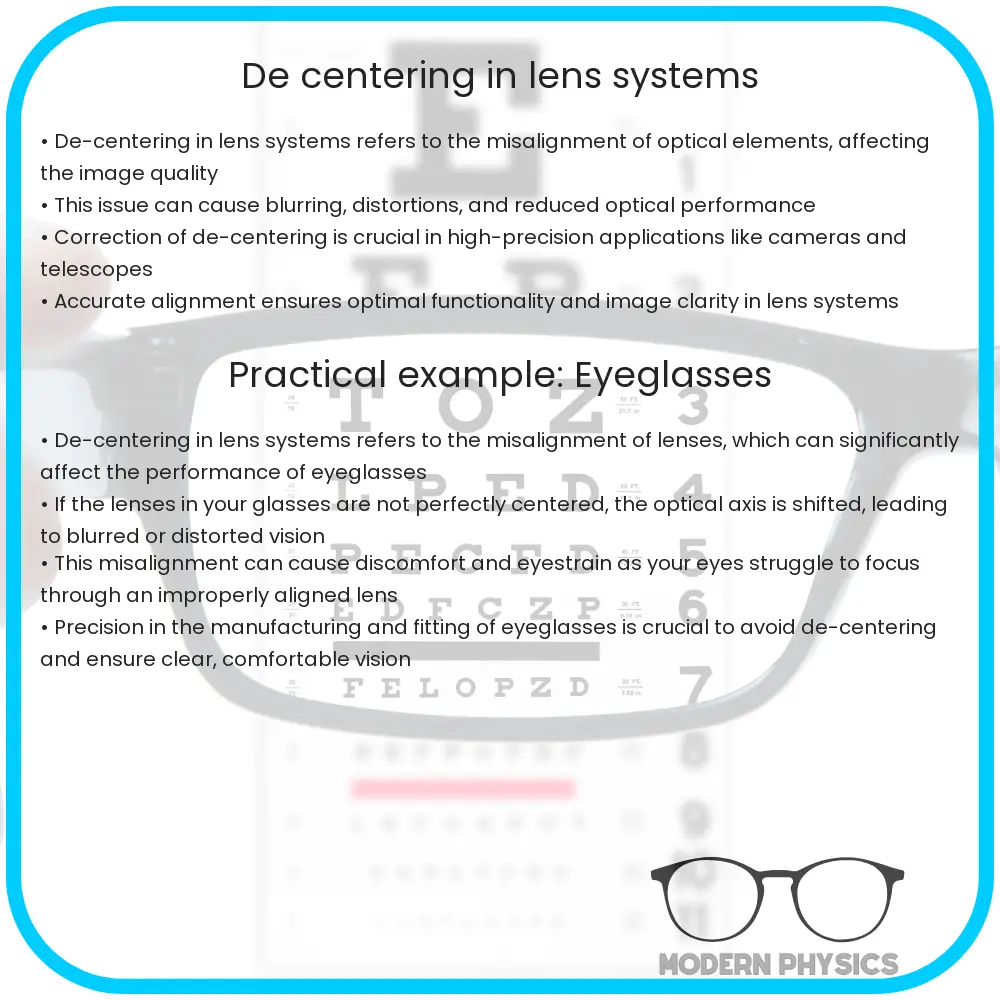
De-centering in lens systems is a critical parameter that affects the optical performance, precision, and clarity of lenses used in various applications ranging from photography to complex scientific instruments. It refers to the misalignment of lens elements relative to the optical axis, which can lead to a decrease in image quality, including sharpness and contrast. Understanding the implications of de-centering, its causes, and how it’s managed is essential for both lens designers and users seeking optimal performance from their optical systems.
Impacts of De-centering on Optical Performance
The primary impact of de-centering is the degradation of image quality. Even slight misalignments can introduce aberrations such as astigmatism and coma, which distort the image. In high-precision applications, like microscopy or telescopic observations, these aberrations can significantly affect the accuracy and clarity of observed images. For photographers, de-centering can mean the difference between a crisp, clear photo and one that’s noticeably soft or distorted at the edges.
Causes of Lens De-centering
- Manufacturing Imperfections: No manufacturing process is perfect, and slight deviations in lens element positioning can occur. High-quality lens manufacturers strive to minimize these imperfections through precision engineering and rigorous quality control.
- Mechanical Stress: Lenses are subject to various forms of mechanical stress, from assembly pressures to everyday use impacts. Over time, these stresses can shift lens elements from their optimal positions.
- Thermal Expansion: Changes in temperature can cause lens materials to expand or contract, potentially altering the alignment of lens elements. This is particularly relevant for lenses used in environments with significant temperature fluctuations.
Design Strategies to Minimize De-centering
Lens designers employ several strategies to minimize the impact of de-centering on optical performance. These include the use of high-precision manufacturing techniques, robust lens assembly designs that resist mechanical and thermal stress, and advanced optical designs that are less sensitive to minor misalignments. Additionally, compensating optical elements can be introduced to counteract the effects of de-centering, ensuring that the final image remains sharp and clear.
Advanced Techniques for Detecting and Correcting De-centering
To ensure the highest quality in lens systems, advanced techniques are employed for both detecting and correcting de-centering. High-resolution optical metrology tools, such as laser interferometers and computer-aided alignment systems, are used to measure deviations with extreme accuracy. These measurements allow for precise adjustments during the assembly process, ensuring each lens element is optimally aligned. For systems already in use, techniques such as adaptive optics can dynamically correct for de-centering and other aberrations in real-time, significantly enhancing performance without the need for physical adjustments.
Maintaining Precision in Varied Environmental Conditions
Lens systems are often used in a wide range of environmental conditions, which can exacerbate de-centering issues. Designers therefore must consider factors such as temperature variability and mechanical vibrations in their designs. Special materials with low thermal expansion coefficients, like certain types of glass or composite materials, are used to reduce the impact of temperature changes. Additionally, mechanical design improvements, such as shock-absorbing mounts, help to protect lens systems from vibrations and impacts that could lead to de-centering.
The Role of Quality Control and Maintenance
Quality control plays a pivotal role in minimizing lens de-centering from the manufacturing stage through to the end user. Rigorous testing and inspection ensure that only lenses meeting the highest standards reach the market. For end users, regular maintenance and calibration are essential, especially for precision applications. Professional services can realign lens elements and perform detailed checks to ensure that lens systems continue to operate at their best, despite the rigors of use and the passage of time.
Conclusion
De-centering in lens systems presents a significant challenge to achieving optimal optical performance. However, through sophisticated manufacturing processes, innovative design strategies, and advanced correction techniques, the impact of de-centering can be minimized. Understanding the causes and solutions for lens de-centering is crucial for both manufacturers and users who demand the highest levels of precision and clarity. As technology advances, the pursuit of perfection in optical systems continues, with de-centering being a key factor in the design, manufacture, and maintenance of high-performance lenses.