
Dark state physics explores quantum states that are invisible to certain light frequencies due to no net absorption or emission, with applications in various quantum technologies.
Introduction to Dark State Physics
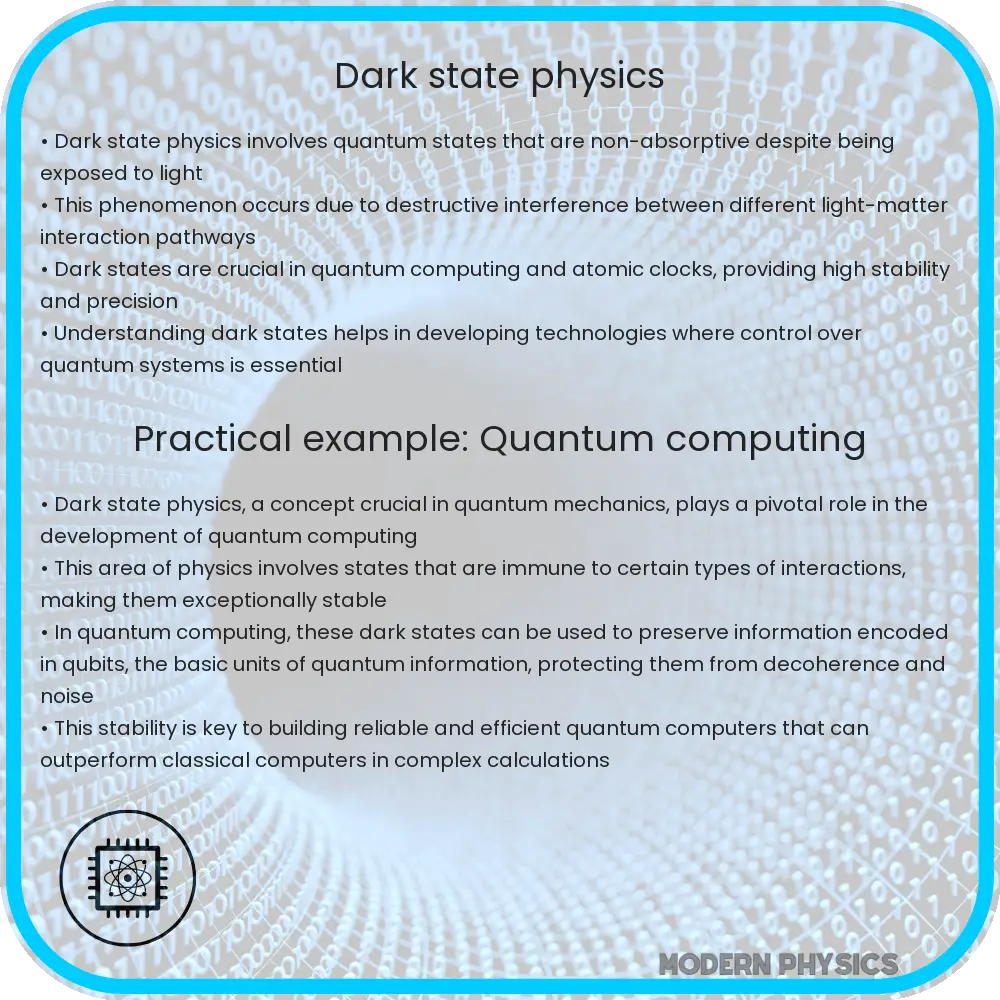
Dark state physics is a fascinating area of quantum mechanics that deals with the properties and behaviors of quantum states with no net absorption or emission of light under certain conditions. These states are termed “dark” because they effectively become invisible to specific light frequencies. This concept has significant implications in fields such as quantum computing, optical trapping, and atomic clocks.
Understanding the Basics of Dark States
A dark state occurs when a quantum system is in a superposition of two or more states that are immune to excitation by a particular light frequency due to destructive interference between the different pathways of absorption and emission. This phenomenon can be observed in systems like atoms, molecules, and quantum dots when they interact with coherent light sources.
Key Concepts in Dark State Physics
- Coherent Population Trapping: This is a primary mechanism behind the formation of dark states. It occurs when atoms or molecules are driven by two or more laser fields and the interference effects lead to a non-absorbing state.
- Electromagnetically Induced Transparency (EIT): EIT is another intriguing aspect where a medium becomes transparent over a narrow range of light frequencies due to the presence of dark states. It is widely used in slowing light and other quantum optical applications.
The Role of Quantum Interference
Quantum interference is central to the formation of dark states. Interference arises when multiple quantum pathways coexist and waves associated with these pathways combine destructively. The resultant cancellation of absorption at certain frequencies causes the system to remain in a coherent superposition of states, avoiding energy absorption that would otherwise occur.
Applications of Dark State Physics
The principles of dark state physics find applications in several cutting-edge technologies. Here are some of the most notable ones:
- Quantum Computing: Dark states can be used to preserve the state of qubits, reducing errors due to decoherence and improving the reliability of quantum computing systems.
- Optical Trapping: Scientists use dark states to trap and manipulate particles without exerting physical contact, an essential technique in biological research and nanotechnology.
- Atomic Clocks: The unmatched accuracy of atomic clocks, critical in GPS technologies and network synchronization, benefits significantly from dark state phenomena, ensuring minimal perturbation by external light sources.
Challenges and Future Prospects
While dark state physics holds great promise, it also presents challenges that must be overcome to advance these technologies further. The precision required in setting up the necessary conditions for dark states, such as the exact alignment and frequency of laser beams, poses significant technical hurdles. Despite these challenges, ongoing research and technological improvements continue to expand the practical applications of this quantum phenomenon.
Future research in dark state physics could lead to breakthroughs in several fields, including more robust quantum communication systems and highly sensitive measurements at the atomic scale. Scientists are also exploring the use of dark states in novel areas like quantum metrology and sensor technologies.
Conclusion
In conclusion, dark state physics offers a fascinating glimpse into the nuanced interplay of light and matter at the quantum level. The ability of quantum systems to ‘hide’ from light under certain conditions not only enriches our understanding of quantum mechanics but also opens up new avenues for technological innovation. From making more stable quantum computers to enhancing the precision of atomic time-keeping, the applications of dark state physics address some of the most pivotal needs in science and technology today. As research continues to unfold, the scope and impact of dark state physics are bound to increase, leading to more sophisticated technologies and an expanded understanding of the quantum world.