
Explore the enigmatic concept of Dark Energy Stars, an alternative to black holes, challenging our cosmic understanding and redefining astronomy’s frontiers.
Unveiling the Mystery: Dark Energy Stars
The universe is brimming with mysteries that challenge our understanding of the cosmos. Among these, the concept of Dark Energy Stars stands out as a particularly fascinating and controversial theory. This concept offers an alternative perspective to the traditional understanding of black holes, proposing that what we perceive as black holes may, in fact, be an entirely different class of cosmic objects.
Understanding Dark Energy Stars
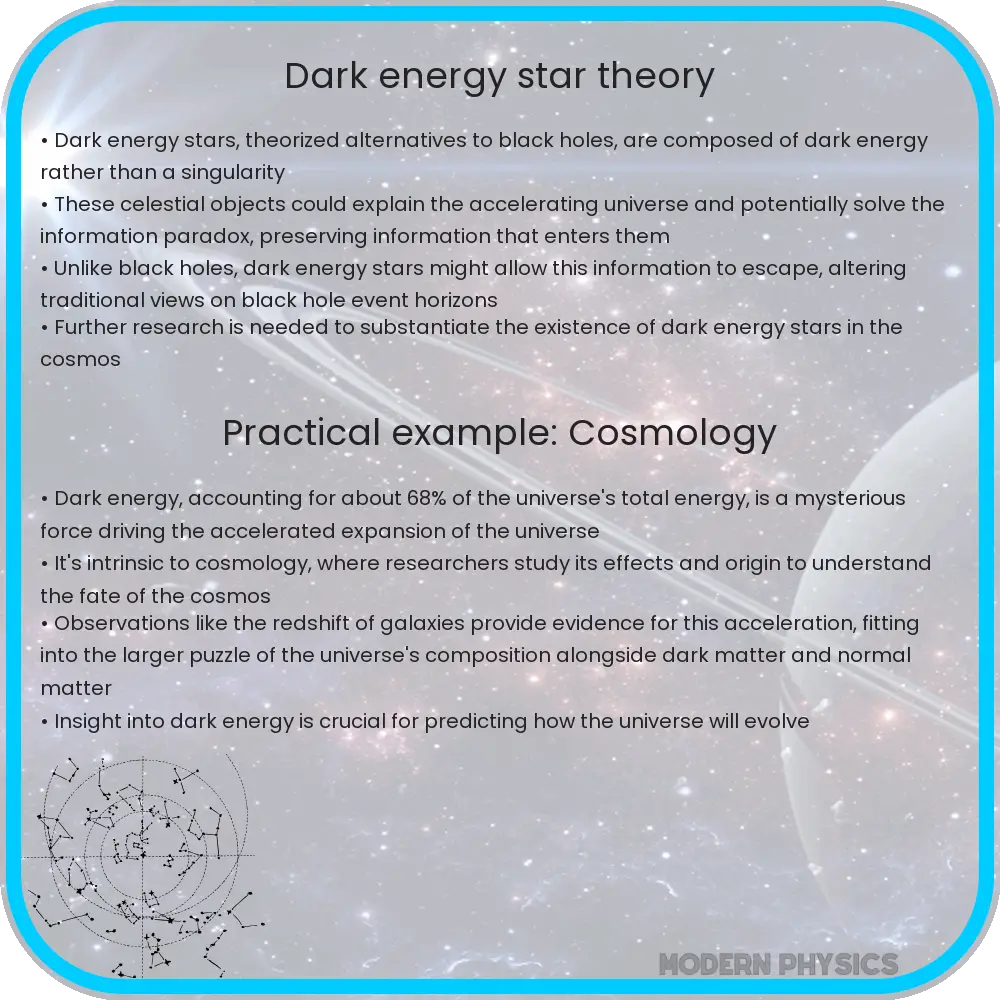
Dark Energy Stars were first proposed by physicist George Chapline, suggesting that what astronomers had identified as black holes might actually be entities filled with dark energy. Unlike black holes, which are thought to have a singularity at their core and an event horizon from which nothing can escape, Dark Energy Stars are theorized to have no singularity. Instead, they possess a quantum critical surface, beyond which the laws of physics as we know them start to break down.
The theory posits that these stars are made of dark energy, the mysterious force driving the acceleration of the universe’s expansion. Inside a Dark Energy Star, this repulsive force counteracts the gravitational collapse that would typically lead to the formation of a black hole. This concept challenges the event horizon’s existence, proposing a surface where matter and energy are not doomed to fall inward forever but can potentially be transformed or emitted back into space.
Cosmological Implications
The implications of Dark Energy Stars extend far beyond their structure and composition. If proven true, this theory could revolutionize our understanding of cosmic phenomena and the ultimate fate of the universe. It intersects with various fields of physics, including quantum mechanics, general relativity, and cosmology, suggesting new pathways for understanding the universe’s expansion and the nature of dark energy itself.
The debate over Dark Energy Stars is not just academic; it has tangible implications for observational astronomy. For instance, the way these stars bend light and the potential radiation they emit could differ significantly from traditional black holes, offering astronomers new observational targets.
Debates and Challenges in the Dark Energy Star Theory
The theory of Dark Energy Stars, while intriguing, is not without its controversies and challenges. Critics argue that there is currently insufficient observational evidence to support the existence of these hypothetical objects. Moreover, the theory requires us to rethink gravity’s role and the fundamental nature of the universe, challenging the well-established model of black holes supported by Einstein’s theory of general relativity.
Additionally, the concept of Dark Energy Stars necessitates advanced technology and methodologies to observe phenomena that blur the lines between quantum mechanics and gravitational physics. This represents a significant hurdle for astronomers and physicists, requiring innovative approaches and potentially new theoretical frameworks.
The Future of Dark Energy Star Research
Despite these challenges, the pursuit of understanding Dark Energy Stars holds the promise of significant advancements in cosmology. Scientists are exploring the quantum aspects of gravity, dark energy, and the fabric of spacetime itself in an effort to validate or refute the existence of these enigmatic objects. Upcoming astronomical surveys and missions may offer fresh insights into the nature of cosmic phenomena and help determine whether Dark Energy Stars are a reality or a fascinating theoretical detour.
The resolution of this debate will likely hinge on the development of new observational techniques capable of probing the extreme environments surrounding these cosmic objects. As technology progresses, so too will our ability to test the boundaries of our cosmic understanding, potentially leading to a paradigm shift in how we perceive the universe.
Conclusion
The theory of Dark Energy Stars offers a provocative alternative to traditional black holes, challenging our understanding of the cosmos. While surrounded by debate and requiring further evidence for validation, this theory underscores the dynamic nature of scientific inquiry. As we stand on the cusp of new discoveries, the exploration of Dark Energy Stars represents the relentless pursuit of knowledge and the ever-evolving quest to understand the universe’s deepest secrets. Whether or not Dark Energy Stars are proven to exist, their theoretical exploration enriches our cosmic perspective and propels forward the frontiers of physics and astronomy.