
Explore the intriguing world of D-Brane models in quantum theory, string dynamics, and cosmology, offering insights into the universe’s fundamental forces and dimensions.
Understanding D-Brane Models in Quantum Theory
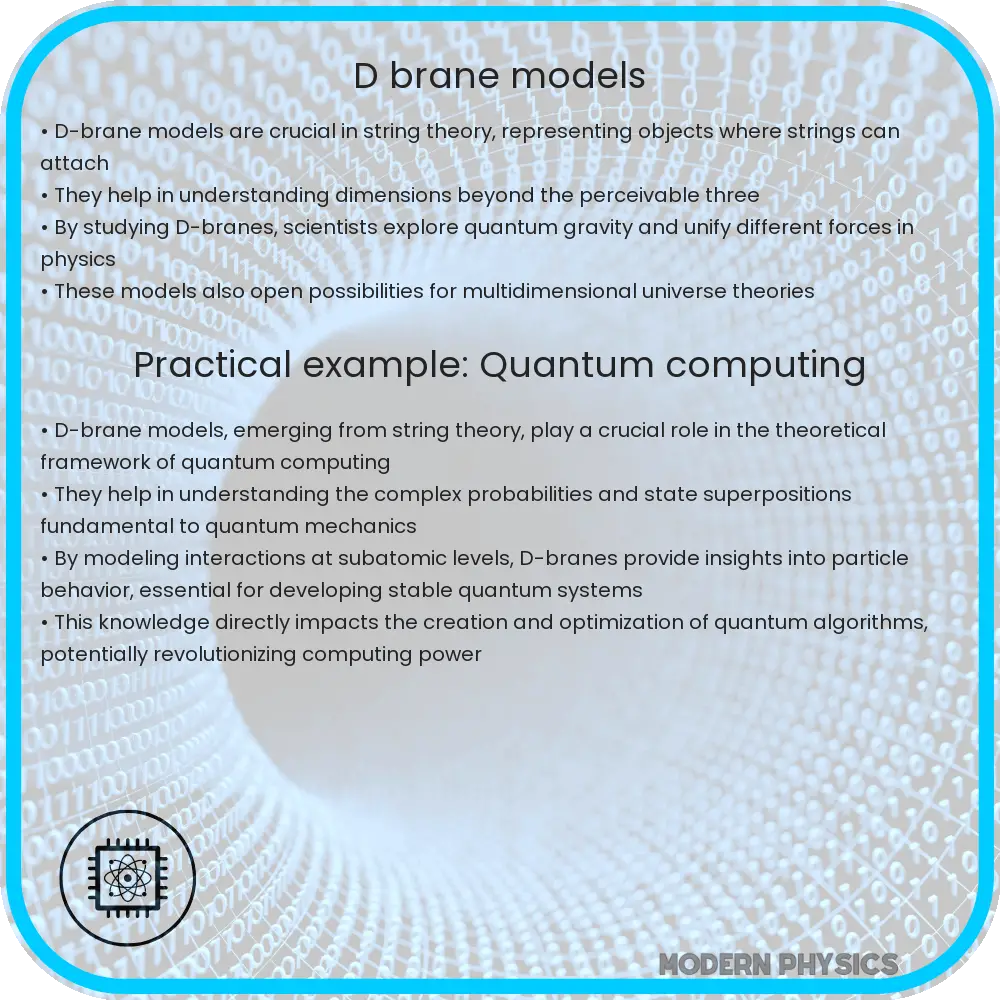
D-Brane models are essential for comprehending the complexities of quantum theory, string dynamics, and cosmology. These models represent a revolutionary approach to string theory, offering a unique perspective on the universe’s fundamental components and the forces that govern them. D-Branes, or Dirichlet-branes, are hypothetical one-dimensional objects within string theory that extend our understanding beyond traditional point-like particles.
The Role of D-Branes in String Theory
In string theory, particles are not point-like dots but rather one-dimensional “strings” that vibrate at different frequencies. This vibration determines the particle’s mass and force charge, leading to the various particle types observed in the universe. D-Branes extend this concept by acting as surfaces on which open strings can end, introducing new possibilities for the strings’ boundary conditions and interactions.
String Dynamics and Multidimensional Universes
The introduction of D-Branes into string theory has led to the development of the idea that our universe could exist on a D-Brane in a higher-dimensional space. This suggests that while gravity can spread through the bulk of these extra dimensions, other forces, such as electromagnetism, are confined to the D-Brane. This separation could explain why gravity is significantly weaker than the other fundamental forces.
D-Branes and Cosmology
D-Branes also offer new insights into cosmology, particularly in the context of the early universe and the Big Bang theory. By applying D-Brane models, cosmologists can explore scenarios where universes are created through the collision of D-Branes in higher-dimensional spaces. This approach provides a novel framework for understanding cosmic inflation, the mysterious period of rapid expansion that occurred fractions of a second after the Big Bang.
Moreover, D-Brane cosmology can address some of the most pressing issues in modern physics, such as the nature of dark matter and dark energy. These components constitute most of the universe’s mass-energy content, yet remain poorly understood. D-Brane models suggest that these mysterious substances could arise from the dynamics of strings and branes in extra dimensions.
Implications of D-Brane Models for Quantum Gravity
One of the most significant challenges in theoretical physics is formulating a coherent theory of quantum gravity that reconciles general relativity with quantum mechanics. D-Brane models contribute to this field by offering a framework in which gravitational and quantum effects can coexist. This is particularly evident in the study of black holes, where D-Branes provide a mathematical structure for understanding their entropy and temperature, aligning with Stephen Hawking’s radiation theory. By analyzing the microstates of black holes through D-Brane dynamics, physicists can explore the quantum aspects of gravity with unprecedented detail.
Challenges and Future Directions
Despite their potential, D-Brane models and string theory face significant challenges. One of the main issues is the lack of direct experimental evidence supporting these theories. The energy scales at which string theory operates are far beyond current particle accelerators’ reach, making empirical validation challenging. Furthermore, the mathematical complexity of string theory and D-Branes requires advanced computational techniques and novel mathematical frameworks, which are still in development.
Future research in D-Brane models is directed towards resolving these challenges, enhancing the mathematical tools available, and finding innovative methods to test these theories experimentally. Collaborations across cosmology, particle physics, and quantum information science are crucial for advancing our understanding of D-Branes and their implications for the universe.
Conclusion
D-Brane models represent a fascinating and complex facet of modern theoretical physics, offering profound insights into the nature of the universe, from the smallest particles to the vast cosmological structures. While challenges remain in validating and fully understanding these models, their potential to unify the fundamental forces and explain the universe’s structure and origins continues to inspire physicists. As research progresses, D-Branes may hold the key to unlocking some of the most profound mysteries in physics, from the fabric of spacetime to the ultimate fate of the cosmos.