
Explore Culmann’s Method in statics for precision & clarity in engineering designs. Learn its applications, advantages, and modern integration.
Understanding Culmann’s Method in Statics
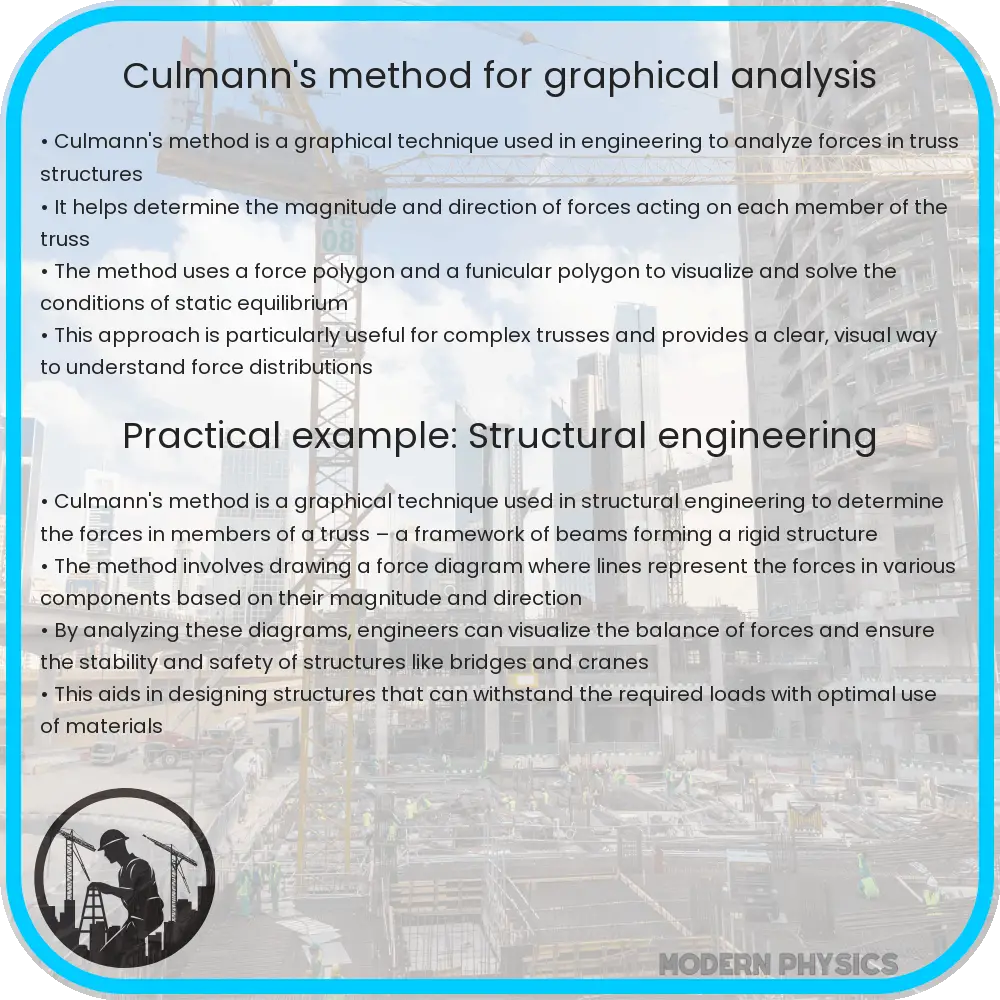
Culmann’s Method is a highly regarded approach in the field of statics, a branch of mechanics dealing with bodies at rest or in equilibrium. It stands out for its precision, efficiency, and clarity, especially in complex problems involving numerous forces. This method is named after Carl Culmann, a 19th-century German engineer known for his contributions to graphical statics. Culmann’s approach is particularly useful in determining the forces acting in truss structures, which are common in bridges and architectural designs.
Core Principles of Culmann’s Method
At the heart of Culmann’s Method lies the principle of force equilibrium. In statics, a body or structure is in equilibrium if the sum of all forces and the sum of all moments (torques) acting on it are zero. Culmann’s Method simplifies this process by translating these conditions into graphical solutions, providing a visual and intuitive approach to solving static problems.
Application in Engineering and Design
One of the primary applications of Culmann’s Method is in the analysis of truss structures. Trusses are assemblies of triangles, typically made of steel or wood, designed to support loads. Engineers use Culmann’s Method to determine the forces in each member of the truss. This is crucial for ensuring that the truss can support the intended loads without failure.
Advantages of Culmann’s Method
- Precision: Culmann’s Method provides accurate results, essential for the safe design of structures.
- Efficiency: It offers a quicker solution to complex problems compared to algebraic methods, especially when dealing with multiple force vectors.
- Clarity: The graphical nature of the method provides clear visual insights into the nature of the forces involved, aiding in better understanding and communication among engineers.
Step-by-Step Process
The process begins with a free-body diagram, illustrating all the forces acting on the structure. Next, using Culmann’s Method, these forces are represented graphically. The method involves drawing a force polygon, where each side represents a force vector in both magnitude and direction. This polygon aids in determining the unknown forces in the structure, ensuring equilibrium.
By applying Culmann’s Method, engineers can efficiently and accurately assess the viability of their designs, ensuring structural integrity and safety. Its application extends beyond trusses to other complex structures, making it a versatile tool in the field of statics.
Enhancing Understanding Through Culmann’s Method
Culmann’s Method not only serves as a practical tool for solving statics problems but also enhances the understanding of fundamental concepts in physics and engineering. By visually representing forces and their interactions, it bridges the gap between abstract theoretical concepts and their practical applications. This visual aspect is particularly beneficial in educational settings, where students can more easily grasp the principles of equilibrium and force interactions.
Limitations and Considerations
Despite its advantages, Culmann’s Method has limitations. It is predominantly suitable for planar structures where forces lie in a single plane. For three-dimensional problems, the method becomes complex and less practical. Additionally, it requires a clear understanding of vector representation and geometry, which can be challenging for beginners.
Integration with Modern Technology
In the era of digital engineering, Culmann’s Method has been integrated into various software tools. These tools enhance the method’s efficiency, allowing for quick adjustments and more complex calculations. The integration of Culmann’s Method with modern technology highlights its enduring relevance in the field of engineering and design.
Real-World Applications
From the construction of bridges and buildings to the design of machinery and aerospace structures, Culmann’s Method finds extensive application. It is particularly valuable in the preliminary design phase, where quick and accurate assessments of structural elements are crucial.
Conclusion
Culmann’s Method, with its combination of precision, efficiency, and clarity, remains a cornerstone in the field of statics and engineering design. While it has its limitations, particularly in three-dimensional applications, its integration with modern technology and enduring relevance in various engineering sectors underscore its importance. It not only aids engineers in designing safe and efficient structures but also serves as a vital educational tool, bridging theoretical knowledge with practical application. As engineering challenges evolve, Culmann’s Method continues to adapt, maintaining its status as an indispensable tool in the engineer’s toolkit.