
Explore the transformative potential of cryotrons in cryogenic electronics, delving into superconductivity innovations, applications, and future prospects.
Cryotron: Pioneering Superconductivity in Cryogenic Electronics
The realm of cryogenic electronics has witnessed substantial advancements with the introduction of the cryotron, a device that epitomizes the integration of superconductivity principles for enhanced electrical system performance. As we delve into the intricacies of cryogenic electronics, it is imperative to understand the role and functionality of cryotrons and how they harness the phenomenon of superconductivity to revolutionize electronic circuits.
Understanding Cryotrons
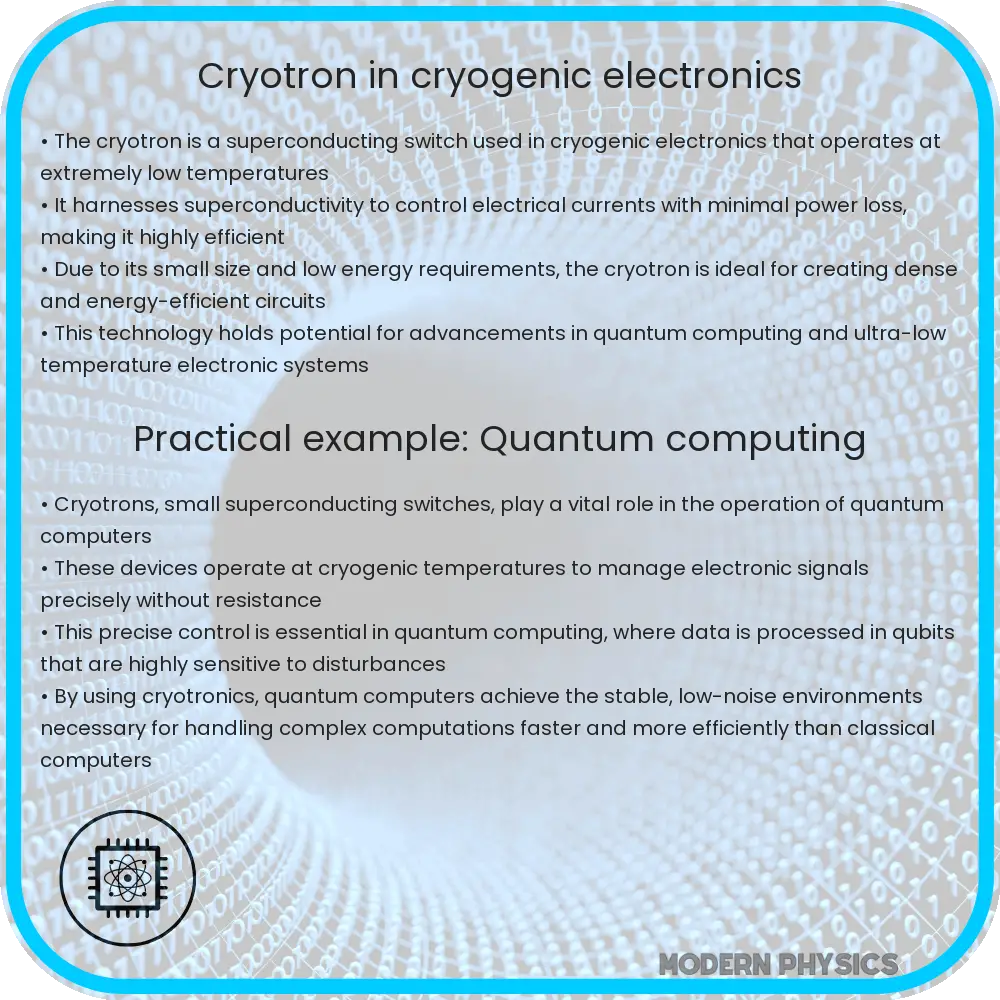
A cryotron is a type of superconducting switch that operates at cryogenic temperatures, typically below 10 Kelvin (-263.15°C). The fundamental principle behind its operation is the transition of a superconducting material from a zero-resistance state to a resistive state when exposed to a magnetic field, a hallmark of superconductivity known as the Meissner effect. This switchable property enables the cryotron to function as an effective digital gate or switch in cryogenic electronics, offering minimal energy dissipation compared to conventional semiconductor devices.
Superconductivity Innovations
Superconductivity, the phenomenon where materials exhibit zero electrical resistance and expel magnetic fields at low temperatures, is at the core of cryotron technology. Innovations in superconducting materials, such as the discovery of high-temperature superconductors like YBa2Cu3O7-x (yttrium barium copper oxide), have significantly impacted the development and application of cryotrons. These materials have allowed cryotrons to operate at higher temperatures, albeit still in the cryogenic range, thus broadening their applicability in electronic systems.
Applications in Cryogenic Electronics
The unique properties of cryotrons make them highly suitable for various applications within the field of cryogenic electronics. They are particularly advantageous in areas requiring ultra-low power consumption and high-speed operations. Cryotrons are used in quantum computing, where their superconducting switches contribute to the creation of qubits, the fundamental building blocks of quantum computers. Additionally, their rapid switching capabilities and low power requirements make them ideal for use in advanced communication systems and sensitive astronomical sensors.
Challenges and Future Prospects
Despite their promising attributes, cryotrons and superconducting electronics face several challenges. The requirement for cryogenic temperatures necessitates sophisticated cooling systems, which can be bulky and expensive. This has limited the widespread adoption of cryotronic-based devices in commercial applications. Furthermore, the fabrication of superconducting materials and cryotrons involves complex processes that can escalate costs and hinder large-scale manufacturing.
However, ongoing research aims to surmount these hurdles. Innovations in cooling technology and material science are gradually reducing the operational costs and improving the feasibility of cryotronic devices. Moreover, the potential energy efficiency and speed advantages of cryotrons continue to drive interest and investment in this field.
Integrating Cryotrons with Conventional Electronics
One of the most exciting prospects is the integration of cryotrons with conventional semiconductor electronics. This hybrid approach could combine the best of both worlds: the high-speed, low-power operation of cryotrons with the versatility and maturity of silicon-based technologies. Such integration could lead to new classes of electronic devices that offer unprecedented performance and efficiency.
Additionally, the development of room-temperature superconductors, although still a distant goal, could revolutionize cryogenic electronics by eliminating the need for cryogenic cooling altogether. This would make the advantages of cryotrons accessible for a wide range of applications, from everyday electronics to large-scale computing infrastructures.
Conclusion
The cryotron represents a significant milestone in the field of cryogenic electronics, leveraging the unique properties of superconductivity to offer low-power, high-speed switching capabilities. While challenges remain in terms of cooling requirements and manufacturing complexities, the ongoing advancements in material science and cooling technologies hold promise for overcoming these obstacles. The integration of cryotrons into broader electronics systems could usher in a new era of energy-efficient and powerful computing, signaling a transformative phase in the evolution of electronic devices. As research continues to push the boundaries of what is possible, the future of cryotronic technology appears both promising and vibrant, poised to redefine the landscape of modern electronics.