
The cryosphere encompasses all of Earth’s frozen water forms, including glaciers, ice caps, and permafrost, playing a vital role in global climate regulation.
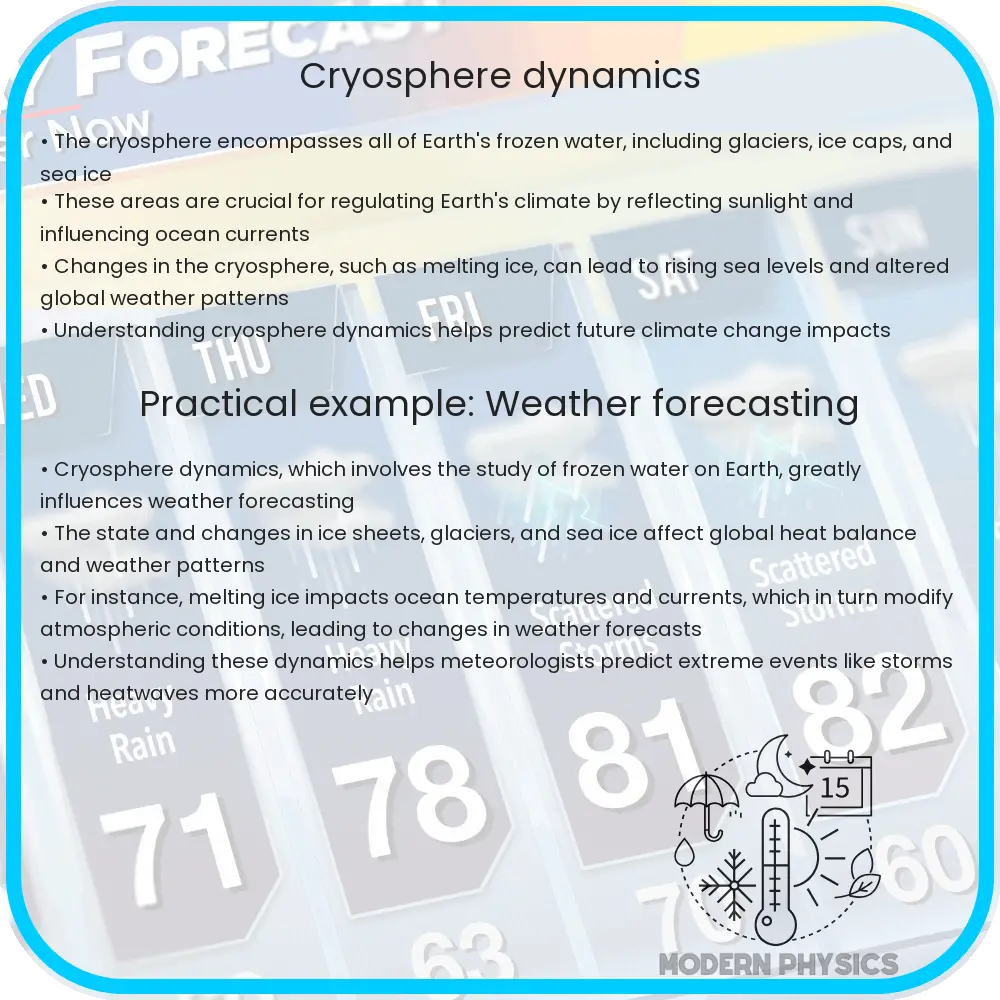
Understanding Cryosphere Dynamics: Climate Impact, Modeling, and Trends
The cryosphere comprises all the areas on Earth’s surface where water is found in its solid form, including glaciers, ice caps, ice sheets, sea ice, snow cover, and permafrost. This frozen part of the Earth’s system plays a crucial role in global climate dynamics because of its ability to reflect solar radiation and regulate global temperatures. In this article, we explore the impact of the cryosphere on climate, the processes that govern its dynamics, and the trends observed due to climate change.
Impact of the Cryosphere on Climate
The cryosphere influences the global climate system in several significant ways. Its high albedo effect (the ability to reflect sunlight) helps maintain lower temperatures in polar regions and globally. Ice and snow-covered surfaces reflect as much as 80%-90% of the incoming solar radiation, compared to only about 15% for forests and less than 10% for grasslands. This reflective property can drastically reduce the amount of energy absorbed by the Earth, thereby influencing the global temperature and weather patterns.
Moreover, the cryosphere contributes to the global heat conveyor belt by driving thermohaline circulation. This circulation is an ocean deep-water movement caused by differences in water density, which is influenced by temperature and salinity. For instance, as seawater freezes at the poles, it expels salt, making the surrounding water saltier and denser, which causes it to sink and drive a global deep ocean current.
Modeling Cryosphere Dynamics
Understanding and predicting changes in the cryosphere require complex mathematical models that account for various physical and climatic variables. These models typically involve the simulation of heat transfer, ice flow, snow compaction, and interactions between the atmosphere, oceans, and cryosphere.
One of the fundamental equations used in modeling ice dynamics is the conservation of mass expressed as:
\[ \frac{\partial h}{\partial t} + \nabla \cdot (h\vec{v}) = a – ab \]
where \( h \) is the ice thickness, \( \vec{v} \) represents the ice velocity vector, \( a \) is the accumulation rate of snow, and \( ab \) is the ablation rate, including melting and sublimation.
Additionally, energy balance models (EBMs) are employed to calculate the exchange of energy at the surface of the ice, taking into consideration factors like solar radiation absorption, heat convection, and long-wave radiation emission. These models help in determining the melting rates and formation of melt ponds which have significant implications for ice albedo.
Observational Trends in the Cryosphere
In recent decades, significant changes have been recorded in the cryosphere due to global warming. These changes include:
- Retreat and thinning of mountain glaciers worldwide.
- Shrinkage of the polar ice caps and a reduction in the volume and extent of sea ice.
- Permafrost thawing which releases methane, a potent greenhouse gas.
The decrease in ice coverage not only has local impacts, such as reduced freshwater availability and shifts in ecosystems, but also triggers global effects like sea-level rise and altered global ocean circulation patterns. This continued loss highlights the global importance of the cryosphere and lends urgency to efforts aimed at understanding and mitigating climate change impacts.
Technological Advances in Cryosphere Research
The study of the cryosphere has benefitted greatly from technological advances that improve data collection and analysis. Satellites equipped with sensors, for instance, provide comprehensive data on ice surface temperatures, extent, and changes over time. Drones and remotely operated vehicles (ROVs) are also increasingly used to access and study areas that are dangerous or inaccessible to humans.
Furthermore, advanced computing technologies have enhanced the simulation capabilities of cryospheric models. High-performance computers can process complex datasets faster and with more accuracy, leading to better predictions of future changes in the cryosphere.
Adapting to Cryospheric Changes
Communities, governments, and organizations across the globe are beginning to take steps to adapt to the inevitable changes occurring within the cryosphere. Strategies include reinforcing infrastructure to withstand permafrost thaw, modifying water management practices to work with changing glacial melt patterns, and creating policies to manage and mitigate sea-level rise.
Moreover, international cooperation is crucial in sharing resources, knowledge, and strategies to proactively address the broader implications of cryospheric deterioration on global systems including weather patterns, sea levels, and ecosystems.
Conclusion
The cryosphere is an integral part of our planet’s climate system, deeply interwoven with the global environment and human societies. Through advanced scientific research and strategic international collaborations, we continue to deepen our understanding of this vital component of the Earth’s system. Recognizing the impacts of its changes is crucial for developing effective adaptation strategies that safeguard our communities and future generations from adverse outcomes. As we face the challenges brought on by these environmental changes, the role of continued innovation and adaptation becomes more important than ever. Embracing these challenges not only helps mitigate impacts but also opens up new opportunities for growth and learning in the realms of science, technology, and international cooperation.