
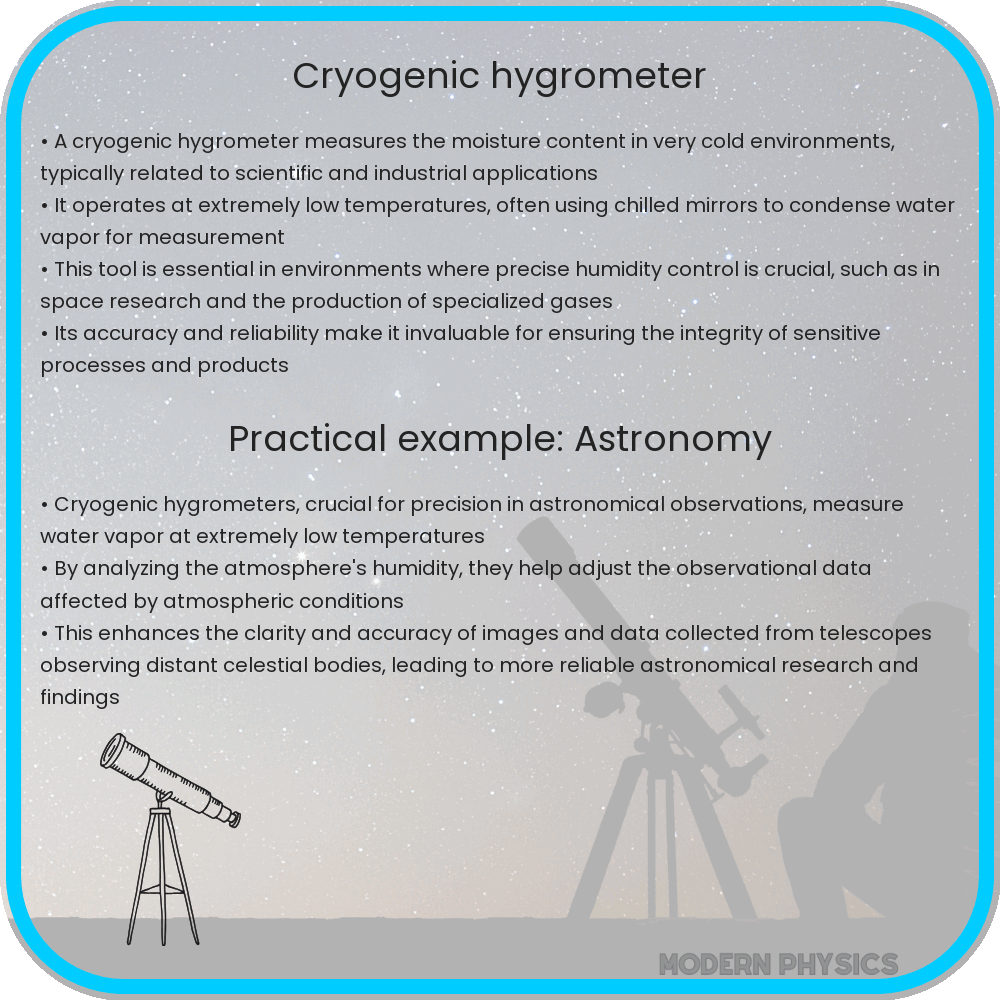
Cryogenic hygrometers are instruments designed to measure humidity at extremely low temperatures, essential for atmospheric research in meteorology and astronomy.
Understanding Cryogenic Hygrometers
Cryogenic hygrometers play a crucial role in the fields of meteorology, astronomy, and various scientific inquiries where precise and reliable atmospheric moisture measurements are necessary. These instruments are engineered to measure humidity at extremely low temperatures, which is vital for both ground-based and high-altitude atmospheric research.
The Science Behind Cryogenic Hygrometers
At its core, a cryogenic hygrometer measures the amount of water vapor present in the atmosphere at cryogenic temperatures, where traditional hygrometers fail to operate effectively. This is achieved through the cooling of a surface to temperatures low enough to condense the water vapor from the gas phase into the ice phase, allowing it to be quantitatively measured.
Two common methods used by cryogenic hygrometers are:
- Frost Point Method: This is where the temperature at which water vapor begins to condense into frost is measured. The frost point is a direct indicator of the amount of water vapor in the atmosphere.
- Lyman-Alpha Absorption Technique: This method uses the absorption characteristics of water vapor at specific ultraviolet (UV) wavelengths to quantify moisture content. It’s highly effective at very low temperatures and is commonly used in upper-atmospheric research.
Applications of Cryogenic Hygrometers
Cryogenic hygrometers are indispensable in various scientific and practical applications:
- Climate Research: They help in understanding and analyzing high-altitude clouds and atmospheres, which are crucial for modeling climate change scenarios.
- Aerospace Engineering: Monitoring the atmospheric conditions at high altitudes helps in designing better aircraft and spacecraft that can withstand extreme environments.
- Astronomical Observations: Precise humidity readings are critical for calibrating instruments used in space observatories and ground-based telescopes.
Each of these applications relies on the precise and reliable data provided by cryogenic hygrometers to push the boundaries of our understanding and capabilities in both terrestrial and extraterrestrial environments.
Precision and Reliability
The precision of cryogenic hygrometers lies in their ability to perform accurately under extreme conditions. This precision is essential for researchers who require consistent and dependable data for long-term atmospheric studies. The reliability of these instruments is ensured through rigorous testing and continuous development in materials and sensor technologies, adapting to harsh environments without degrading in performance.
Cryogenic hygrometers typically offer resolutions down to parts per million (ppm), making them incredibly sensitive to even minute changes in moisture levels. This makes them ideal for research where high accuracy is paramount.
Moreover, advancements in digital technology and data processing tools have enhanced the ability of cryogenic hygrometers to collect, store, and analyze atmospheric data efficiently, increasing both their utility and reliability in scientific research.
Challenges and Future Directions
Despite their effectiveness, cryogenic hygrometers face challenges, such as the need for high maintenance and regular calibration. The extremely low operating temperatures require sophisticated cooling systems that are not only costly but also complex to manage. Additionally, the precision components in these devices are sensitive to contamination, which can affect their accuracy.
Future developments in cryogenic hygrometry are likely to focus on enhancing the robustness and user-friendliness of these instruments. Research is being directed towards improving the materials used in sensor mechanisms to prevent ice buildup and contamination. There is also an ongoing effort to integrate more advanced computational models that can predict environmental changes with greater precision, accommodating faster real-time data processing.
Conclusion
Cryogenic hygrometers, though complex, are indispensable tools in the scientific community. With their ability to measure humidity at ultra-low temperatures, they provide critical data for climate research, aerospace engineering, and astronomy. The frost point method and the Lyman-Alpha absorption technique exemplify the sophisticated approaches employed to obtain accurate moisture readings under challenging conditions. As technology advances, these instruments are set to become even more reliable and easier to use, expanding their applications and effectiveness in both existing and new fields of research. Acknowledging their importance, the scientific community continues to innovate and overcome obstacles, ensuring that cryogenic hygrometers remain at the forefront of atmospheric research technology.