
Explore the revolutionary world of Cryo-Electron Microscopy, its precision in 3D molecular imaging, applications in drug discovery, and its impact on scientific research.
Cryo-Electron Microscopy: Unveiling the Intricate World of Molecules
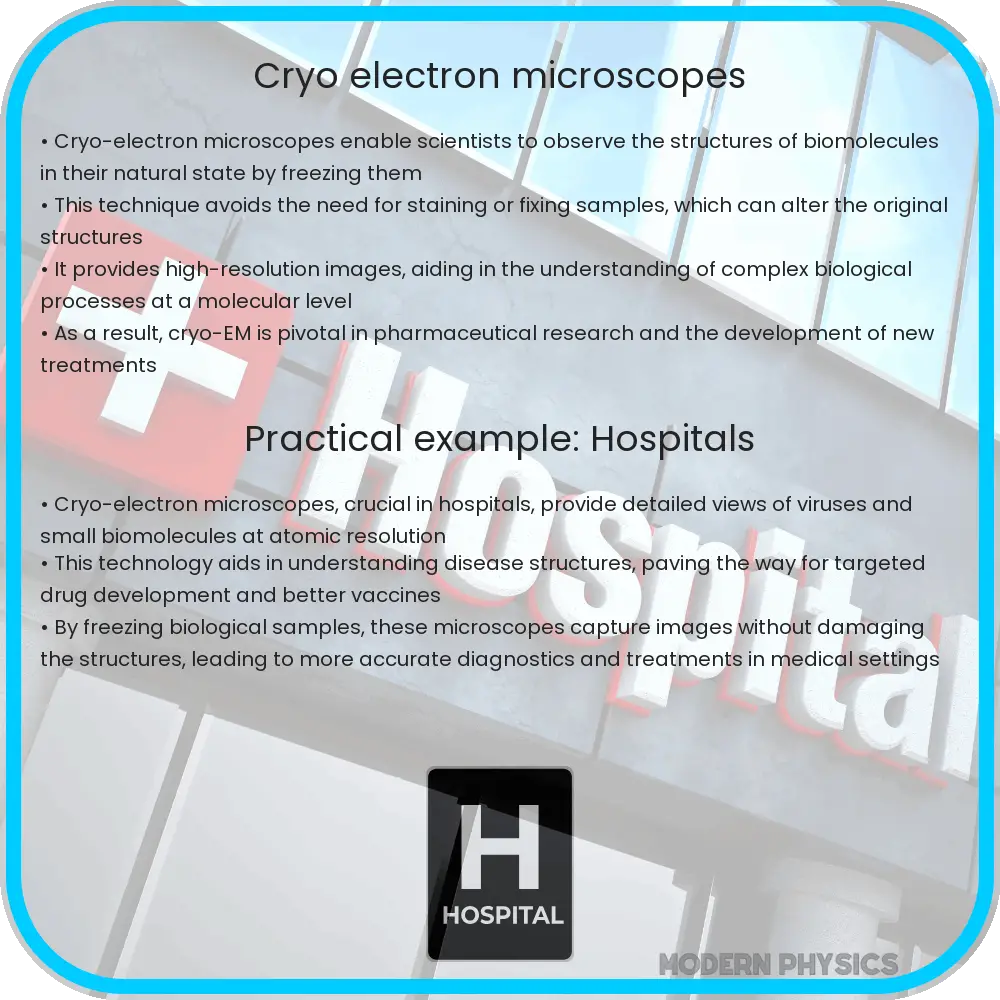
Cryo-Electron Microscopy (cryo-EM) has revolutionized the field of structural biology by providing an unprecedented glimpse into the atomic structure of biological molecules. This powerful technique combines the precision of electron microscopy with the ability to preserve specimens in a near-native state, enabling scientists to visualize complex biomolecules in three dimensions with remarkable clarity.
Principles of Cryo-EM
At its core, cryo-EM involves flash-freezing biological specimens in a thin layer of vitreous ice, a process that preserves their natural conformation without the need for staining or fixation. This snapshot of molecules in their native environment allows for the detailed study of biological processes at the molecular level. The technique employs a beam of electrons instead of light to image the specimen, overcoming the limitations of optical microscopy and achieving much higher resolution.
Applications and Advantages
- 3D Imaging: Cryo-EM is celebrated for its ability to produce three-dimensional images of biomolecules. This is achieved through the reconstruction of two-dimensional images taken from multiple angles, offering a comprehensive view of the molecule’s structure.
- Structural Analysis: The technique is invaluable for understanding the structure-function relationship within biological systems. By revealing how molecules are assembled, cryo-EM aids in elucidating their mechanisms of action.
- Drug Discovery: With its high-resolution capabilities, cryo-EM has become a crucial tool in drug design and discovery. It allows scientists to observe how drugs interact with their targets at the molecular level, facilitating the development of more effective therapeutics.
Challenges and Solutions
Despite its many advantages, cryo-EM is not without its challenges. The technique requires extremely high vacuum and low temperature conditions, demanding specialized equipment and expertise. Additionally, the data analysis process is complex and computationally intensive. However, advancements in detector technology and software algorithms have significantly improved the efficiency and resolution of cryo-EM, making it more accessible to researchers around the globe.
Through its blend of precision, three-dimensional imaging, and detailed analysis, cryo-EM continues to push the boundaries of molecular biology, offering insights into the microscopic world that were once beyond reach.
The Future of Cryo-Electron Microscopy
The ongoing developments in cryo-EM technology herald a new era in the field of molecular biology. As the technique becomes more refined, it promises to unlock further mysteries of life at the molecular level. Innovations in sample preparation, imaging hardware, and data analysis software are poised to enhance the resolution and speed of cryo-EM, making it an even more powerful tool for scientific discovery.
Integrating Cryo-EM with Other Techniques
A key strength of cryo-EM lies in its versatility and ability to be integrated with other structural biology methods, such as X-ray crystallography and nuclear magnetic resonance (NMR) spectroscopy. This multidisciplinary approach enables a more comprehensive understanding of biomolecular structures and functions, facilitating the exploration of complex biological systems in unparalleled detail.
Implications for Medical Research and Beyond
- Medical Research: Cryo-EM’s ability to elucidate the structure of viruses and protein complexes involved in diseases is transforming medical research. It provides critical insights into the pathogenesis of diseases and paves the way for the development of novel vaccines and therapeutics.
- Materials Science: Beyond biology, cryo-EM is making significant contributions to materials science by enabling the analysis of the structure of nanomaterials and polymers, thus influencing the design of new materials with desired properties.
- Education and Training: The advancement of cryo-EM also necessitates the training of the next generation of scientists in this sophisticated technology. Educational institutions are increasingly incorporating cryo-EM into their curricula, ensuring that future researchers are well-equipped to continue the exploration of the molecular world.
Conclusion
Cryo-Electron Microscopy stands at the forefront of a scientific revolution, offering a window into the atomic details of the biological world with unprecedented clarity. Its contributions to understanding life’s fundamental processes, combined with its implications for drug discovery and beyond, underscore its indispensable role in modern science. As cryo-EM technology continues to evolve, it will undoubtedly unveil new dimensions of molecular complexity, driving forward our quest for knowledge and fostering innovations across multiple fields of study. Embracing the challenges and opportunities presented by cryo-EM will be essential as we advance into the future, armed with deeper insights into the fabric of life itself.