
The Crop Water Stress Index (CWSI) is an agricultural tool for determining optimal irrigation by measuring water stress levels in crops.
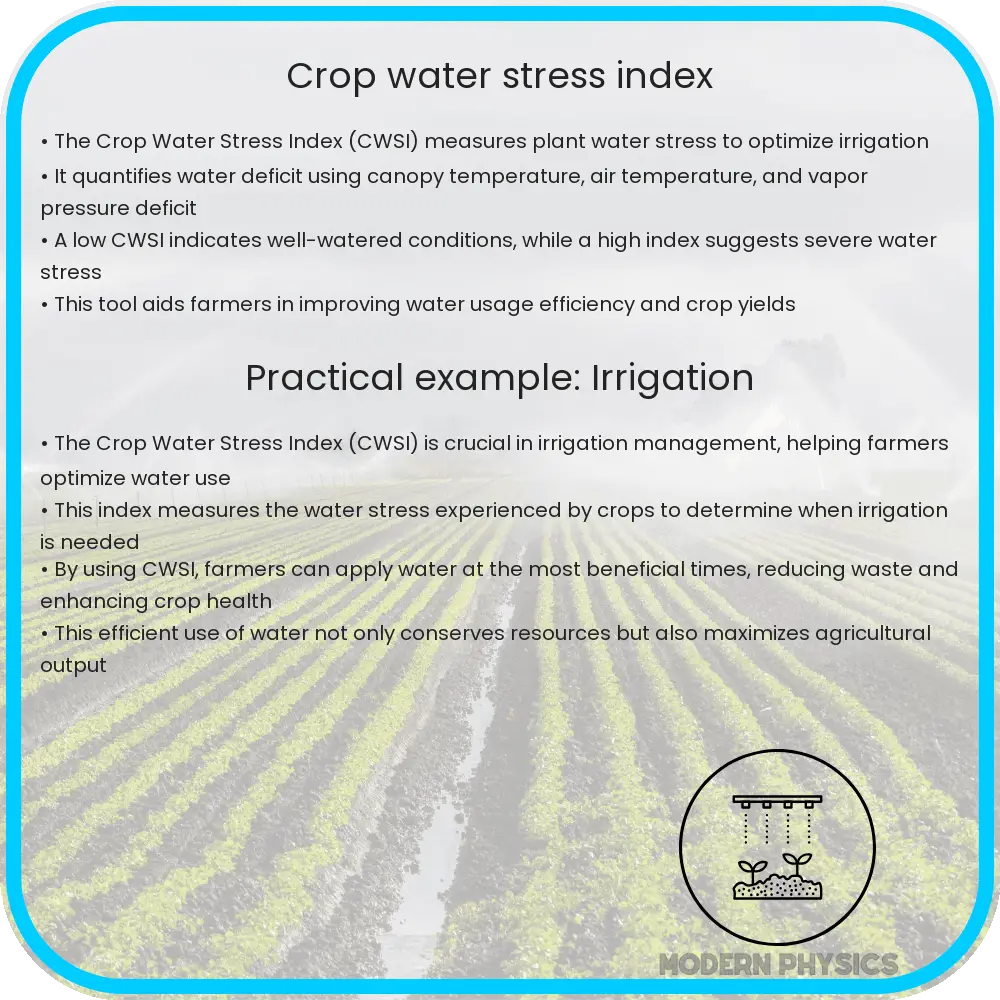
Understanding the Crop Water Stress Index (CWSI) for Optimizing Irrigation and Crop Yield
The Crop Water Stress Index (CWSI) is a crucial tool used in agricultural practices to determine the appropriate amount of water needed for crops at various stages of growth. By effectively using CWSI, farmers can optimize irrigation, which not only conserves water but also enhances crop yield and quality. Let’s delve into what CWSI is, how it is calculated, and its implications for irrigation management.
What is the Crop Water Stress Index?
The Crop Water Stress Index is a numerical index that quantifies the water stress experienced by a crop at any given time. It essentially helps in identifying how much a crop’s transpiration is reduced due to water deficiency. CWSI is invaluable in precision agriculture where the goal is to apply water and other inputs as efficiently and effectively as possible to maximize output and minimize waste.
How is CWSI Calculated?
CWSI is calculated based on the difference between the canopy temperature of a crop and the air temperature, alongside other environmental and crop-specific factors. The formula can be expressed as follows:
\[ CWSI = \frac{(T_c – T_a) – (T_{c,wet} – T_a)}{(T_{c,dry} – T_a) – (T_{c,wet} – T_a)} \]
- Tc: Canopy temperature of the crop measured via infrared thermometers or thermal cameras.
- Ta: Ambient air temperature.
- Tc,wet: Canopy temperature of the crop under well-watered conditions.
- Tc,dry: Canopy temperature of the crop under dry or drought conditions.
This computation integrates both ideal and stressed conditions to generate a value typically ranging from 0 (no stress) to 1 (severe stress). Hence, it allows for a comparison against a baseline to determine how much stress the crop is experiencing due to a lack of water.
Factors Influencing CWSI
Several factors can influence the value of CWSI, making its application site and crop-specific. These factors include:
- Weather conditions (temperature, humidity, and solar radiation)
- Crop type and variety
- Stage of crop growth
- Soil type and moisture levels
Understanding these factors is crucial for accurately assessing and interpreting CWSI readings, leading to more informed irrigation decisions.
Practical Applications of CWSI in Agriculture
The practical uses of CWSI extend beyond simple monitoring; it is a pivotal tool in irrigation management. Farmers and agricultural engineers use the CWSI to schedule irrigation more effectively. By understanding when crops are experiencing water stress, irrigation can be applied more precisely, which not only saves water but also ensures that crops receive moisture at critical growth stages.
For example, using CWSI data, a farmer can avoid over-irrigation during times of low stress and focus water resources when the index indicates higher stress levels. This targeted irrigation approach helps in maintaining an ideal moisture balance in the soil, crucial for optimal crop health and yield.
Advantages of Using CWSI
Implementing the CWSI in crop management offers several advantages:
- Improved water use efficiency, reducing wastage and conserving water resources.
- Enhanced crop yields by ensuring crops are not stressed by either too much or too little water.
- Decreased costs related to water usage and irrigation.
- Better adaptation to changing climatic conditions by enabling dynamic irrigation practices.
These benefits make CWSI an essential component in modern agricultural strategies, particularly in regions where water scarcity is a significant concern.
Challenges in Implementing CWSI
While CWSI offers numerous benefits, its implementation is not without challenges. These include:
- The need for specific tools and technologies, such as thermal cameras and specialized software.
- Training and expertise required to interpret CWSI data accurately.
- Variabilities in weather and environmental conditions that might affect the accuracy of the index.
Addressing these challenges through continued research, development, and training is crucial for optimizing the use of CWSI in agriculture.
Conclusion
The Crop Water Stress Index (CWSI) is a sophisticated tool that has revolutionized irrigation practices in agriculture. By accurately measuring and responding to water stress in crops, it allows farmers to optimize water usage, ultimately leading to better crop yields and reduced environmental impact. As global water resources become increasingly strained, tools like CWSI will play a vital role in ensuring agricultural sustainability and food security. Embracing this technology, overcoming its implementation challenges, and continuously improving its accuracy and usability will be key to its success in managing future agricultural demands.