
Light Use Efficiency (LUE) measures how effectively plants convert absorbed light into biomass during photosynthesis, a crucial factor for crop yield and ecosystem productivity.
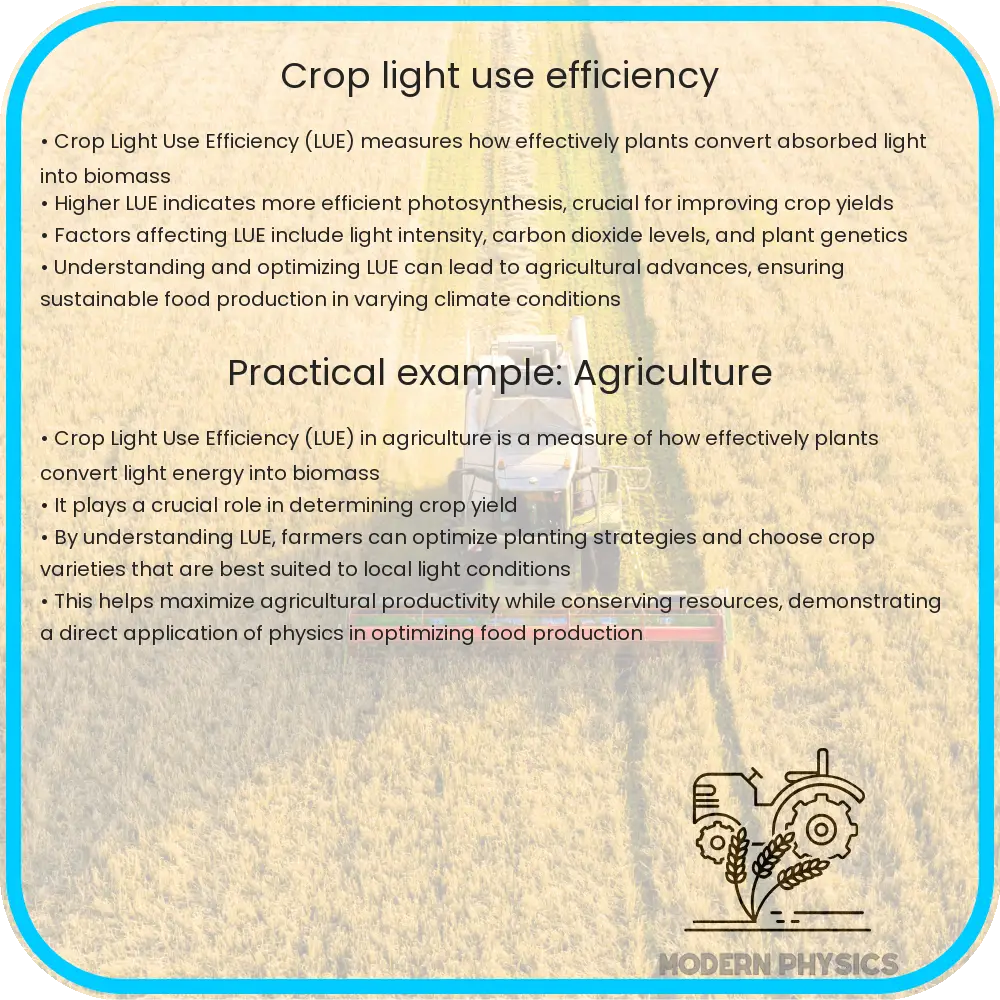
Understanding Crop Light Use Efficiency in Photosynthesis
Light Use Efficiency (LUE) is a critical scientific concept that helps us understand how crops utilize light to produce biomass through photosynthesis. Photosynthesis is the process by which green plants, algae, and some bacteria convert light energy, usually from the sun, into chemical energy stored in molecules like glucose. This process is not only fundamental to the existence of plants but also pivotal in sustaining the Earth’s ecosystems by serving as a primary productivity pathway and a key component in the global carbon cycle.
Photosynthesis Basics
Photosynthesis can be simplified into a two-stage process involving light-dependent reactions and light-independent reactions, also known as the Calvin Cycle. In the light-dependent reactions, sunlight is converted into ATP (adenosine triphosphate) and NADPH (nicotinamide adenine dinucleotide phosphate), which are energy-rich molecules. These reactions take place in the thylakoids of chloroplasts where chlorophyll pigments absorb light, hence initiating a sequence of energy transformations.
The light-independent reactions, on the other hand, do not require light directly. Instead, they use the ATP and NADPH generated during the light-dependent stages to convert atmospheric carbon dioxide (CO2) into glucose. This stage occurs in the stroma of the chloroplasts.
The Concept of Light Use Efficiency
Light Use Efficiency (LUE) is defined as the efficiency with which plants use the absorbed light to convert CO2 into organic matter, essentially measuring how well a plant converts electromagnetic energy (light) into chemical energy (biomass). It is a critical metric for agronomists and environmental scientists who are evaluating or enhancing crop yields and assessing ecosystem productivity.
Factors Influencing LUE
- Light Intensity: Higher light levels can increase photosynthesis up to a certain point beyond which the rate levels off due to light saturation.
- Light Quality: The spectrum of light can significantly affect LUE. Chlorophyll absorbs mostly blue and red light; thus, light within these wavelengths will promote higher LUE.
- CO2 Concentration: Increased levels of CO2 can enhance the rate of the light-independent reactions, leading to greater biomass production.
- Temperature: Each plant species has an optimal temperature range for photosynthesis. Deviations from this range can reduce enzymatic activities, thereby decreasing LUE.
- Water Availability: Water stress can reduce the photosynthetic efficiency of crops by causing the closure of stomata, which decreases CO2 uptake.
Calculating LUE
The mathematical representation of LUE can be expressed as:
LUE = (ΔBiomass / ΔTime) / (Absorbed Photosynthetically Active Radiation)
Here, ΔBiomass refers to the increase in biomass over a given period, and Absorbed Photosynthetically Active Radiation represents the amount of light energy (in the 400 to 700 nm wavelength range) absorbed by a crop during the same period.
Understanding and optimizing LUE is crucial for enhancing agricultural productivity and managing natural resources effectively. In the context of global challenges like climate change and food security, improving LUE through genetic, agronomic, or technological means is a vital area of research. This enhancement could lead to greater crop yields without requiring additional agricultural inputs such as water or fertilizers, which are often limited or have significant environmental impacts.
Enhancing Light Use Efficiency
Several practical approaches can be taken to enhance LUE in crops, offering potential solutions to increase agricultural productivity sustainably:
- Genetic Modification: Scientists are working on developing crop varieties with genetically enhanced photosynthetic pathways to improve LUE. By altering the genetic makeup responsible for photosynthesis, crops can harness light more efficiently.
- Agronomic Practices: Proper field management, including optimal planting density, accurate irrigation schedules, and nutrient management, can significantly influence LUE.
- Controlled Environment Agriculture (CEA): CEA technologies like greenhouses and vertical farms allow for the manipulation of light, temperature, and CO2 levels, optimizing these conditions to maximize LUE.
- Advanced Materials: Utilizing reflective mulches or films can alter the light environment of crops, increasing the amount of light available for photosynthesis and potentially improving LUE.
Real-World Applications and Future Directions
In addition to enhancing crop yields, understanding and applying principles of LUE extend to various fields including ecology, where it explains productivity in different ecosystems, and climate science, as it correlates with carbon sequestration. With increasing technological advancements, LUE can also contribute to bioengineering fields, where researchers are exploring artificial photosynthesis systems to generate energy or produce biofuels.
The ongoing research and innovations in enhancing LUE promise not only improved agricultural efficiency but also environmental preservation by reducing dependency on chemical inputs and contributing to carbon neutrality. As global populations rise and climate patterns shift, the importance of maximizing LUE in both natural and controlled environments will undoubtedly continue to grow.
Conclusion
Light Use Efficiency is a cornerstone concept in understanding the intricate process of photosynthesis and its impact on ecosystem productivity and crop yields. By delving into the mechanics of photosynthetically active radiation and its conversion into biomass, researchers are unraveling methods to bolster agricultural yield sustainably. Enhancing LUE paves the way for innovative agricultural practices that could potentially revolutionize food production systems worldwide. The cumulative benefits of improved LUE stretch beyond agriculture, impacting ecological stability and contributing to climate change mitigation. Ultimately, the study and optimization of Light Use Efficiency stand as a testament to the convergence of biology, technology, and environmental science, aiming to foster a sustainable future for all.