
Learn how crop canopy reflectance technology impacts precision farming by monitoring plant health through light absorption and reflection patterns.
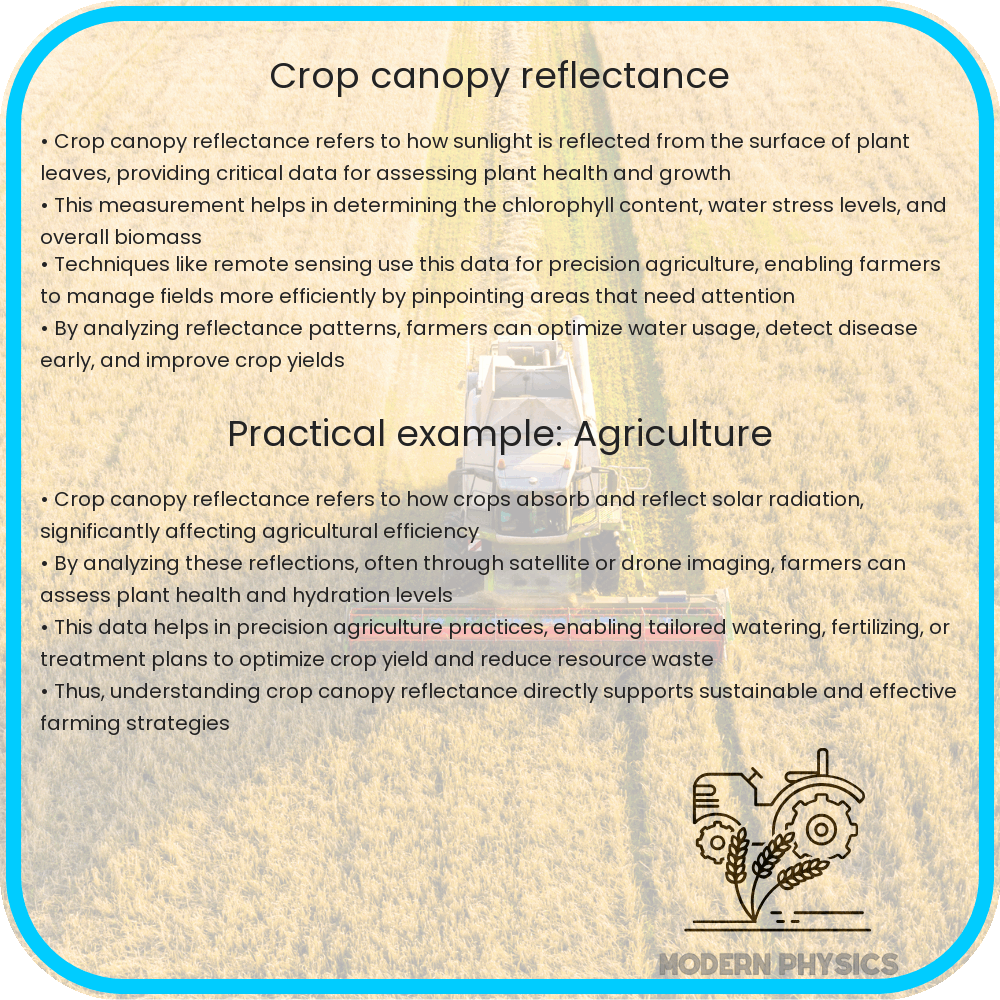
Understanding Crop Canopy Reflectance in Precision Farming
In the world of precision agriculture, the health and yield of crops are monitored and managed with incredible accuracy and efficiency. One of the key technologies enabling this precision is the analysis of crop canopy reflectance. This method involves understanding how different wavelengths of light are absorbed and reflected by the crop canopy, which consists of the upper layer of crop leaves and stems.
The Science Behind Crop Canopy Reflectance
Crop canopy reflectance is based on the principle that healthy plants reflect light differently than stressed or diseased plants. By using sensors mounted on satellites, drones, or ground-based equipment, farmers can collect data on light reflectance in various spectral bands. This data is then used to infer the health and vigor of the crops.
The most commonly analyzed spectral bands are:
- Visible light (400-700 nm)
- Near-infrared (NIR) light (700-1100 nm)
- Shortwave infrared (SWIR) light (1100-2500 nm)
The ratio of light reflected in the near-infrared band to that in the visible band is a key indicator of plant health. Healthy, vigorous plants absorb most of the visible light (used for photosynthesis) and reflect a larger portion of the near-infrared light. This difference in absorption and reflection patterns is captured as a vegetative index, most commonly the Normalized Difference Vegetation Index (NDVI).
The NDVI is calculated using the formula:
\[ NDVI = \frac{(NIR – Red)}{(NIR + Red)} \]
Where NIR is the reflectance in the near-infrared band and Red is the reflectance in the visible red band. An NDVI value close to +1 indicates high reflectance in the NIR (characteristic of healthy vegetation), while values close to zero or negative values may indicate stressed or unhealthy vegetation.
Applications in Crop Management
By analyzing crop canopy reflectance data, farmers can make more informed decisions about irrigation, pesticide application, and harvesting, leading to more efficient farm management. For example:
- Irrigation management: Areas of a field that show lower NDVI values may be under-watered and can be targeted for increased irrigation.
- Disease and pest control: Unexpected changes in reflectance patterns can indicate disease or pest infestations, allowing for early detection and localized treatment.
- Yield optimization: By continuously monitoring crop health, farmers can predict yield with greater accuracy and adjust farming practices to enhance production.
The precision and efficiency brought by analyzing crop reflectance not only help in increasing the yield but also in reducing the environmental footprint by minimizing the use of water, fertilizers, and pesticides.
Technological Advances and Future Prospects
With the advancement of technology, the tools and methods used in measuring and analyzing crop reflectance are becoming more sophisticated. Innovations like higher resolution sensors, machine learning algorithms, and improved data analysis software are making it easier and more cost-effective for farmers to implement precision farming practices.
Machine learning models are particularly promising, as they can analyze complex data from multiple sources to provide more accurate diagnostics and predictions. These models learn from vast datasets of reflectance patterns and can correlate them with specific crop conditions or potential yields, leading to insights that were not previously possible.
As we continue to advance our understanding and technology, the potential for precision agriculture to revolutionize farming practices grows ever larger. The improved accuracy in monitoring and managing crop health not only boosts productivity but also ensures sustainable agricultural practices that benefit both farmers and the environment.
Challenges and Considerations
Despite the significant advancements in technology and its applications in precision farming, there are several challenges that must be addressed. One major issue is the initial cost of acquiring and setting up advanced sensor systems and drones. Small-scale farmers, in particular, may find it difficult to invest in such high-end technology without assurance of a quick return on investment.
Furthermore, the interpretation of data collected through these technologies requires specialized knowledge and skills. Farmers and agricultural workers need training to understand and effectively make decisions based on the data from crop reflectance. There is also the challenge of data overload, where the sheer volume of information available becomes overwhelming and difficult to manage without proper tools.
Environmental factors such as cloud cover can also affect the accuracy of satellite images, leading to potential inaccuracies in NDVI readings and other vegetative indices. This necessitates the need for robust algorithms that can account for such discrepancies and still provide reliable data.
Conclusion
The integration of crop canopy reflectance in precision farming significantly enhances the ability to monitor and manage crop health and yield with unprecedented precision. Through the use of advanced sensors, farmers can visualize the health of their crops in real-time, enabling informed decision-making that leads to efficient use of resources and optimized outputs.
As we move forward, the blend of evolving technology and innovative agricultural practices promises to further empower farmers and enhance the sustainability of farming operations worldwide. By overcoming the challenges associated with implementation and data management, precision agriculture could well become the standard practice, contributing both to environmental preservation and food security. The future of farming lies in the strategic use of technology to ensure that crop production is not only economically viable but also environmentally responsible.