
Explore the intriguing world of critical phenomena in thermodynamics, uncovering the secrets of phase transitions and their wide-ranging applications.
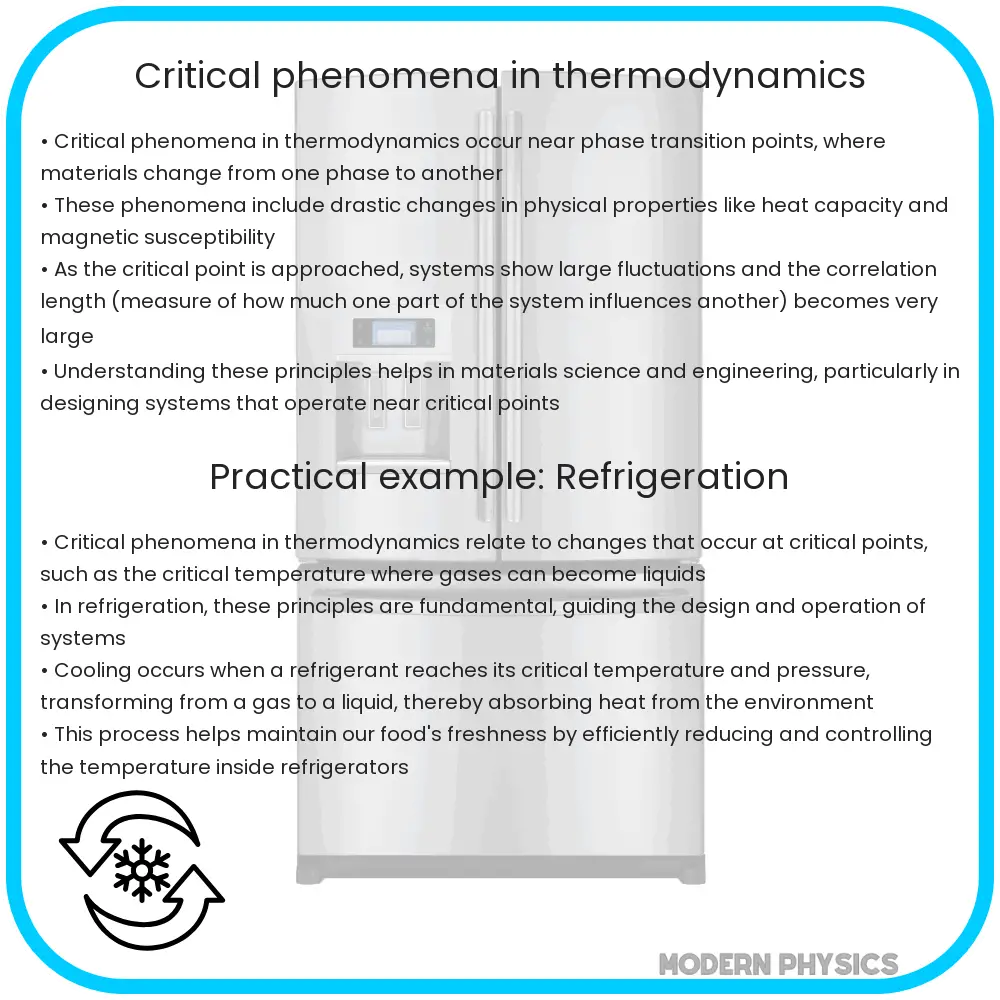
Understanding Critical Phenomena in Thermodynamics
Thermodynamics, a fundamental branch of physics and chemistry, is pivotal in understanding the behavior of systems at various temperatures and pressures. A key aspect of this field is the study of critical phenomena, which occur at the critical point of a substance, where there is no distinction between its liquid and gas phases. This concept not only enriches our theoretical understanding but also has practical implications in various industries.
The Critical Point: A Unique State of Matter
At the critical point, substances exhibit unique properties. For example, water (H2O) reaches its critical point at approximately 647 K (374 °C) and 22.064 MPa (3200 psi). Here, its liquid and gas phases become indistinguishable, forming a single fluid phase known as a supercritical fluid. This state is characterized by unusual properties, like a density similar to liquids and the viscosity of gases, making it useful in various applications like supercritical fluid extraction.
Phenomena Near the Critical Point
As a substance approaches its critical point, several phenomena become evident. One of the most notable is critical opalescence, a phenomenon where the fluid becomes opaque due to fluctuations in density. This occurs because the correlation length of density fluctuations becomes comparable to the wavelength of light, scattering it in all directions. Additionally, properties like heat capacity, compressibility, and thermal expansion coefficient tend to diverge, showing an infinite response to small changes in temperature or pressure.
The Role of Scaling Laws
In the realm of critical phenomena, scaling laws play a crucial role. These laws describe how physical quantities change near the critical point. For instance, the scaling law for correlation length, ξ, can be expressed as ξ ∝ |T – Tc|-ν, where T is the temperature, Tc is the critical temperature, and ν is a critical exponent. These laws help in understanding the universality class of the system, a concept indicating that different systems can exhibit similar behavior near their critical points.
Applications of Critical Phenomena
The study of critical phenomena has far-reaching applications. In industrial processes, understanding these phenomena is crucial for designing efficient separation processes, such as distillation or supercritical fluid extraction. Additionally, the principles of critical phenomena are applied in material science for the synthesis of novel materials with tailored properties.
Exploring Phase Transitions and Critical Phenomena
Phase transitions near the critical point offer a rich field of study. A phase transition is a change of a substance from one state of matter to another, like from a liquid to a gas. Near the critical point, these transitions become continuous, known as second-order or continuous transitions. In this regime, the latent heat, which is the heat absorbed or released during a phase change, approaches zero, marking a distinct contrast from the first-order transitions where latent heat is significant.
Renormalization Group Theory
A breakthrough in understanding critical phenomena came with the development of the Renormalization Group (RG) theory. This theoretical framework explains how the properties of a system change as one zooms out to view the system at larger and larger scales. RG theory has not only deepened our understanding of critical phenomena but also provided insights into quantum field theory and the statistical mechanics of phase transitions.
Experimental Studies and Simulation
Experimental studies of critical phenomena involve precise measurements of physical properties like specific heat, magnetic susceptibility, or opacity near the critical point. These experiments are often challenging due to the extreme conditions and the sensitivity of the measurements. In recent years, computer simulations have become an invaluable tool, allowing scientists to model and study complex systems under critical conditions, offering insights that are often difficult to obtain experimentally.
Implications in Other Fields
The concepts of critical phenomena have found relevance in fields beyond traditional thermodynamics. In economics, the idea of a critical point helps in understanding market behavior under stress. In biology, the study of criticality is contributing to our understanding of brain function and neural networks.
Conclusion
The study of critical phenomena in thermodynamics is a testament to the interconnectedness of various scientific disciplines. It not only enhances our comprehension of the fundamental principles governing phase transitions and critical behavior but also serves as a bridge to applications in diverse fields. As research continues, the insights gained from critical phenomena are likely to lead to new technologies and deeper understanding in both physical sciences and beyond. This fascinating area remains a vibrant topic of research, promising to unveil further mysteries of nature and its governing laws.