
Explore the groundbreaking discovery of the CP-even Higgs boson, its pivotal role in particle physics, and its vast implications for astrophysics and our universe.
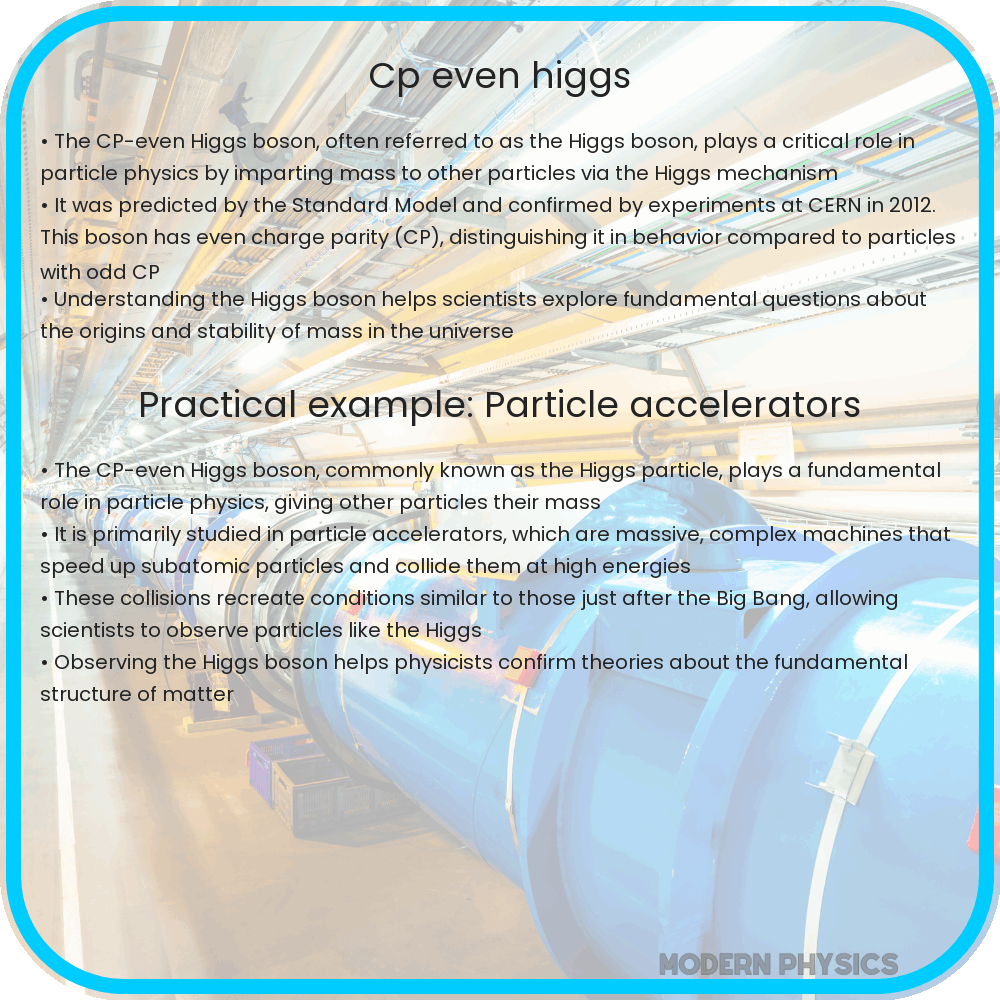
Discovery of the CP-even Higgs Boson
The discovery of the CP-even Higgs Boson represents a landmark achievement in the field of particle physics and astrophysics. The elusive particle, often referred to simply as the Higgs boson, was theorized in 1964 by Peter Higgs and other physicists. However, it was not until 2012 that scientists at CERN’s Large Hadron Collider (LHC) near Geneva confirmed its existence, marking a monumental milestone in our understanding of the fundamental structure of the universe.
The Higgs boson is a pivotal component of the Standard Model of particle physics, which serves as the theoretical framework describing the fundamental particles and forces. The significance of the Higgs boson lies in its unique role: it is responsible for giving mass to elementary particles through the Higgs mechanism, a process that imbues particles with mass as they interact with the Higgs field, a ubiquitous energy field present throughout the universe.
Impact on Astrophysics
The confirmation of the Higgs boson has profound implications for astrophysics. By validating the Higgs mechanism, scientists can now provide a more complete explanation for the mass of particles, an essential factor in understanding the formation and evolution of the universe. This discovery has also paved the way for new research into dark matter, the mysterious substance that makes up a significant portion of the universe’s mass but does not emit, absorb, or reflect light.
Furthermore, the study of the Higgs boson and its properties has contributed to our knowledge of the early universe, particularly during the first fractions of a second after the Big Bang. Understanding the behavior of the Higgs field during this period is crucial for explaining why the universe is composed predominantly of matter rather than antimatter, a phenomenon known as baryon asymmetry.
Despite its significant impact, the discovery of the CP-even Higgs Boson also raises new questions and challenges in the field, prompting further investigations and experiments to explore the full scope of its implications for astrophysics and beyond.
Discovery of CP-Even Higgs
The discovery of the CP-Even Higgs boson marks a pivotal moment in the field of particle physics and astrophysics. CP stands for Charge Parity, a symmetry between particles and antiparticles involving their charges and spatial coordinates. The CP-Even Higgs, a specific manifestation of the Higgs boson, adheres to this symmetry. Its discovery at the Large Hadron Collider (LHC) by the ATLAS and CMS collaborations in 2012 confirmed a fundamental piece of the Standard Model of particle physics, which provides a framework for understanding the fundamental forces and particles in the universe.
Impact on Astrophysics and Particle Physics
The discovery of the CP-Even Higgs boson has profound implications for both astrophysics and particle physics. It plays a critical role in our understanding of the early universe and the mechanisms that led to the formation of matter as we know it. By giving mass to elementary particles through the Higgs mechanism, the CP-Even Higgs boson has been central to theories explaining mass and energy distribution in the cosmos, impacting models of cosmic inflation and dark matter.
Theory Behind CP-Even Higgs
The theoretical framework behind the CP-Even Higgs involves the Higgs field, an energy field that permeates the universe. According to the Standard Model, particles acquire mass when they interact with this field. The CP-Even Higgs boson is a quantum excitation of this field and respects charge-parity symmetry, meaning its properties do not change if a particle is replaced by its antiparticle and vice versa, while also inverting spatial coordinates. This symmetry makes the CP-Even Higgs distinct from other possible forms that could break this balance, leading to new physics beyond the Standard Model.
Conclusion
The discovery and study of the CP-Even Higgs boson continue to enlighten our understanding of the universe. By confirming the existence of the Higgs field and its mechanism of giving mass to particles, this discovery has cemented the Standard Model’s role as the cornerstone of modern particle physics. However, the journey does not end here. The CP-Even Higgs opens new avenues for research, challenging scientists to delve deeper into the mysteries of the cosmos, investigate the origins of the universe, and explore the possibilities of new physics beyond the Standard Model. As research progresses, the CP-Even Higgs promises to remain at the forefront of astrophysical and particle physics investigations, potentially unlocking further secrets of our universe.