
Explore the mysteries of the cosmological horizon, the limits of the observable universe, and the implications of its expansion on our understanding of cosmos.
Exploring the Cosmological Horizon: The Boundary of the Observable Universe
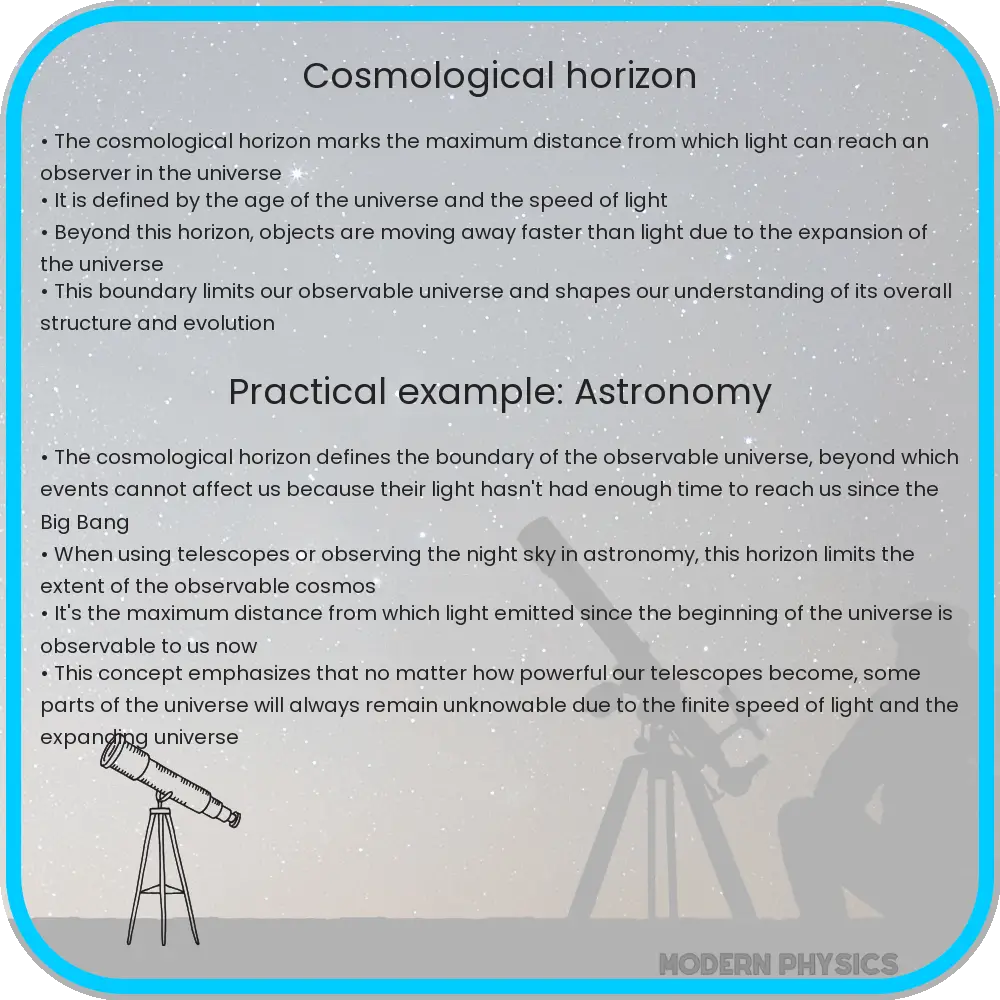
The concept of the cosmological horizon is central to our understanding of the universe’s structure and its evolution. This invisible boundary delineates the observable universe, defining the limit beyond which light has not had enough time to reach us since the Big Bang. As the universe expands, so too does this horizon, constantly extending the realms of our cosmic visibility.
The Mystery of the Universe’s Expansion
The expansion of the universe is described by the Hubble Law, which posits that galaxies are moving away from us at speeds proportional to their distance. This expansion leads to the redshift of light, a phenomenon where light stretches into longer wavelengths as it travels through expanding space. The most distant galaxies we can observe are receding at speeds close to the speed of light, which delineates the edge of our observable universe, or the cosmological horizon.
Limits and Implications of the Cosmological Horizon
The cosmological horizon sets a limit not just on what we can currently observe, but also on the fundamental questions we can answer about the universe. Beyond this horizon, the universe remains a mystery, potentially filled with galaxies, stars, and phenomena that we cannot currently detect. The horizon’s existence raises questions about the shape, size, and ultimate fate of the entire cosmos, influencing theories ranging from the Big Bang to cosmic inflation.
- Observable Universe: The region of space from which light has had time to reach us since the beginning of the universe.
- Expansion of Space: The increase in distance between two points in the universe over time, a concept central to modern cosmology.
- Hubble’s Law: The observation that the speed at which galaxies recede from us is proportional to their distance, leading to the expanding universe model.
Understanding the cosmological horizon not only expands our knowledge of the cosmos but also underscores the vastness and the dynamic nature of the universe. As technology advances, so too will our ability to probe further beyond this horizon, opening new windows into the mysteries of the cosmos.
Advancements and Challenges in Cosmic Observation
As we delve deeper into the mysteries of the universe, advancements in technology play a crucial role in extending our observational capabilities. Telescopes, both ground-based and in space, have become increasingly powerful, allowing astronomers to detect light from galaxies at the edge of our observable universe. These observations help scientists understand the cosmic microwave background radiation, providing insights into the universe’s infancy and its subsequent expansion.
Despite these technological advancements, the cosmological horizon presents a fundamental challenge: it marks the boundary beyond which the universe remains unknowable, at least with current technologies. The light from beyond this horizon has not yet had time to reach us due to the finite speed of light and the continuous expansion of the universe. This limitation not only restricts our view but also our understanding of the universe’s full scale and structure.
Theoretical Implications and Future Prospects
The concept of the cosmological horizon has profound implications for theoretical physics and cosmology. It challenges scientists to ponder what lies beyond and to develop new theories and models that can describe the entirety of the cosmos. Ideas such as the multiverse theory and the concept of an infinite universe have emerged from these contemplations, pushing the boundaries of traditional cosmology.
Future missions, such as the James Webb Space Telescope and other next-generation observatories, promise to push the boundaries of our observable universe even further. These advancements may one day allow us to observe light from the very edge of the cosmological horizon or even glimpse signals from beyond, offering new insights into the nature of space, time, and the ultimate fate of the cosmos.
Conclusion
The cosmological horizon serves as a reminder of the vastness and the inherent mysteries of the universe. It defines the scope of our observable reality while simultaneously hinting at the unobservable, challenging our understanding of the cosmos. As we continue to explore and understand the universe within this horizon, we also push the limits of our knowledge, technology, and imagination. The journey to understand the universe is as much about pushing these boundaries as it is about the discoveries we make along the way. As we stand on the precipice of the known, the cosmological horizon beckons, inviting us to question, explore, and dream about the infinite mysteries lying beyond our current reach.