
Explore the mysteries of cosmic voids, the largest structures in the universe, their formation, impact in astrophysics, and the challenges in studying these vast spaces.
Cosmic Void: Unveiling the Enigmatic Spaces of the Universe
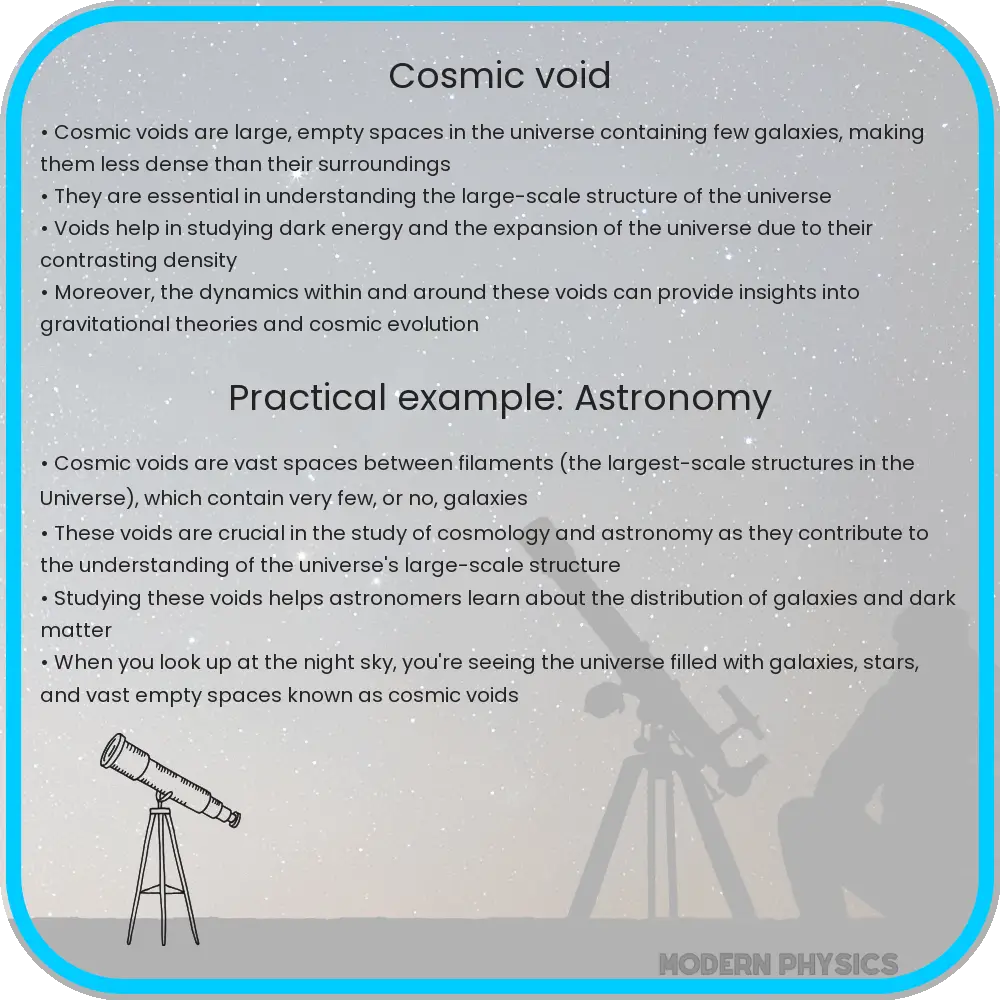
In the vast expanses of the universe, cosmic voids present one of the most enigmatic phenomena in astrophysics. These immense, nearly empty spaces, punctuate the cosmic landscape, contrasting starkly with the densely packed galaxies and galactic clusters. Understanding cosmic voids is crucial for unraveling the mysteries of the universe’s structure and evolution.
Understanding Cosmic Voids
Cosmic voids are vast regions in the universe where the density of matter is significantly lower than the average. They can span anywhere from 10 to 500 million light-years across, making them the largest structures in the universe. Despite their size, they contain very few galaxies, leading to their characterization as “voids. The boundaries of cosmic voids are not sharply defined, gradually transitioning into filaments and walls composed of galaxies and dark matter.
Formation of Cosmic Voids
The formation of cosmic voids is intricately linked to the early universe’s conditions and the cosmic web’s evolution. According to popular theories, voids form as a result of fluctuations in the density of matter shortly after the Big Bang. These fluctuations, magnified by the universe’s expansion, led to regions where gravity was insufficient to overcome the expansion, resulting in the vast empty spaces we observe today.
Impact in Astrophysics
The significance of cosmic voids extends beyond their sheer size. They play a critical role in cosmology and astrophysics, particularly in the study of dark energy and the large-scale structure of the universe. Voids can serve as natural laboratories for studying the properties of dark energy, as their expansion rates may differ from the rest of the universe. Additionally, the shape and distribution of voids can provide valuable insights into the nature of dark matter and the early universe’s conditions.
The study of cosmic voids also challenges our understanding of gravity and the cosmological principle, which posits that the universe is homogeneous and isotropic on large scales. The existence and characteristics of voids test this principle, offering clues about the universe’s overall geometry and expansion.
Research and Exploration of Cosmic Voids
Researchers utilize a variety of astronomical surveys and techniques to identify and study cosmic voids. These include redshift surveys, which map the distribution of galaxies and voids across the universe, and cosmic microwave background (CMB) studies, which can reveal fluctuations in temperature that correspond to early density variations. By analyzing the data from these surveys, scientists can better understand the size, distribution, and density profiles of cosmic voids.
Challenges in Void Analysis
Despite advances in technology and methodology, studying cosmic voids presents significant challenges. Their vast size and the sparse distribution of matter within them make it difficult to obtain accurate measurements. Additionally, the boundaries of voids are often ill-defined, complicating their identification and classification. Researchers must also contend with observational biases and limitations, such as the zone of avoidance, where dust and stars in the Milky Way obscure our view of distant cosmic structures.
The Future of Void Studies
As astronomical surveys become more extensive and sensitive, our understanding of cosmic voids is expected to deepen. Future missions and telescopes, such as the Euclid satellite and the Large Synoptic Survey Telescope (LSST), promise to provide more detailed maps of the cosmos, revealing new insights into the nature and evolution of voids. These advancements may unlock answers to fundamental questions about the universe’s expansion, the nature of dark energy, and the ultimate fate of the cosmos.
Conclusion
Cosmic voids, with their vast emptiness and mysterious nature, continue to captivate astronomers and cosmologists. Their study not only sheds light on the largest structures in the universe but also offers critical insights into the fundamental laws governing the cosmos. As we delve deeper into the mysteries of cosmic voids, we inch closer to understanding the grand tapestry of the universe, from the smallest particles to the largest cosmic structures. The exploration of these enigmatic spaces remains a frontier in astrophysics, promising to reveal secrets of our universe that are as vast and profound as the voids themselves.