
Explore the Cosmic Censorship Hypothesis in theoretical physics, delving into debates, evidence, and its impact on our understanding of black holes and cosmology.
The Cosmic Censorship Hypothesis: Unveiling the Universe’s Safeguards
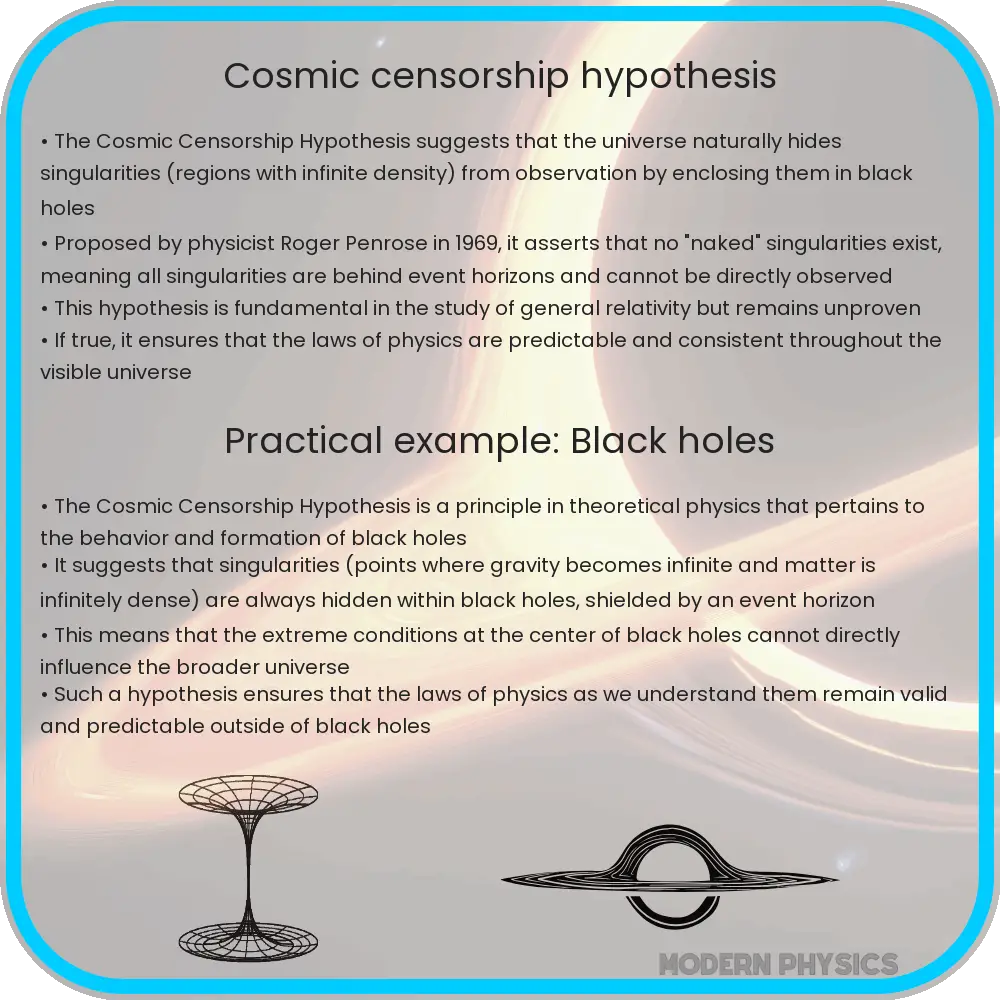
The Cosmic Censorship Hypothesis (CCH) stands as a cornerstone in the realm of theoretical physics, particularly within the study of black holes and singularities. Proposed by Roger Penrose in 1969, the hypothesis suggests a form of cosmic censorship that prevents the exposure of “naked singularities” to the outside universe. In the context of general relativity, a singularity is a point in space-time where matter is infinitely dense and the laws of physics as we know them cease to function.
There are two primary versions of the hypothesis: the weak and the strong cosmic censorship. The weak cosmic censorship hypothesis posits that singularities produced by the gravitational collapse of a star are always hidden within an event horizon; hence, they are not visible to distant observers and do not influence the universe beyond the black hole’s confines. Conversely, the strong cosmic censorship hypothesis extends this concept, asserting that the laws of physics are predictable everywhere except at singularities, which are not just hidden but also encapsulated in such a way that their effects cannot extend to the external universe.
Debates and Controversies Surrounding CCH
The Cosmic Censorship Hypothesis has sparked considerable debate within the scientific community. One of the main points of contention is the lack of a rigorous mathematical proof supporting the hypothesis. Despite numerous attempts, the hypothesis remains unproven, leading to varied speculative theories and mathematical models. Critics argue that without concrete evidence, the hypothesis might not fully account for all aspects of the universe’s behavior, particularly under extreme conditions such as those existing inside a black hole.
Supporters of the hypothesis, however, contend that it is essential for the consistency of general relativity and the predictability of physical laws. They argue that the hypothesis acts as a safeguard for the deterministic nature of the universe, ensuring that singularities, with their undefined properties and behaviors, do not expose their irregularities to the external universe, thus maintaining the integrity of physical law.
The debate over the Cosmic Censorship Hypothesis is not merely academic; it has significant implications for our understanding of the universe. If the hypothesis is valid, it supports the notion that the universe is a well-ordered and predictable system, governed by consistent laws even under the most extreme conditions. If invalidated, it could mean that singularities could, under certain conditions, influence the broader universe, leading to unpredictable and potentially unsettling consequences.
Evidence and Implications in Modern Cosmology
The quest for evidence supporting the Cosmic Censorship Hypothesis has intertwined with advances in cosmology and astrophysics. Observational evidence remains elusive due to the inherent challenges in studying regions near black holes and singularities. However, numerical simulations and theoretical models have provided insights, albeit indirect, into the nature of gravitational collapse and singularity formation. These studies often explore the dynamics of black holes and the behavior of matter under extreme gravitational forces, seeking to uncover conditions that could lead to the formation of naked singularities.
Further complicating the search for evidence is the advent of quantum gravity theories, such as string theory and loop quantum gravity. These frameworks propose different scenarios for the fate of singularities and could potentially offer alternative resolutions to the problems addressed by the Cosmic Censorship Hypothesis. For example, some quantum gravity models suggest that singularities might be resolved into more fundamental structures, avoiding the issues of infinite density and space-time breakdown.
The implications of the Cosmic Censorship Hypothesis extend beyond the realm of theoretical physics. They touch on philosophical questions about the nature of the universe, determinism, and the limits of scientific knowledge. If the universe indeed censors its own singularities, it suggests a certain robustness in the fabric of space-time and the laws governing it. On the other hand, the existence of naked singularities would challenge our understanding of the cosmos, indicating that there are phenomena beyond the reach of our current scientific paradigms.
Conclusion
The Cosmic Censorship Hypothesis remains one of the most intriguing and debated concepts in modern theoretical physics. While it serves as a crucial element in the stability of general relativity and the predictability of the cosmos, its true nature remains shrouded in mystery. As research continues, both in theoretical frameworks and observational astronomy, the hypothesis stands as a testament to our quest for understanding the most extreme conditions in the universe. Whether it will be proven, modified, or refuted, the journey towards unraveling the secrets of cosmic censorship will undoubtedly contribute profound insights into the fabric of the cosmos and the laws that govern it.