
Explore Conformal Gravity: a theoretical physics approach offering new insights into gravity, dark matter, and the universe’s mysteries.
Understanding Conformal Gravity
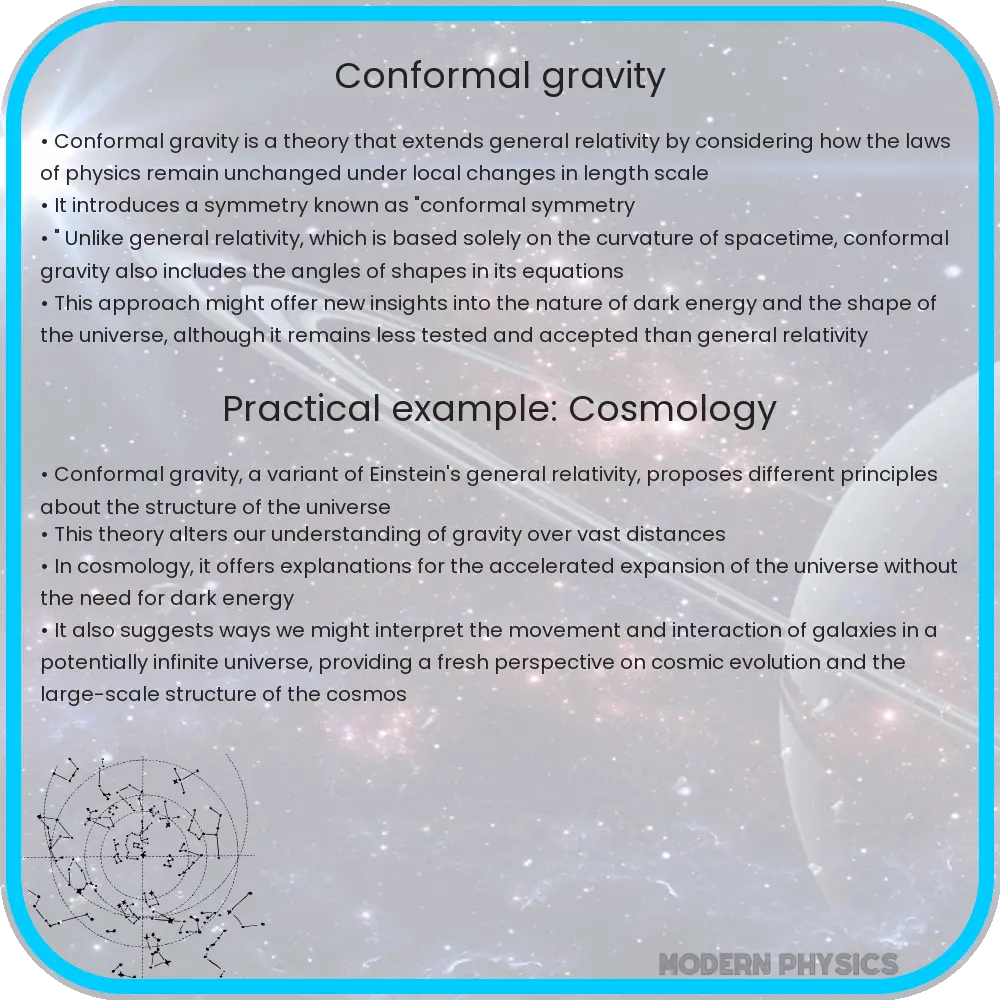
Conformal Gravity is a captivating field in theoretical physics, proposing a modification to Einstein’s General Relativity. This theory, developed in part to address certain cosmological puzzles, introduces a unique approach to the fabric of spacetime, potentially providing insights into the elusive dark matter and dark energy phenomena.
Quantum Insights in Conformal Gravity
At the heart of Conformal Gravity lies the principle of conformal invariance – the idea that the laws of physics remain unchanged under local transformations of spacetime metrics. This principle, deeply rooted in quantum field theory, suggests that at a fundamental level, distances and scales might not be absolute, but relative. By adopting this view, Conformal Gravity allows for a novel interpretation of gravitational interactions at quantum scales.
Models and Theoretical Framework
The mathematical foundation of Conformal Gravity is built upon an alternative action principle, differing from the Einstein-Hilbert action that forms the core of General Relativity. The key equation, known as the Weyl action, incorporates higher-order curvature terms, which are crucial for conformal invariance. This leads to field equations that are fourth-order differential equations, as opposed to the second-order equations in General Relativity. Such equations offer new solutions for the structure of spacetime, potentially resolving singularities like those found in black holes.
Experimental Tests and Observational Evidence
Testing the predictions of Conformal Gravity is a challenging yet essential aspect of validating the theory. Observational evidence plays a critical role in this context. For instance, the rotation curves of galaxies, which deviate from the predictions of Newtonian dynamics, could be explained by Conformal Gravity without invoking dark matter. Additionally, the theory’s potential to account for the accelerated expansion of the universe, typically attributed to dark energy, offers a unified framework for understanding these cosmic mysteries.
Moreover, precision tests in the solar system, such as the precession of Mercury’s orbit and the bending of light by the sun, provide critical benchmarks. Conformal Gravity must not only reproduce the successful predictions of General Relativity in these regimes but also offer novel predictions that can be empirically tested.
Advancements in observational technology, such as more precise telescopes and detectors, are crucial in providing the data needed to test the predictions of Conformal Gravity. These developments promise exciting prospects for new discoveries and a deeper understanding of the universe’s structure and evolution.
Challenges and Future Directions
Despite its promising aspects, Conformal Gravity faces significant challenges. One of the main hurdles is the complexity of its mathematical structure. The fourth-order differential equations that underpin the theory are notoriously difficult to solve, posing a challenge for theorists. Additionally, the theory must convincingly integrate with the Standard Model of particle physics, which is an area of ongoing research.
Another critical challenge is the necessity for more precise observational data to distinguish Conformal Gravity’s predictions from those of General Relativity and other alternative theories. This requires not only advancements in astronomical instruments but also a deeper theoretical understanding of the implications of Conformal Gravity in various astrophysical contexts.
Implications for Understanding the Universe
Conformal Gravity, if proven valid, could radically alter our understanding of the universe. It has the potential to provide a more comprehensive framework for understanding gravitational phenomena, eliminating the need for dark matter and dark energy. This would simplify our cosmic inventory and offer a more unified picture of the universe.
Furthermore, the theory’s implications extend beyond astrophysics, potentially offering insights into the nature of time, space, and the early universe. For instance, Conformal Gravity’s approach to resolving spacetime singularities could shed light on the initial conditions of the Big Bang and the ultimate fate of black holes.
Conclusion
Conformal Gravity stands as a fascinating and potentially revolutionary approach in theoretical physics, challenging our conventional understanding of gravity and the universe. While it offers intriguing solutions to some of the most perplexing cosmic mysteries, it remains a theory in need of further validation through both theoretical refinement and empirical testing. The journey to unravel its secrets involves a blend of complex mathematics, astute theoretical insights, and cutting-edge observational techniques. As research in this field progresses, Conformal Gravity could either reshape our cosmic perspective or pave the way for new theories, maintaining the ever-evolving nature of our quest to understand the universe.