
Explore the quantum phenomenon of Color Transparency in QCD, its role in particle physics, and future research directions in this insightful article.
Understanding Color Transparency in Quantum Physics
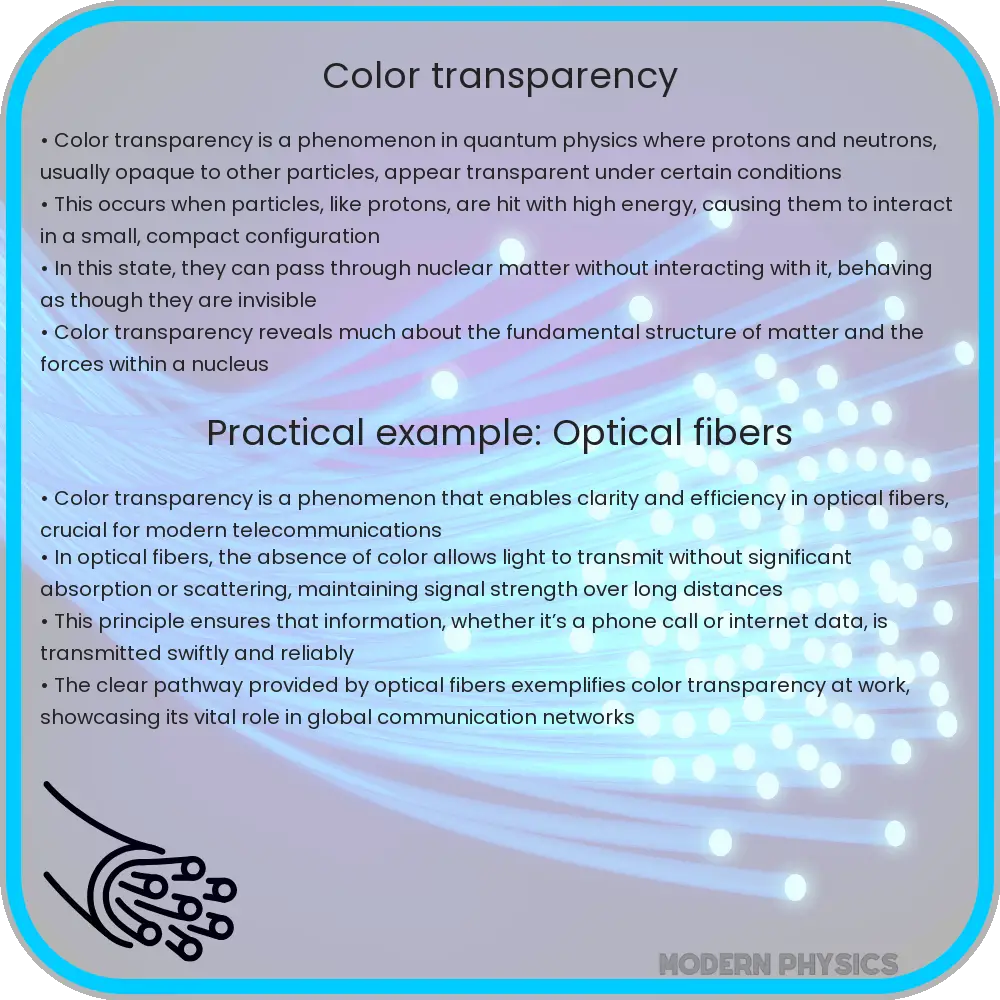
Color Transparency (CT) is a fascinating quantum phenomenon that has captivated the attention of physicists worldwide. It emerges within the realm of Quantum Chromodynamics (QCD), the theory describing the strong force, one of the four fundamental forces in the universe. This intriguing phenomenon occurs when hadrons, such as protons or neutrons, pass through nuclear matter with minimal interaction, appearing almost “transparent.
Probing the Quantum World: The Role of Color Transparency
Exploring CT provides a unique window into the quantum world, particularly in understanding the behavior of quarks and gluons, the fundamental particles constituting hadrons. Quarks are bound together by gluons through the strong force, characterized by a property known as “color charge. Unlike everyday color, this charge relates to how quarks interact within hadrons under QCD. In certain high-energy conditions, hadrons can traverse nuclear matter as if they were unaffected, showcasing CT.
Quantum Chromodynamics: The Backbone of Color Transparency
Quantum Chromodynamics (QCD) plays a pivotal role in explaining CT. It describes how quarks and gluons interact through the strong force. In QCD, the concept of “asymptotic freedom” is key, where quarks behave almost as free particles at high energies, leading to reduced interactions with surrounding matter. This forms the basis of CT, as hadrons under specific conditions can pass through nuclear media with minimal interaction, a counterintuitive phenomenon from a classical perspective.
Experimental Investigations and Challenges
The study of CT is not without its challenges. Experimentally observing this phenomenon requires sophisticated techniques and facilities like particle accelerators. Researchers use high-energy collisions to create conditions where CT can manifest. However, isolating and identifying CT from other background processes is complex, demanding precise measurements and advanced theoretical models to interpret the data accurately.
Understanding CT has significant implications in particle physics. It not only provides insights into the fundamental properties of matter at the quantum level but also tests the limits of QCD. Investigations into CT continue to push the boundaries of our knowledge, offering potential breakthroughs in the field of quantum physics and beyond.
Advancements in Color Transparency Research
Recent advancements in high-energy physics have significantly contributed to our understanding of Color Transparency (CT). Innovations in accelerator technology and particle detection methods have enabled experiments that were previously unfeasible. These advancements facilitate more precise observations of CT, allowing physicists to probe deeper into the nuances of Quantum Chromodynamics (QCD) and the behavior of quarks and gluons under extreme conditions.
Implications for Nuclear Physics and Beyond
The implications of CT extend beyond the realm of fundamental particle physics. Understanding how hadrons interact with nuclear matter under the influence of CT has potential applications in nuclear physics, including the development of more accurate models for nuclear interactions. Furthermore, it provides a unique perspective on the structure of hadrons, offering insights into the complex dynamics governed by the strong force.
Future Directions in Color Transparency Research
Looking forward, the field of CT research is ripe with potential. Future experiments, particularly at facilities like the Large Hadron Collider (LHC) or the upcoming Electron-Ion Collider (EIC), are expected to provide even more data to refine our understanding of CT. These experiments could unveil new aspects of QCD, possibly leading to the discovery of new phenomena or particles. Additionally, theoretical advancements in QCD could lead to a better conceptual understanding of CT, aiding in the interpretation of experimental data.
Conclusion
In summary, Color Transparency represents a crucial aspect of modern quantum physics, offering a window into the intricate workings of Quantum Chromodynamics. Through the phenomenon of CT, we gain valuable insights into the behavior of quarks and gluons, the fundamental constituents of matter. The continued exploration of CT not only deepens our understanding of the strong force but also challenges and enriches our comprehension of the quantum universe. As research in this field progresses, fueled by technological and theoretical advancements, we anticipate a new era of discoveries that will further unravel the mysteries of the quantum world.