
Explore the Color Glass Condensate in Quantum Chromodynamics: Understand gluon saturation, QCD theory, and breakthroughs in high-energy physics.
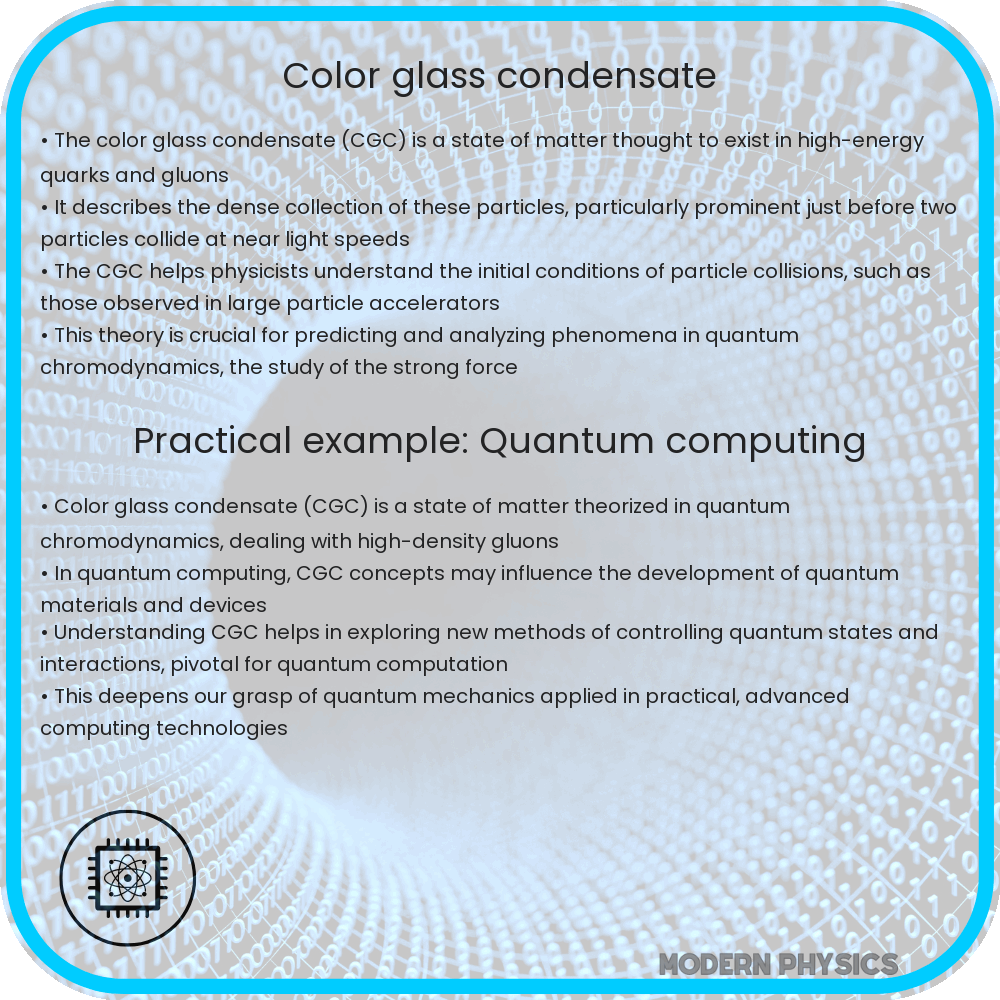
Understanding the Color Glass Condensate in Quantum Chromodynamics
The concept of the Color Glass Condensate (CGC) is an essential aspect of Quantum Chromodynamics (QCD), the theory describing the strong interaction within the framework of the Standard Model of particle physics. This phenomenon is particularly significant in high-energy physics, specifically in understanding the behavior of gluons, the force-carriers of the strong interaction, under extreme conditions. The CGC is a state of matter believed to be formed in the early moments of high-energy collisions, such as those involving heavy ions.
Gluon Saturation: The Heart of CGC
Gluon saturation is a key feature of the CGC. In simple terms, it occurs when the density of gluons in a nucleus becomes so high that their effects overlap, leading to a saturation effect. This situation is analogous to a crowded room where adding more people does not significantly increase the noise level because the room is already filled to capacity. In the context of QCD, when the gluon density reaches a critical threshold, further increases in energy or density do not lead to a proportional increase in the number of gluons. This saturation is a non-linear effect, fundamentally different from the linear behaviors observed in less extreme conditions.
Analysis and Experimental Observations
Experimental evidence for the CGC has been gathered from various particle accelerators around the world, including the Large Hadron Collider (LHC) at CERN and the Relativistic Heavy Ion Collider (RHIC) at Brookhaven National Laboratory. These experiments involve colliding heavy ions at near-light speeds, creating conditions similar to those just after the Big Bang. Observations from these experiments, such as the distribution of particles produced in the collisions, provide indirect evidence of gluon saturation and the formation of the CGC.
One of the main analytical tools in studying the CGC is the use of equations that describe the evolution of gluon densities. These equations, known as the JIMWLK (Jalilian-Marian, Iancu, McLerran, Weigert, Leonidov, and Kovner) equations, are a set of non-linear equations that model the dynamics of gluons under extreme conditions. They incorporate aspects of both classical and quantum physics, reflecting the complex nature of the interactions in the CGC state.
The study of the CGC is not only important for understanding the fundamental properties of matter under extreme conditions but also has broader implications for other areas of physics, including the early universe’s evolution and the nature of neutron stars.
Challenges and Advances in CGC Research
Despite significant progress, research into the Color Glass Condensate faces numerous challenges. One of the primary difficulties lies in the complexity of the calculations involved. The non-linear nature of the JIMWLK equations makes them computationally intensive, requiring sophisticated numerical methods and substantial computational resources. Additionally, interpreting experimental data from high-energy collisions is challenging due to the myriad of particles and interactions involved.
Future Directions and Applications
Looking ahead, the study of the CGC promises exciting developments. Advances in computational power and techniques are enabling more precise simulations and analyses. Furthermore, upcoming experiments and upgrades to existing particle accelerators, like the LHC, are expected to provide even more detailed data, potentially revealing new aspects of the CGC and gluon saturation. Researchers are also exploring the implications of CGC in astrophysical contexts, such as understanding the internal dynamics of neutron stars and the behavior of matter in the early universe.
Conclusion
The exploration of the Color Glass Condensate represents a cutting-edge frontier in particle physics, offering profound insights into the nature of the strong force and the behavior of matter under extreme conditions. The concept of gluon saturation central to the CGC challenges traditional understandings and opens up new avenues for research. The CGC is not just a theoretical construct but a tangible aspect of the quantum world, with experiments at major particle accelerators providing critical evidence for its existence. As technology and theoretical models continue to evolve, the study of the CGC will undoubtedly contribute significantly to our understanding of the universe and its fundamental forces.