
Explore the essentials of chromatography systems, covering their precision, efficiency, and analytical capabilities in separating complex mixtures for various scientific applications.
Understanding Chromatography Systems: Precision, Efficiency, and Analysis
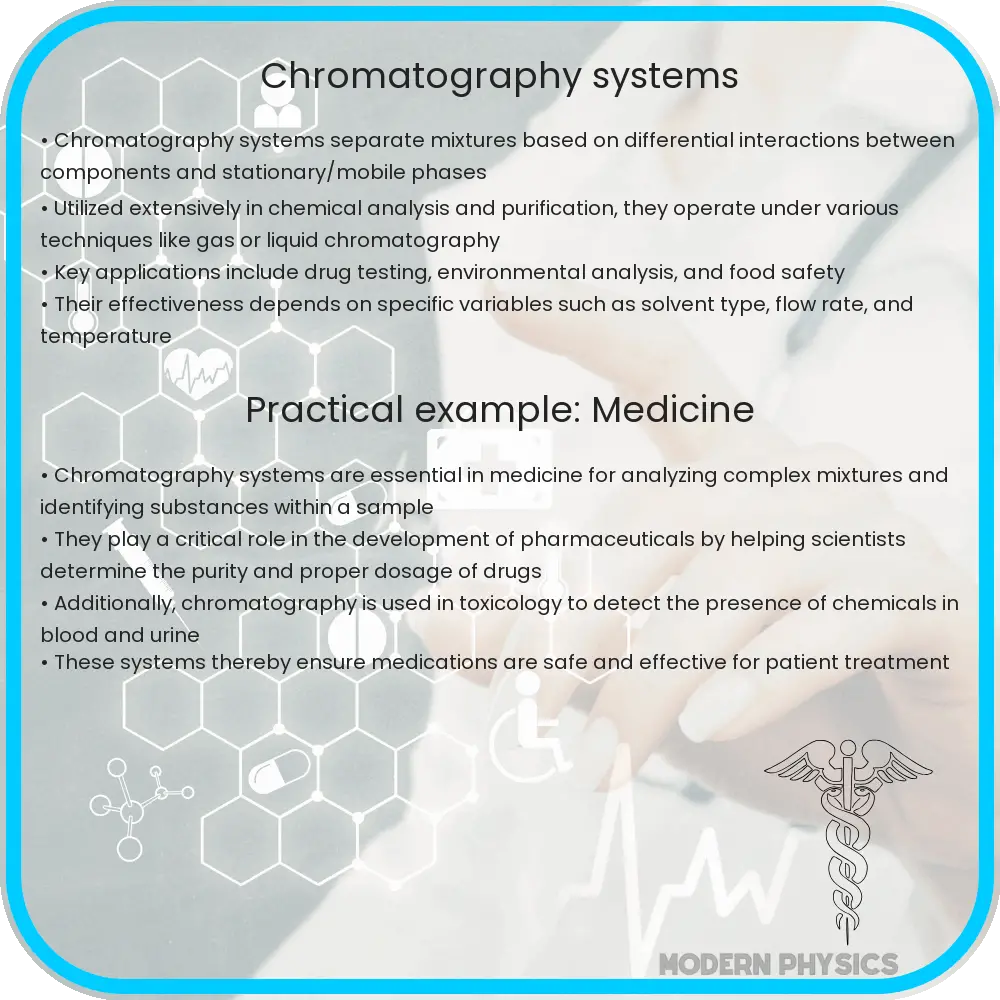
Chromatography systems are pivotal in the field of analytical chemistry, offering unmatched precision, efficiency, and detailed analysis of chemical mixtures. These systems enable the separation of different components within a mixture, allowing for in-depth study and identification of substances. Their application spans across various sectors including pharmaceuticals, environmental testing, and food safety, underscoring their versatility and importance in scientific research.
Key Components of Chromatography Systems
At the heart of chromatography systems are two main components: the stationary phase and the mobile phase. The stationary phase is a solid or viscous liquid on a solid support, while the mobile phase is a liquid or gas that moves through or over the stationary phase. As the mixture being analyzed is introduced into the system, it is carried by the mobile phase across the stationary phase. Different components of the mixture move at different speeds, leading to their separation based on differences in their partition coefficients, which is a measure of how they divide themselves between the two phases.
Types of Chromatography Systems
- Gas Chromatography (GC): Utilizes a gas as the mobile phase and a column coated with a liquid stationary phase. Ideal for volatile and gaseous compounds.
- High Performance Liquid Chromatography (HPLC): Employs a liquid mobile phase and a high-pressure system to push solutes through a densely packed column. Suitable for a wide range of applications, including compounds in biological samples.
- Thin Layer Chromatography (TLC): Uses a thin layer of stationary phase on a glass, metal, or plastic plate. This method is highly effective for quick and simple separations.
Enhancing Precision and Efficiency
Modern chromatography systems have evolved to offer higher precision and efficiency in separation processes. Innovations such as capillary columns in GC and ultra-high performance liquid chromatography (UHPLC) have significantly reduced analysis times while improving resolution. Additionally, software integration allows for sophisticated data analysis and automation, enhancing the overall throughput and reliability of chromatographic analyses.
The implementation of these systems in analytical laboratories has revolutionized the way chemical analyses are conducted, offering deeper insights into the composition and properties of complex mixtures. Whether it’s identifying pollutants in water, testing for drug compounds in blood, or ensuring the safety of food products, chromatography systems have become indispensable tools in the scientific community.
Advancements in Chromatography for Complex Analysis
The landscape of chromatography has been significantly enhanced by technological advancements, facilitating the analysis of increasingly complex mixtures. Innovations such as multidimensional chromatography and hyphenated techniques combine different chromatographic methods or couple chromatography with other analytical techniques (e.g., mass spectrometry) to improve selectivity and sensitivity. These advancements have opened new horizons in the detection and quantification of compounds at trace levels, crucial for areas like toxicology, metabolomics, and environmental monitoring.
Considerations for Optimal Performance
To achieve the best results from chromatography systems, several factors must be carefully considered. The choice of stationary and mobile phases, column dimensions, temperature, and flow rates can greatly impact the efficiency and resolution of separation. Moreover, regular maintenance of the system, including the cleaning and replacement of parts, is essential to ensure consistent performance and longevity of the equipment.
Future Directions in Chromatography
The future of chromatography looks promising with ongoing research focused on enhancing the speed, resolution, and eco-friendliness of separations. The development of greener chromatography techniques, which aim to reduce solvent usage and waste, is gaining momentum. Additionally, the integration of artificial intelligence and machine learning for predictive modelling and optimization of chromatographic processes is set to transform the field, making it more efficient and precise than ever before.
Conclusion
Chromatography systems stand as a cornerstone in the field of analytical chemistry, celebrated for their precision, efficiency, and comprehensive analysis capabilities. The ability to separate and analyze complex mixtures has profound implications across various scientific disciplines, contributing to advancements in pharmaceuticals, environmental science, food safety, and beyond. As technology progresses, the continuous evolution of chromatography methods promises to enhance our analytical capabilities further, driving discoveries and innovations that impact society at large. Embracing these advancements while considering the environmental and economic impacts will ensure that chromatography remains a vital tool in scientific research, contributing to our understanding of the world at a molecular level.