
Explore the revolutionary Chirped Pulse Amplification (CPA) technology, its applications in science and industry, and future advancements in laser physics.
Introduction to Chirped Pulse Amplification
Chirped Pulse Amplification (CPA) stands as a groundbreaking technology in the realm of laser physics, pivotal for generating high-power, ultra-short laser pulses. This technique, which earned Arthur Ashkin, Gérard Mourou, and Donna Strickland the Nobel Prize in Physics in 2018, has revolutionized various scientific and industrial fields by enabling precise and powerful laser applications that were previously unattainable.
The CPA Technique Explained
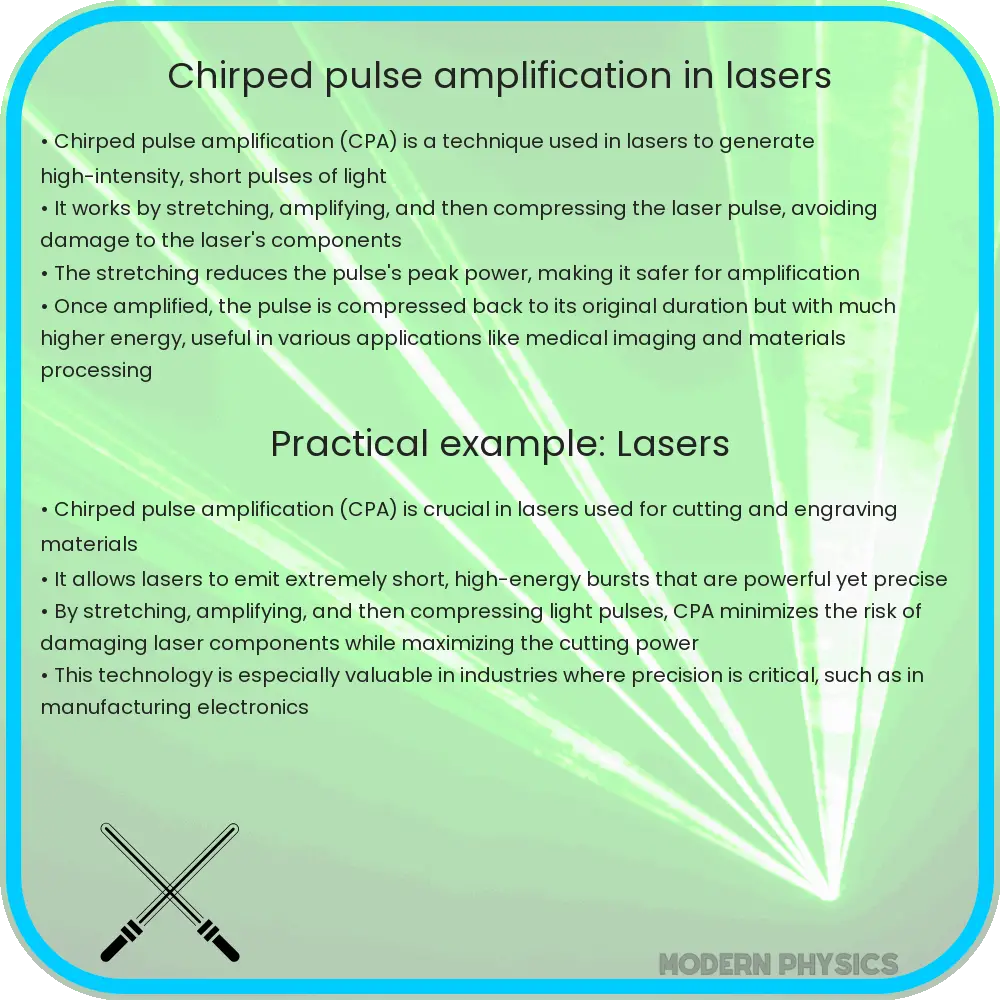
At its core, CPA involves stretching, amplifying, and then compressing a laser pulse. The process starts with a short, low-energy pulse that is ‘chirped’ by stretching it in time to reduce its peak power. This stretching is achieved through a device called a ‘chirped Bragg grating’, which disperses different frequencies of the pulse at various speeds. The result is a pulse that spans a longer duration, significantly lowering its peak power and making it safer to amplify without causing damage to the amplifying medium.
Amplification and Compression
Once stretched, the pulse is then amplified to a much higher energy level. This step is crucial as it boosts the pulse’s power while maintaining its stretched state, thereby avoiding the limitations imposed by the nonlinear effects and damage thresholds of the amplification medium. Following amplification, the pulse is compressed back to its original, or even shorter, duration. This compression is achieved using another set of dispersive elements that reverse the initial stretching effect, resulting in a pulse that is both extremely short and incredibly powerful.
Applications and Impact
CPA technology has opened the door to a plethora of applications across various domains. In medicine, it enables precise, minimally invasive surgeries, significantly improving patient outcomes. In industrial settings, it facilitates the cutting and machining of materials with unparalleled precision and speed. Furthermore, in scientific research, CPA is instrumental in studying ultrafast processes, allowing scientists to observe phenomena occurring on the femtosecond (10-15 second) scale.
Advancements in CPA Technology
Since its inception, continuous advancements in CPA technology have led to the development of lasers with peak powers in the petawatt range (1015 watts). These cutting-edge systems push the boundaries of what’s possible, from probing the fundamental laws of physics to driving innovations in nuclear fusion research. The ability to generate such high-power pulses has also significantly enhanced the capabilities of high-harmonic generation, paving the way for new types of X-ray sources that are compact and powerful.
Challenges and Future Directions
Despite its impressive capabilities, CPA technology is not without its challenges. The complexity of high-power laser systems requires meticulous design and maintenance to prevent optical damage and ensure stable operation. Moreover, as applications become more advanced, the demand for even higher power and shorter pulse durations continues to grow, pushing the technology towards new frontiers. Researchers are actively exploring innovative materials and configurations to overcome current limitations, aiming to achieve more efficient amplification and compression techniques.
Conclusion
Chirped Pulse Amplification has fundamentally transformed the landscape of laser technology, enabling unprecedented levels of power and precision. From its Nobel Prize-winning origins to its wide array of current applications in science, medicine, and industry, CPA represents a remarkable achievement in the field of photonics. As we look to the future, the ongoing evolution of CPA promises to unlock even more exciting possibilities, further solidifying its role as a cornerstone of modern laser physics. The journey of CPA, from theoretical concept to a tool that is indispensable across various domains, underscores the endless potential of human ingenuity and the ever-expanding horizon of technological advancement.