
Explore Chern-Simons Theory: Unveiling the link between quantum states, gauge invariance, topology, and their impact on modern physics and tech.
Understanding Chern-Simons Theory: A Quantum Field Theoretical Perspective
The Chern-Simons theory, a cornerstone in theoretical physics, offers a unique perspective on quantum states, gauge invariance, and topology. This quantum field theory, developed in the late 20th century, has profound implications in various areas of physics, particularly in the understanding of the quantum Hall effect and topological quantum computation.
Quantum States in Chern-Simons Theory
In the context of quantum mechanics, Chern-Simons theory provides a framework for understanding the quantum states of a system. It operates under the principles of topological quantum field theory, where the physical properties of a system are defined by its topology rather than its metric details. This theory posits that quantum states are not only characterized by traditional quantum numbers but also by their topological properties, making it a pivotal tool in studying condensed matter systems like quantum Hall fluids.
Gauge Invariance in Chern-Simons Theory
Gauge invariance is a fundamental principle in field theories, stating that certain physical phenomena remain unchanged under local transformations. In Chern-Simons theory, gauge invariance plays a crucial role. The theory is defined by the Chern-Simons action, SCS, which is invariant under gauge transformations. This action is expressed as:
SCS = k ∫ A ∧ dA + (2/3) A ∧ A ∧ A,
where A represents the gauge field, d denotes the exterior derivative, and k is the Chern-Simons level, an integral constant that quantifies the strength of the interaction.
Topology and Chern-Simons Theory
Topology, the study of properties that remain unchanged under continuous deformations, is central to Chern-Simons theory. This theory exploits the concept of topological invariants, quantities that remain constant under continuous transformations, to describe physical phenomena. For example, in the quantum Hall effect, the Hall conductivity is a topological invariant described by Chern-Simons theory. This relationship between physical phenomena and topological invariants showcases the power of the theory in providing deep insights into the nature of quantum states.
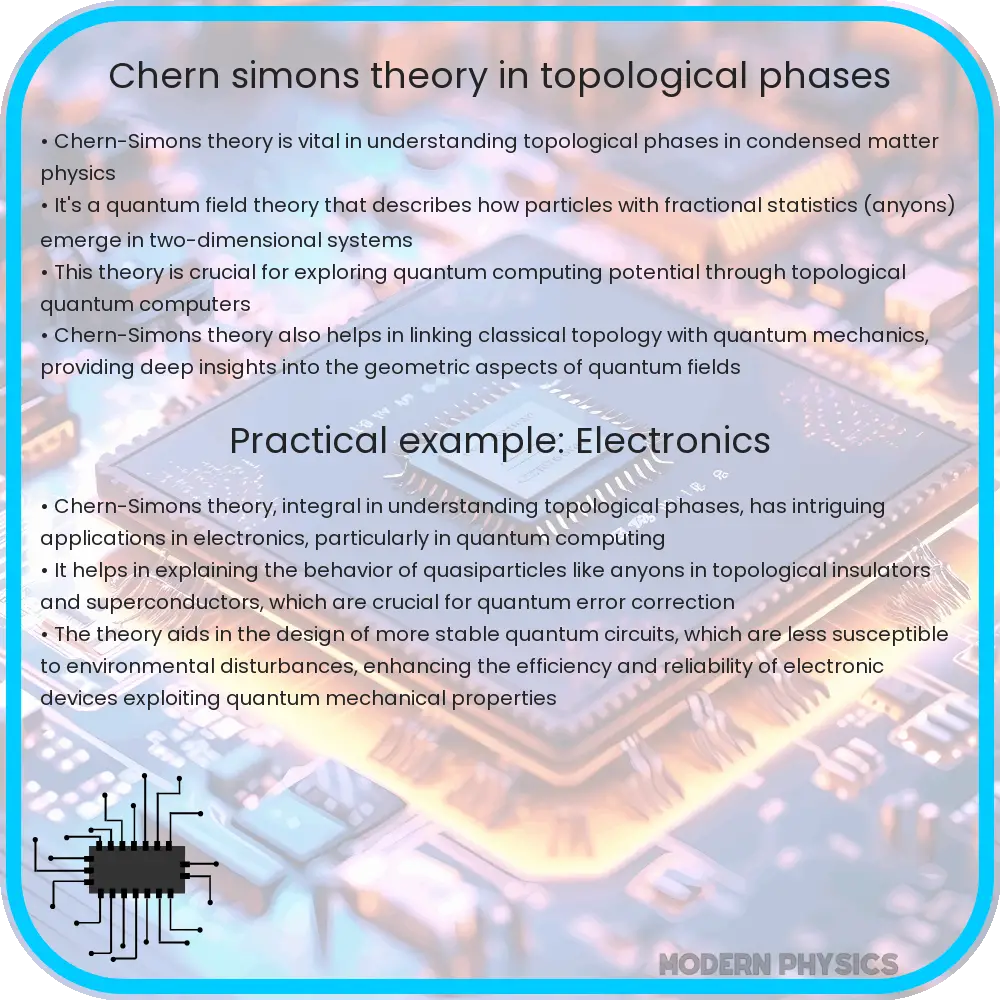
Chern-Simons theory’s application to topological quantum computation is another area of significant interest. Here, the theory aids in understanding the braiding statistics of anyons, quasi-particles that exhibit neither bosonic nor fermionic statistics. These anyons are pivotal in realizing robust quantum computation models that are less susceptible to environmental disturbances, thanks to their topological nature.
Applications of Chern-Simons Theory
The applications of Chern-Simons theory extend beyond theoretical physics, permeating areas like mathematics and material science. In mathematics, this theory has deep connections with knot theory, a branch that studies the properties of knots and links. Chern-Simons theory provides a framework for understanding the invariants of knots, like the Jones polynomial, through quantum field theoretical techniques.
In material science, the theory’s principles are instrumental in exploring new states of matter, such as topological insulators and superconductors. These materials exhibit unique properties governed by their topological characteristics, leading to potential revolutionary applications in electronics and quantum computing.
Challenges and Future Directions
Despite its profound implications, Chern-Simons theory is not without challenges. One of the primary issues is the mathematical complexity involved in dealing with topological field theories. Moreover, experimental verification of the theoretical predictions remains a daunting task, requiring sophisticated and highly sensitive equipment.
Future research in Chern-Simons theory is directed towards a deeper understanding of topological quantum matter and the exploration of new quantum states. Additionally, there’s an ongoing effort to find more practical applications, especially in the realm of quantum computing and advanced material science.
Conclusion
Chern-Simons theory, with its unique approach to quantum states, gauge invariance, and topology, stands as a pivotal concept in modern physics and mathematics. Its ability to link seemingly disparate fields, from knot theory to quantum computing, highlights its versatility and depth. As research continues to unveil its potential, Chern-Simons theory not only deepens our understanding of the quantum world but also paves the way for technological advancements that could transform our approach to computation and material design. Embracing both its theoretical elegance and practical applications, Chern-Simons theory promises to remain a key focus in the pursuit of knowledge about the quantum realm.