
Explore the essentials of charge mobility in electrostatics, its impact on device efficiency, factors affecting it, and its wide-ranging applications.
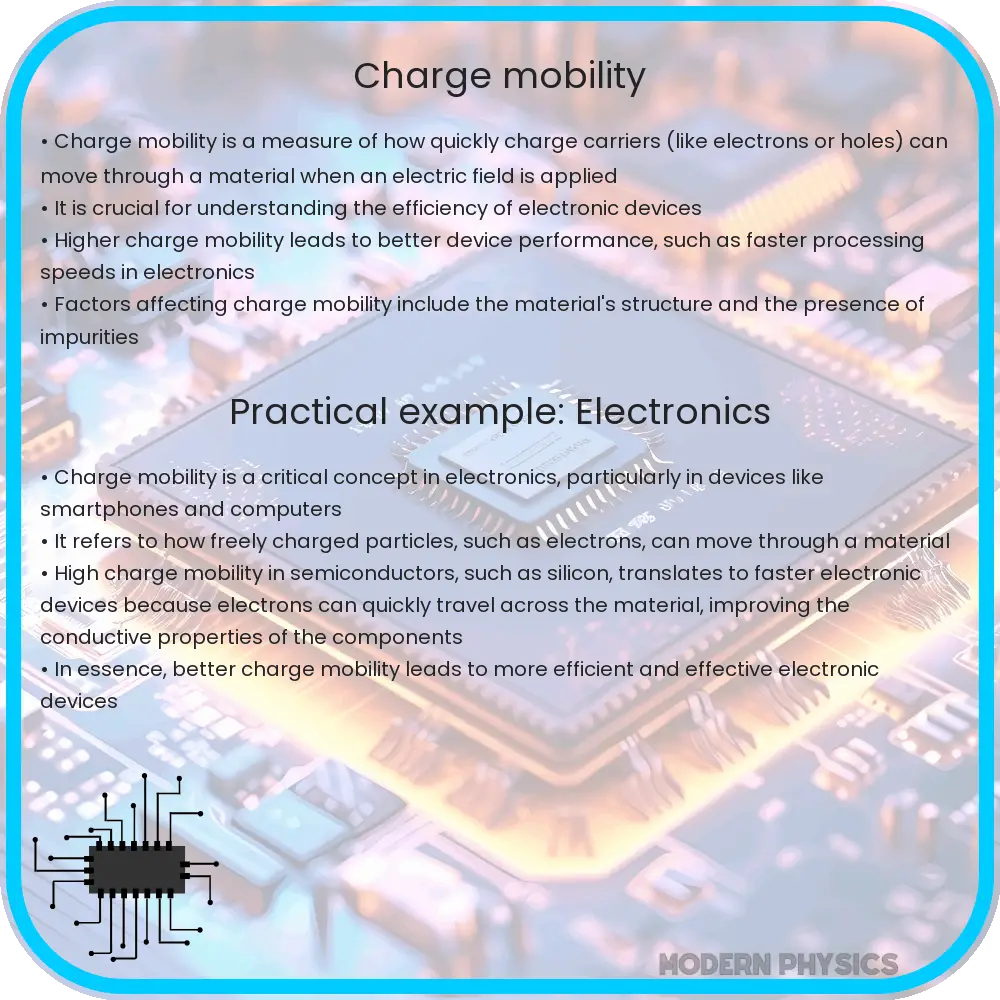
Understanding Charge Mobility in Electrostatics
Charge mobility is a fundamental concept in the field of electrostatics, playing a crucial role in the efficiency and functionality of various electronic devices. This property refers to the ease with which an electric charge moves through a material when an electric field is applied. In this article, we will explore the efficiency of charge mobility, the factors that affect it, and its diverse applications.
Efficiency of Charge Mobility
The efficiency of charge mobility is essential in determining the performance of electronic devices. Higher mobility allows for quicker and more efficient movement of charges, which is crucial in applications like transistors, solar cells, and light-emitting diodes (LEDs). In semiconductors, for example, the mobility of electrons and holes (the absence of an electron) is a key parameter in their functionality.
Factors Influencing Charge Mobility
- Material Type: Different materials have inherently different charge mobilities. Conductors, semiconductors, and insulators vary significantly in their ability to conduct electric charges.
- Temperature: Generally, as temperature increases, mobility decreases due to increased scattering of charge carriers.
- Impurities and Defects: The presence of impurities and defects in a material can hinder the flow of charge carriers, reducing mobility.
- Electric Field: The strength and direction of the applied electric field can also affect the rate and efficiency of charge movement.
Applications of Charge Mobility
- Semiconductor Devices: In semiconductor technology, charge mobility is a crucial factor in the design and operation of transistors, diodes, and integrated circuits.
- Photovoltaic Cells: The efficiency of solar cells depends significantly on the mobility of charge carriers within the photovoltaic material.
- Organic Electronics: Organic light-emitting diodes (OLEDs) and organic photovoltaics rely on the mobility of charges in organic materials for their operation.
The study and manipulation of charge mobility are vital in advancing electronic technology. By understanding and controlling the factors that influence this property, engineers and scientists can develop more efficient and effective electronic devices.
Advanced Techniques in Measuring and Enhancing Charge Mobility
Advancements in technology have led to the development of sophisticated methods for measuring and enhancing charge mobility. Techniques like Time-of-Flight (ToF) measurements and Field-Effect Transistor (FET) based methods provide accurate insights into mobility characteristics. Additionally, nanostructuring of materials and the use of high mobility compounds like graphene are at the forefront of enhancing charge mobility in various applications.
Impact of Charge Mobility on Energy Efficiency
Charge mobility has a direct impact on the energy efficiency of electronic devices. Higher mobility translates to lower energy consumption for the same level of performance, making devices more energy-efficient and environmentally friendly. This is particularly significant in the context of sustainable technology and green energy solutions.
Future Prospects and Challenges
- Emerging Materials: Research in new materials like two-dimensional materials and nanostructured compounds holds promise for unprecedented levels of charge mobility.
- Environmental and Operational Stability: Ensuring that high mobility is maintained under various environmental conditions remains a challenge.
- Integration with Current Technologies: Incorporating materials with enhanced mobility into existing technology platforms requires overcoming compatibility and fabrication challenges.
Conclusion
In conclusion, charge mobility is a pivotal factor in the field of electrostatics, dictating the efficiency and performance of a wide range of electronic devices. The efficiency of charge mobility is influenced by material properties, temperature, impurities, and the applied electric field. Its applications span across semiconductor devices, photovoltaic cells, and organic electronics, among others. With ongoing research and technological advancements, there is a continual enhancement in the methods of measuring and improving charge mobility. These developments hold significant promise for the future of electronic devices, emphasizing energy efficiency and sustainability. The future challenges lie in integrating these advancements seamlessly into existing technologies and ensuring stability under various conditions. As we continue to unravel the complexities of charge mobility, its potential to revolutionize electronic technology becomes increasingly apparent.