
Explore the Chaplygin Gas Model in cosmology, a theory that unifies dark energy and dark matter to explain the universe’s accelerated expansion and dynamics.
Understanding the Chaplygin Gas Model in Cosmology
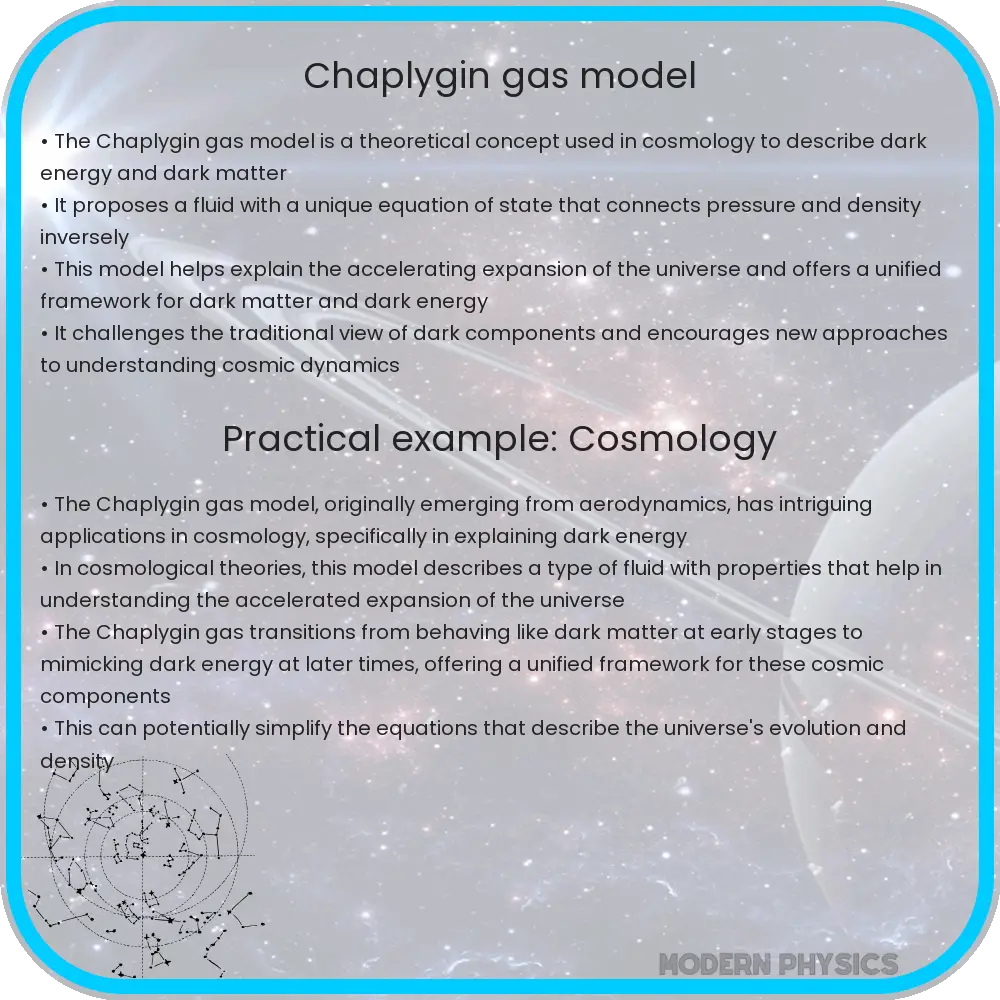
The Chaplygin gas model presents an innovative approach to explaining the accelerated expansion of the universe, a phenomenon traditionally attributed to dark energy. This model is named after Sergei Chaplygin, a Russian scientist, and is based on a unique equation of state which bridges the gap between dark energy and dark matter, two of the most elusive components in cosmology.
Core Principles and Equation of State
The Chaplygin gas model is characterized by its distinctive equation of state, given by p = -A / ρα, where p represents pressure, ρ is the density, A is a positive constant, and α is a parameter that ranges from 0 to 1. This equation suggests a transition from a universe dominated by matter to one dominated by dark energy. At high densities, the Chaplygin gas behaves like dark matter, while at low densities, it mimics dark energy, providing a unified framework for the evolution of the universe.
Implications for the Universe’s Dynamics
The Chaplygin gas model offers intriguing insights into the dynamics of the universe. By incorporating this model into cosmological equations, scientists can account for the accelerated expansion without relying on unknown forms of dark energy. This approach also impacts the structure formation in the universe, suggesting a smoother transition between the eras dominated by dark matter and dark energy.
Experimental Evidence and Challenges
While the Chaplygin gas model provides a compelling narrative for cosmic acceleration, it is not without its challenges. Observational data from supernovae, cosmic microwave background radiation, and large-scale structure formations provide tests for the viability of this model. The compatibility of the Chaplygin gas parameters with observational data is crucial for its acceptance in the scientific community.
Despite its potential, the Chaplygin gas model faces skepticism due to its unconventional properties and the lack of direct observational evidence. Critics argue that the model requires fine-tuning and may not adequately explain all cosmological observations. Nonetheless, its ability to unify dark matter and dark energy into a single framework keeps it relevant in cosmological discussions.
Further Developments and Theoretical Implications
Recent advancements in the Chaplygin gas model involve its extensions, such as the Modified Chaplygin Gas (MCG) and the Generalized Chaplygin Gas (GCG) models. These variations introduce additional parameters to better fit the observational data and provide more flexibility in describing the universe’s evolution. For instance, the GCG model, characterized by the equation of state p = -A / ρβ, where β is a new parameter, allows for a broader range of cosmic behaviors and can more accurately mimic the transition between the dark matter and dark energy dominated eras.
Moreover, these models have significant implications for the fate of the universe. Depending on the values of the Chaplygin gas parameters, the universe could end in a Big Freeze, where it expands forever but at an ever-slowing rate, or in a Big Rip, where the expansion accelerates indefinitely until all matter is torn apart.
Integration with Other Cosmological Theories
The Chaplygin gas model also intersects with other cosmological theories and observations. Its integration with inflationary theory, for instance, provides a seamless narrative from the universe’s early exponential expansion to its current accelerated rate. Additionally, the model’s parameters can be constrained by astrophysical observations, such as galaxy rotation curves and gravitational lensing, further testing its validity against the standard cosmological model.
Conclusion
The Chaplygin gas model represents a bold attempt to unify the dark components of the cosmos under a single theoretical framework. While it introduces elegance and simplicity to cosmological models, it also faces challenges in fitting all observational data perfectly. Despite these hurdles, the ongoing research and debate surrounding the Chaplygin gas model play a crucial role in advancing our understanding of the universe. As observational techniques improve and new data becomes available, the Chaplygin gas model and its variants will continue to be pivotal in the quest to decipher the mysteries of dark matter and dark energy. Ultimately, whether the Chaplygin gas model withstands the test of time or paves the way for new theories, its contribution to cosmology will remain invaluable.