
Chalcogenide glasses are materials known for unique optical properties, including broad infrared transmission and high refractive indices, used in various high-tech applications.
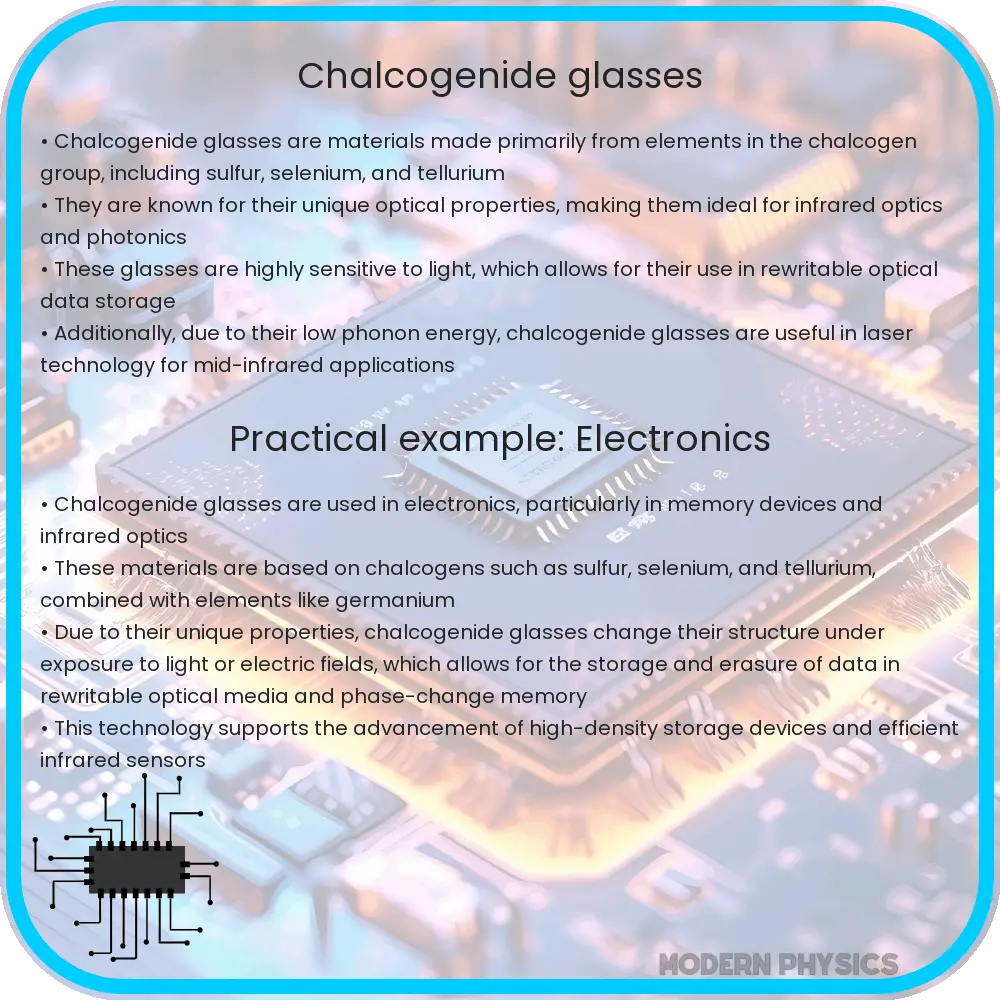
Introduction to Chalcogenide Glasses
Chalcogenide glasses are a distinctive group of materials characterized by the presence of one or more chalcogens (sulfur, selenium, or tellurium) other than oxygen, often combined with elements like arsenic, germanium, or antimony. Unlike oxide-based glasses such as silica, chalcogenide glasses exhibit unique optical properties, making them highly valuable in a range of technological applications.
Optical Properties of Chalcogenide Glasses
One of the defining characteristics of chalcogenide glasses is their broad transmission range in the infrared spectrum. These materials are transparent to wavelengths from about 1 to 14 microns, depending on their composition. This property is significant because it allows for applications in infrared optics, where many other glass types do not transmit infrared light effectively.
Chalcogenide glasses also exhibit high refractive indices, typically around 2 to 3, which is higher than that of most oxide glasses. This high refractive index can be advantageous in designing lenses and other optical components with smaller geometries or higher refractive capabilities.
Another important optical characteristic of chalcogenide glasses is their non-linear optical properties. They can change their refractive index in response to high-intensity light, a feature that is useful in the development of optical switches and all-optical processing systems.
Applications of Chalcogenide Glasses
Due to their unique properties, chalcogenide glasses find applications in various areas:
- Infrared Optics: Chalcogenide glasses are extensively used in infrared sensors, night vision systems, and thermal imaging, benefiting industries like security, military, and automotive. Their ability to transmit infrared light makes them ideal for these applications.
- Fiber Optics: The low phonon energy of chalcogenide glasses makes them suitable for fiber optic cables that operate in the infrared region. These fibers are used in telecommunications and medical instruments, enabling efficient transmission of signals and images.
- Optical Components: High refractive index and adjustability under various light conditions make chalcogenide glasses essential in manufacturing lenses, prisms, and other optical components. They are particularly useful in compact systems that require efficient light manipulation.
- Photonic Devices: The non-linear optical properties of chalcogenide glasses allow for the development of advanced photonic devices like all-optical switches, modulators, and waveguides, which are integral to enhancing the performance of optical communication networks.
Through continued research and development in the field of material sciences, the potential applications of chalcogenide glasses are expanding, leading to innovative uses in both existing and emerging technologies.
Manufacturing Techniques for Chalcogenide Glasses
The production of chalcogenide glasses involves specialized processes that differ from conventional glass-making. These techniques ensure preservation of unique properties essential for their function:
- Melting and Quenching: Elements are combined and heated in a sealed environment to prevent oxidation. The melt is rapidly cooled to form a glassy, amorphous structure, crucial for achieving desired optical qualities.
- Vapor Deposition: This method is used primarily for creating thin films of chalcogenide glasses. It involves the deposition of vaporized chalcogens and other elements onto a substrate, allowing for precise control over the composition and thickness of the films.
- Sputtering: Another technique for film creation, sputtering involves ejecting particles from a solid target material onto a substrate to form a thin film, useful in coatings for lenses and infrared optics.
These manufacturing methods play a critical role in defining the performance characteristics of chalcogenide glasses for specific applications.
Challenges and Future Prospects
Despite their advantages, chalcogenide glasses face certain challenges. Their sensitivity to moisture and tendency to crystallize at lower temperatures than oxide glasses can limit their applications and durability. However, ongoing research aims to improve their stability and expand their application range.
Future developments are likely to leverage the unique properties of chalcogenide glasses in sectors like renewable energy, where they can be used in solar cells and sensors that operate under extreme environmental conditions. Advances in nanostructuring and hybrid materials might also open new avenues for these versatile glasses.
Conclusion
Chalcogenide glasses represent a remarkable class of materials that bridge the gap between traditional optics and modern technological demands. Their exceptional optical properties make them indispensable in infrared technology and photonics, with broadening applications that touch on various aspects of technology and innovation. As research continues to tackle their challenges and enhance their qualities, the potential of chalcogenide glasses to revolutionize fields such as sustainable energy, telecommunications, and security is substantial. Their continuing evolution is a testament to the dynamic nature of material science and its ability to adapt and innovate in response to emerging technological needs.