
Explore the world of ceramic superconductors: their efficiency, stability challenges, innovations, and potential applications in various industries.
Introduction to Ceramic Superconductors
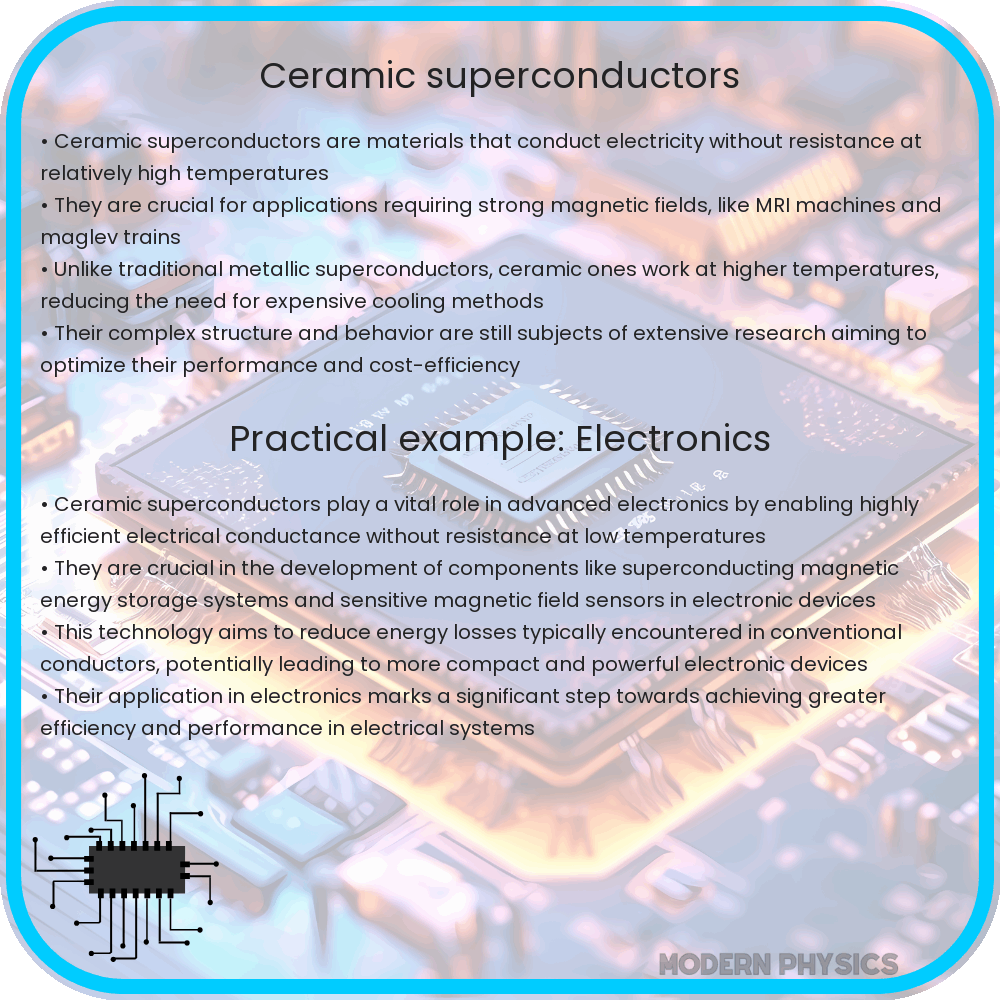
Superconductivity, a phenomenon where materials exhibit zero electrical resistance, has been a focal point of scientific research and technological innovation. Ceramic superconductors, made from complex copper oxides, have gained significant attention due to their high superconducting transition temperatures (Tc). Unlike traditional metallic superconductors, which require extremely low temperatures close to absolute zero, ceramic superconductors operate at higher temperatures, though still below the freezing point of water, making them more feasible for practical applications.
Efficiency of Ceramic Superconductors
The efficiency of ceramic superconductors is measured by their ability to conduct electricity without loss, significantly reducing energy wastage compared to conventional conductors. This efficiency is particularly beneficial in power transmission lines and magnetic resonance imaging (MRI) machines, where reduced energy loss can lead to substantial cost savings and improved performance. However, the efficiency is highly dependent on maintaining the materials below their critical temperatures and in a state free of magnetic interference.
Stability Challenges
Despite their high Tc, ceramic superconductors face stability challenges. The materials are brittle and sensitive to changes in temperature, magnetic fields, and material composition. These factors can lead to superconductivity being easily disrupted, posing challenges for consistent performance in technological applications. Researchers are actively seeking ways to enhance the stability of these materials through various means, including doping with different elements and developing new composite materials.
Innovation in Ceramic Superconductors
Innovation in the field of ceramic superconductors is driven by the need to overcome their intrinsic limitations and to harness their potential for widespread technological applications. Advances in material science and engineering have led to the development of second-generation high-temperature superconductors, such as YBa2Cu3O7-δ, which are more robust and suitable for commercial use. Additionally, research into thallium, bismuth, and mercury-based superconductors aims to find materials with even higher Tc values and better mechanical properties.
Applications and Future Potential
The application of ceramic superconductors spans various fields, from energy to healthcare. In the energy sector, they are being explored for use in high-efficiency power cables, transformers, and fault current limiters, promising a revolution in power distribution with minimal energy losses. In healthcare, their application in MRI machines offers enhanced imaging capabilities with lower operational costs. Moreover, the development of superconducting magnetic energy storage systems represents a significant step forward in energy storage technology, potentially transforming how energy is stored and utilized.
Current Research and Development
Research in the field of ceramic superconductors is focused on enhancing their practicality for everyday applications. Efforts are underway to improve the material’s stability, increase Tc, and develop cost-effective manufacturing processes. The discovery of new materials and the fine-tuning of existing compounds through chemical doping are central to these advancements. Furthermore, the integration of superconductors with other materials, such as insulators and semiconductors, is being explored to develop new hybrid devices, potentially leading to groundbreaking technological innovations.
Challenges Ahead
Despite their promising potential, ceramic superconductors still face significant hurdles. The high cost of material production, complexity of fabrication, and the need for cooling systems to maintain operational temperatures limit their widespread adoption. Addressing these challenges requires interdisciplinary collaboration and continued investment in research and development.
Conclusion
Ceramic superconductors represent a frontier of scientific and technological innovation with the potential to revolutionize industries by offering efficient, energy-saving solutions. While challenges remain in terms of stability, cost, and operational requirements, ongoing research and development are steadily overcoming these obstacles. As we advance in our understanding and technological capabilities, ceramic superconductors stand poised to play a pivotal role in shaping a sustainable, efficient, and technologically advanced future.