
Explore the impact of the Cepheid Metallicity Effect on cosmic distance measurements and its implications for understanding the universe’s expansion and structure.
Cepheid Metallicity Effect: Unveiling Cosmic Distances
The cosmos, vast and intriguing, offers myriad puzzles, one of which pertains to the measurement of cosmic distances. Central to resolving this enigma are Cepheid variables, a type of star used as ‘cosmic yardsticks’. However, their use comes with its complexities, notably the Cepheid Metallicity Effect. This phenomenon is crucial for astrophysicists striving to refine the precision of astronomical measurements and deepen our understanding of the universe’s expansion.
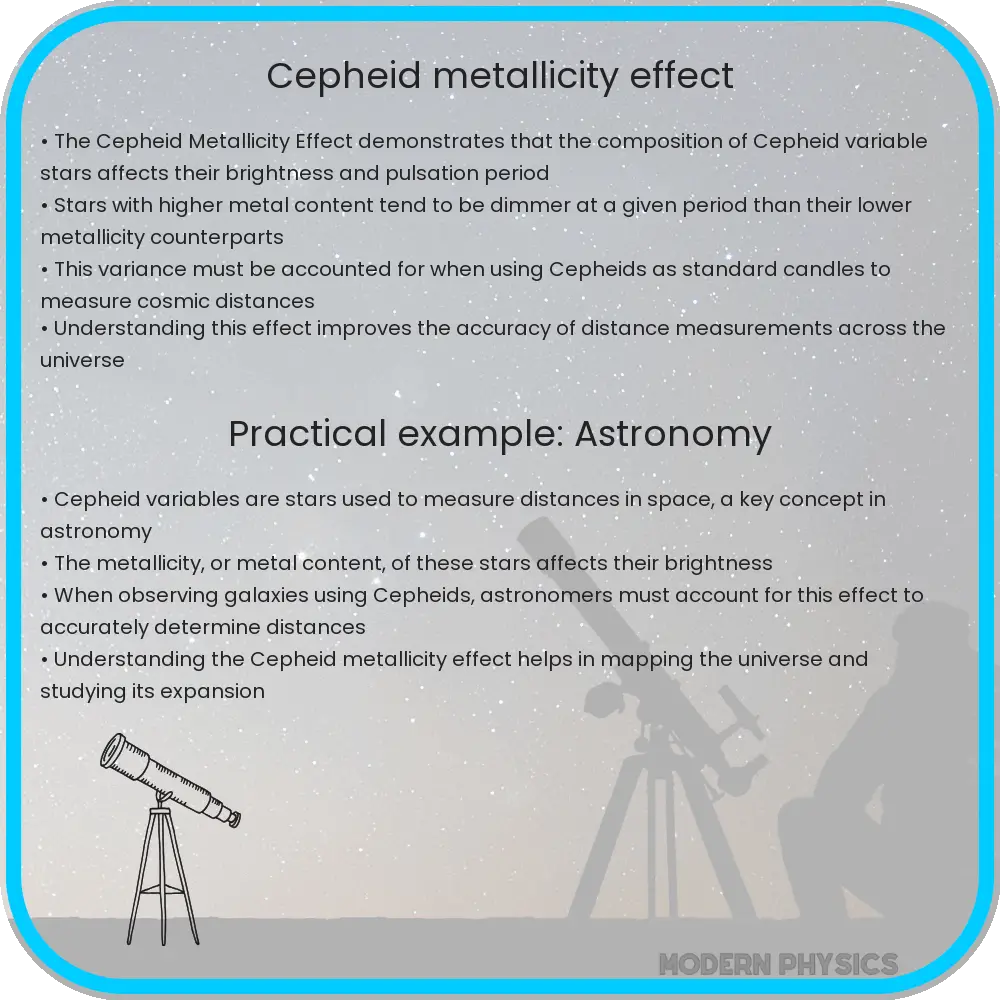
Cepheid variables are pulsating stars, their luminosities varying in a predictable pattern over time. This unique characteristic allows astronomers to determine their absolute brightness based on their pulsation periods, enabling the calculation of vast interstellar and intergalactic distances through the Leavitt Law, also known as the period-luminosity relationship. However, this relationship is significantly influenced by the metallicity of the Cepheid stars, a factor denoting the abundance of elements heavier than hydrogen and helium, symbolized as ‘Z’.
Metallicity impacts the Cepheid variables in two main ways. First, it affects the star’s temperature and brightness. A higher metal content generally leads to a cooler star surface and a dimmer appearance. Second, metallicity alters the opacity of the star’s outer layers, affecting the pulsation periods. Consequently, the same period-luminosity relationship does not apply universally across different galactic environments, leading to potential inaccuracies in distance measurements if the metallicity effect is not properly accounted for.
This metallicity effect on Cepheid variables necessitates adjustments in the cosmic distance scale, impacting our understanding of the universe’s structure and the rate of its expansion, known as the Hubble Constant. As astronomers aim for more precise measurements, understanding and correcting for the Cepheid metallicity effect becomes imperative. This includes developing more refined models that incorporate variations in metallicity and reassessing the distances to far-off galaxies with this corrected lens.
The importance of this effect extends beyond academic curiosity. It plays a pivotal role in calibrating other distance measurement techniques and thereby in shaping our comprehension of cosmic phenomena, such as the rate at which the universe is expanding. Hence, dissecting the Cepheid metallicity effect is not just an exercise in astrophysical precision but a quest to unravel the secrets of the cosmos itself.
Advancements and Implications in Astrophysics
Recent advancements in astrophysical research and observational technology have significantly enhanced our ability to measure and account for the Cepheid metallicity effect. High-resolution spectroscopy and space-based telescopes have provided clearer insights into the chemical compositions of Cepheid stars, allowing for more accurate corrections in distance calculations. Moreover, the advent of infrared observations has mitigated some of the challenges posed by interstellar dust, which can obscure and redden the light of distant Cepheids, further complicating metallicity assessments.
The integration of data from the Gaia satellite, with its precise parallax measurements, has also revolutionized our approach to calibrating the Cepheid distance scale. By providing direct distance measurements to thousands of Cepheid stars in our Milky Way, Gaia has helped refine the period-luminosity-metallicity relation, leading to more accurate cosmic distance estimates.
Furthermore, the interdisciplinary collaboration between astronomers, astrophysicists, and cosmologists has fostered new methodologies and models that better account for varying metallicities across different galactic environments. These efforts have not only improved our understanding of Cepheid variables but also enhanced the reliability of the cosmic distance ladder—a hierarchical framework used to determine distances in the universe.
The implications of these advancements are profound. By improving the accuracy of the cosmic distance scale, we bolster the foundation upon which much of cosmology rests. This, in turn, aids in resolving key questions in the field, such as the tension between different measurements of the Hubble Constant. Addressing the discrepancies in this value could lead to new insights into the nature of dark energy, the mysterious force driving the universe’s accelerated expansion.
Conclusion
The Cepheid metallicity effect illustrates the intricate interplay between the microscopic world of stellar composition and the macroscopic realm of cosmic distances. As we continue to refine our understanding and measurement of this phenomenon, we not only enhance our knowledge of the universe but also inch closer to answering some of the most profound questions in cosmology. The journey of discovery, from the pulsating heart of a Cepheid variable to the vastness of the cosmos, underscores the beauty and complexity of the universe we inhabit. In this quest for precision and understanding, each step forward in accounting for the nuances of metallicity in Cepheid stars brings us closer to unveiling the mysteries of the cosmos and our place within it.