
Explore the fascinating world of caustic optical phenomena, where light, patterns, and optics converge to create stunning visual effects in everyday life.
Understanding Caustic Optical Phenomena: Light, Patterns & Optics
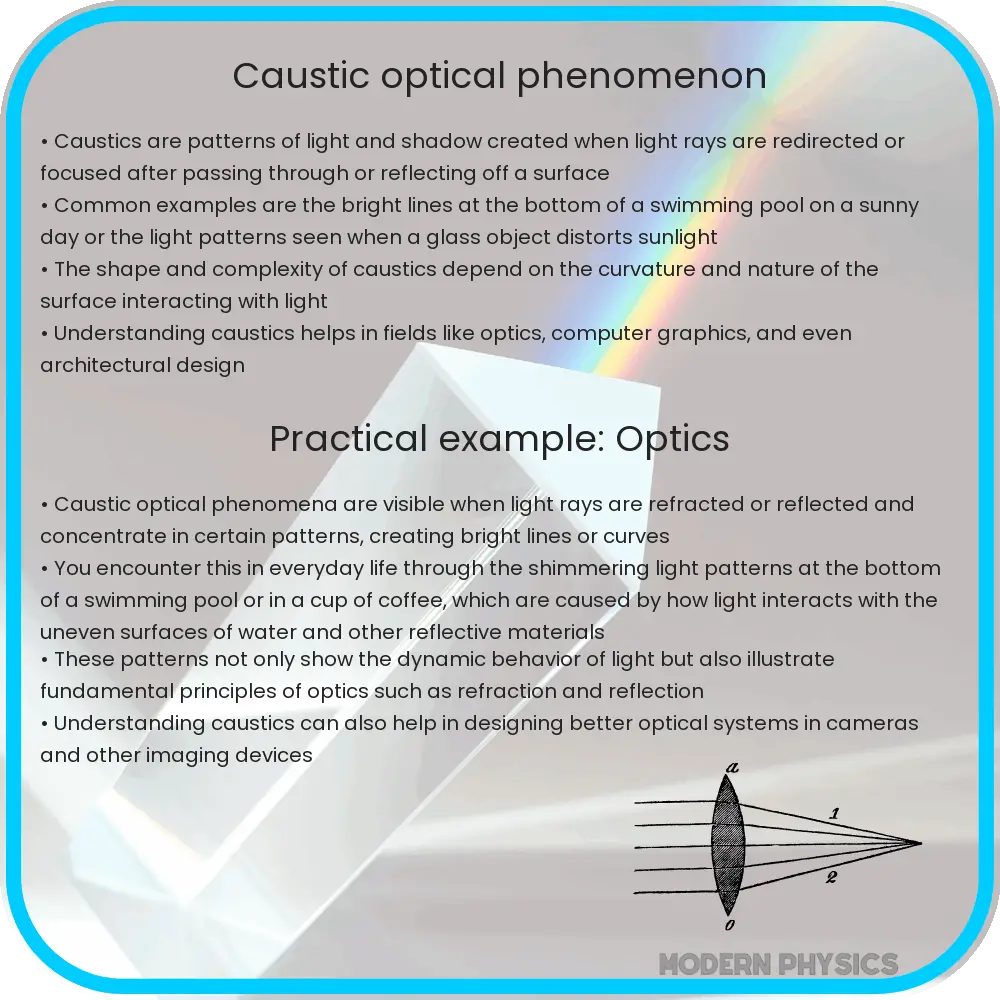
Caustic optical phenomena are captivating visual effects created when light rays are refracted or reflected by a curved surface or object, leading to the concentration of light in certain areas more intensely than others. These phenomena can be observed in everyday life, from the shimmering patterns at the bottom of a swimming pool to the bright arcs of light cast by a glass of water. Understanding the principles behind caustic patterns not only enriches our appreciation of the natural world but also informs various applications in optics, computer graphics, and visual art.
The Science Behind Caustic Patterns
At the heart of caustic optical phenomena lies the principle of light refraction and reflection. Refraction occurs when light travels through mediums of different densities, such as air and water, bending as it does so. This bending of light is governed by Snell’s Law, which describes the relationship between the angles of incidence and refraction and the indices of refraction of the mediums. Reflection, on the other hand, involves light bouncing off a surface, especially when it is smooth and shiny, like a mirror.
When light rays encounter a transparent or reflective curved surface, such as the surface of water or a glass object, they are redirected in a way that concentrates them into brighter, focused patterns, known as caustics. The shape and intensity of these patterns depend on the curvature of the surface and the angle of the incoming light. For instance, a simple circular glass object can create a heart-shaped caustic pattern when illuminated by a light source.
Visualizing Caustic Phenomena
Caustic patterns can vary from simple concentrated spots of light to complex networks of bright curves and lines. These patterns are not static; they dynamically change with the movement of the light source or the object causing the refraction or reflection. The beauty of caustic phenomena is not just in the complexity or the intensity of the patterns, but also in their transient nature, reminding us of the ever-changing interplay between light and matter.
The study and application of caustic patterns extend beyond mere observation. In the field of computer graphics, for example, simulating caustic effects can add realism to rendered scenes, capturing the way light interacts with transparent or reflective surfaces in the real world. This involves complex mathematical modeling and computational techniques to accurately depict the behavior of light as it creates caustic patterns.
Applications and Implications of Caustic Optical Phenomena
The fascination with caustic patterns transcends aesthetic appreciation, extending into practical applications in science and technology. One prominent area is in optical engineering, where understanding caustics is essential for designing lenses and optical systems that minimize unwanted light concentrations, which can cause lens flare and reduce the quality of images. Similarly, in the field of architecture, natural light can be manipulated using caustic phenomena to create dynamic lighting effects within spaces, enhancing the ambiance of a building’s interior without the need for artificial light sources.
Moreover, caustic phenomena play a crucial role in the realms of underwater imaging and sonar technology. The patterns of light focused by water waves can affect the clarity and accuracy of images and data collected from underwater environments. Recognizing and compensating for these effects allows for improved imaging techniques and more reliable data collection in marine research and exploration.
In the artistic domain, artists and designers harness caustic patterns to create visually striking pieces that explore the interplay between light, shadow, and form. These creations often evoke a sense of movement and fluidity, capturing the ephemeral beauty of light as it dances across surfaces and through transparent materials.
Conclusion
Caustic optical phenomena represent a mesmerizing intersection of physics, art, and technology. By studying the way light interacts with surfaces to create intricate patterns, we gain insights into the fundamental principles of optics and light behavior. This knowledge not only satisfies human curiosity about the natural world but also drives innovation in design, technology, and environmental understanding. As we continue to explore and utilize caustic patterns, we unlock new possibilities for harnessing the power of light in both practical and aesthetic applications, highlighting the enduring significance of this fascinating optical phenomenon.