
Explore the catoptric system’s role in geometrical optics, focusing on precision, clarity, and design. Learn how it enhances optical technologies.
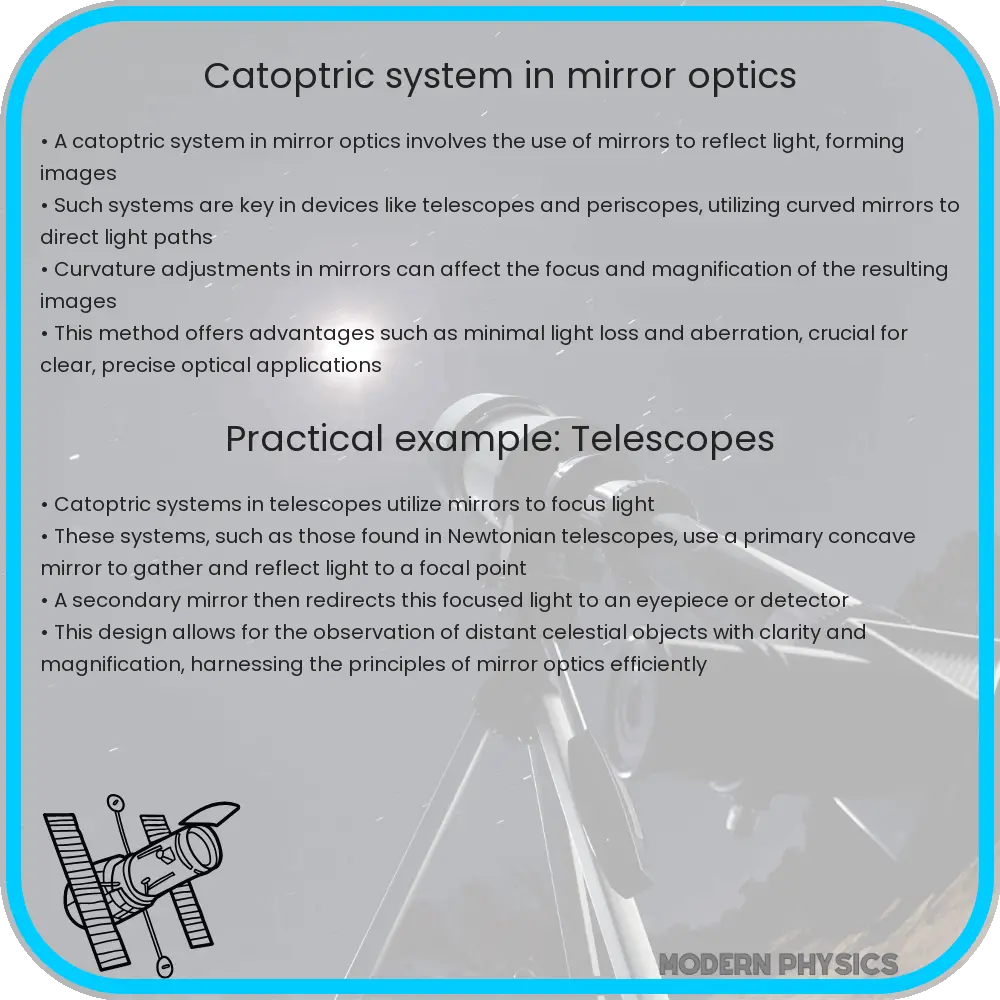
Catoptric Systems: Unveiling the Precision, Clarity, and Design in Geometrical Optics
The realm of geometrical optics, a foundational pillar in the field of physics, offers a fascinating exploration into how light interacts with materials to produce images. Central to this exploration is the catoptric system, a sophisticated arrangement of mirrors that manipulate light to achieve precision, clarity, and design efficiency in optical devices. This article delves into the principles of catoptric systems, their applications, and the technological advancements they have spurred in the optics industry.
Understanding Catoptric Systems
Catoptric systems rely on the principle of reflection, a phenomenon where light bounces off surfaces. Unlike refractive systems, which bend light using lenses, catoptric systems use mirrors to redirect light, enabling the creation of images without the chromatic aberration commonly associated with lenses. This unique characteristic makes catoptric systems invaluable in applications requiring high precision and clarity.
Components and Design
The design of a catoptric system is a meticulous process that involves the strategic placement of mirrors to achieve the desired optical path. The mirrors, typically made from high-grade materials with reflective coatings, are shaped and aligned to specific geometries—concave, convex, or flat—to control the direction and focus of light. The precision in the curvature and alignment of these mirrors is crucial for optimizing the system’s optical performance.
Applications in Modern Optics
Catoptric systems find extensive applications across various fields of modern optics. In astronomy, large telescopes utilize these systems to capture distant celestial objects with remarkable clarity. Similarly, in photography and cinematography, catoptric lenses offer unparalleled image quality, enabling photographers and filmmakers to produce visually stunning works. Furthermore, the precision of catoptric systems has proven instrumental in the advancement of laser technology, where directing light with exactitude is paramount.
The integration of catoptric systems in optical devices not only enhances performance but also introduces design efficiencies. By eliminating the need for multiple lenses, these systems reduce the weight and complexity of optical instruments, making them more accessible and user-friendly. This design simplicity, coupled with the high-quality imaging capabilities, underscores the significance of catoptric systems in pushing the boundaries of optical technology.
Catoptric Systems: Harnessing Precision, Clarity, and Design in Geometrical Optics
The realm of geometrical optics, a branch of physics focusing on light propagation in terms of rays, finds a significant application in catoptric systems. These systems, which utilize mirrors to reflect light, are fundamental in devices ranging from simple periscopes to complex astronomical telescopes. The principles of precision, clarity, and design in catoptric systems are pivotal in advancing both technological capabilities and scientific understanding.
Design Considerations in Catoptric Systems
At the heart of catoptric system design lies the challenge of manipulating light with utmost precision. This involves selecting appropriate types of mirrors (such as flat, concave, or convex) based on the desired reflection properties. For instance, concave mirrors are used in telescopes for their ability to focus parallel light rays into a single point, enhancing the clarity of distant objects. Conversely, convex mirrors find their application in rear-view mirrors, providing a wider field of view.
Another critical aspect of design is the geometrical configuration of mirrors within the system. This configuration determines the path light rays follow and is crucial for achieving the desired optical outcome. For example, in the Cassegrain telescope, a concave primary mirror and a convex secondary mirror work in tandem to compactly focus light, thereby achieving high magnification in a relatively short optical tube.
Advancements and Applications
Advancements in materials science and computational modeling have furthered the capabilities of catoptric systems. Modern mirrors are not only designed for optimal reflective efficiency but also to withstand environmental challenges such as temperature variations and physical stress, ensuring long-term precision and clarity.
The applications of catoptric systems are diverse, extending beyond the confines of scientific research. In the medical field, catoptric systems are integral to instruments like endoscopes, allowing for internal observations with minimal invasiveness. In the entertainment industry, sophisticated mirror systems are used in projectors and lighting equipment to enhance visual experiences. Furthermore, in the realm of security and surveillance, catoptric systems contribute to the design of efficient and comprehensive monitoring setups.
Conclusion
The exploration of catoptric systems in geometrical optics underscores a harmonious blend of science and engineering. Through the meticulous design and application of mirrors, these systems achieve remarkable feats of precision and clarity. As technology progresses, the potential of catoptric systems continues to expand, promising innovative solutions to both existing and emerging challenges. From enhancing astronomical observations to improving medical diagnostics, the role of catoptric systems in shaping the future of optical technologies is undeniably profound. Embracing these advancements, we stand on the cusp of new discoveries that will further illuminate our understanding of the universe and our place within it.