
Catalysis is a chemical process that enhances reaction efficiency by lowering the activation energy, crucial in industrial and academic settings.
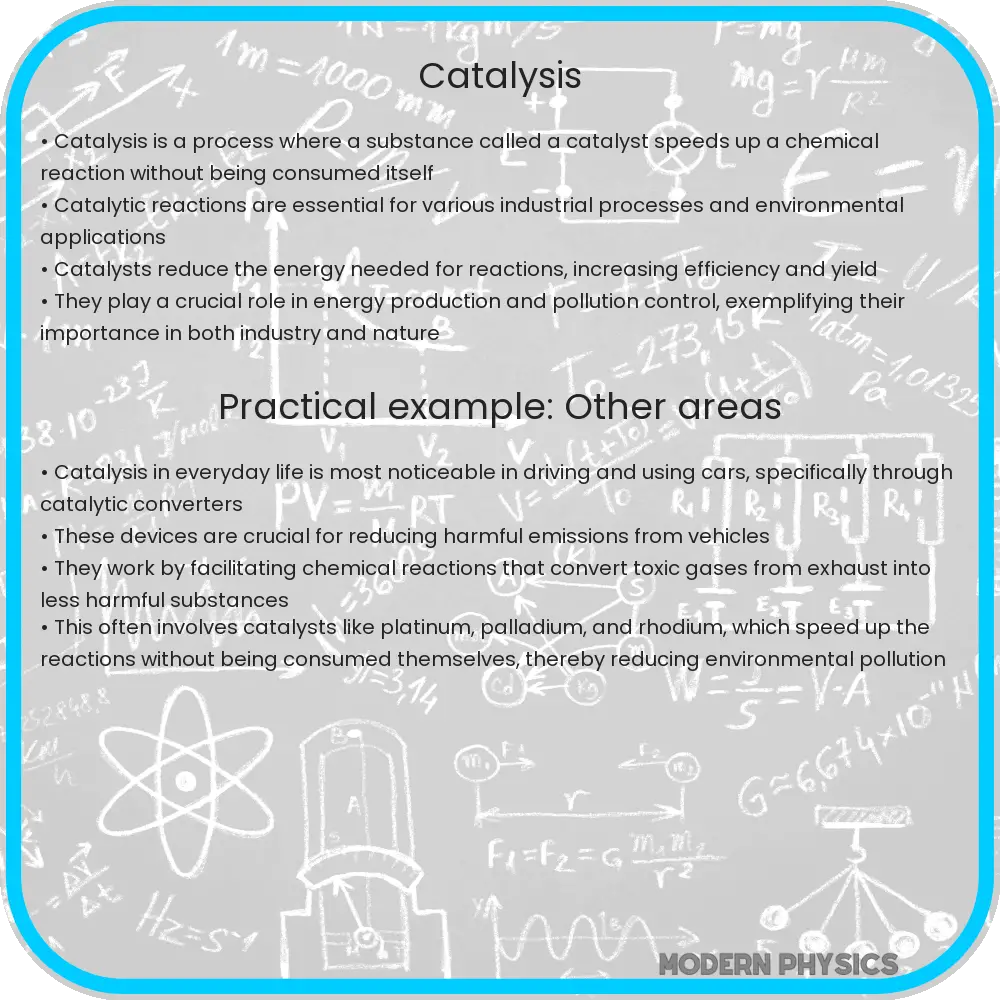
Understanding Catalysis: A Gateway to Chemical Efficiency
Catalysis is a fundamental concept in chemical physics that greatly enhances the efficiency of a chemical reaction by lowering the activation energy required. This transformative process is not only pivotal in academic research but also serves as the backbone of many industrial applications.
The Mechanistic Insight into Catalysis
At its core, catalysis involves the interaction between a catalyst and the reactants. A catalyst is a substance that, although involved in the reaction, remains chemically unchanged upon completion of the reaction. This interaction typically occurs at the molecular level, where the catalyst provides an alternative pathway for the reaction with a lower activation energy.
The basic principle can be articulated through the Arrhenius equation, which demonstrates how reducing the activation energy increases the reaction rate:
\[ k = A * e^{-E_a/(RT)} \]
Here, k is the rate constant, A is the pre-exponential factor, Ea represents the activation energy, R is the gas constant, and T is the temperature in Kelvin. The presence of a catalyst effectively lowers Ea, thereby increasing k.
These catalysts can be classified into two main types: homogeneous and heterogeneous. Homogeneous catalysts exist in the same phase as the reactants, often leading to efficient mixing and interaction. In contrast, heterogeneous catalysts exist in a different phase than the reactants. They typically offer the advantage of being easily separated from the product mixture and reused.
Applications of Catalysis
The applications of catalysis are broad and highly influential in various industries. One prominent example is the synthesis of ammonia through the Haber process, which utilizes iron as a catalyst to facilitate the combination of nitrogen and hydrogen gases under high temperatures and pressures. This process is crucial for the production of fertilizers and, therefore, in global agriculture.
Another significant application is in the refining of crude oil, where catalysts are used to facilitate reactions that convert heavy hydrocarbons into lighter, more valuable products such as diesel and gasoline. Catalytic converters, which are used in reducing vehicle emissions, employ platinum, palladium, and rhodium catalysts to convert harmful gases like NOx, CO, and unburnt hydrocarbons into safer compounds such as N2, CO2 and H2O.
- Haber Process: Synthesis of ammonia using iron catalyst.
- Oil Refining: Conversion of heavy hydrocarbons into lighter compounds using catalysts.
- Emission Control: Use of catalytic converters in vehicles to reduce harmful emissions.
Catalysis not only plays a pivotal role in manufacturing and environmental management but also in sustainable energy solutions. For instance, the development of fuel cells heavily relies on catalysts to enhance the efficiency of the electrochemical reactions that produce electricity from hydrogen or other fuels.
Catalytic Materials and Innovation
In terms of materials used, the range of catalysts includes metals, enzymes, and even certain types of zeolites. Each material type offers distinct characteristics that make them suitable for specific reactions. The ongoing innovation in catalyst technology often involves the development of more efficient, cost-effective, and environmentally friendly catalysts that can withstand various industrial conditions.
Significant research efforts are also directed towards photocatalysis, where light energy (usually solar) is utilized to initiate and drive reactions. This type of catalysis holds the key to harnessing solar power to create chemical products, thereby contributing to the development of green energy solutions.
The exploration of nanotechnology in catalysis presents another promising avenue, where nanoparticles are used as catalysts. These nanoparticles often exhibit superior properties due to their high surface-area-to-volume ratio, which significantly increases the contact area with reactants.
Challenges and Future Directions in Catalysis
Despite the extensive use and benefits of catalysts, there are several challenges that researchers and engineers face. One major challenge is the deactivation of catalysts due to sintering, poisoning, or fouling, which reduces their effectiveness over time. Innovations in material science and engineering are crucial for developing more robust catalysts that can resist such deactivation processes and maintain their activity for longer durations.
Moreover, the quest for more sustainable and environmentally friendly catalytic processes is driving research towards finding alternatives to precious metal catalysts, which are costly and often have issues relating to supply and ethical mining practices. Research into bio-based catalysts or those derived from abundant materials is increasing, with the aim to reduce dependency on non-renewable resources.
Educational and Societal Impacts of Catalysis
The study and application of catalysis also play a critical role in education and societal development. By integrating catalysis into academic curriculums, educational institutions can nurture a new generation of scientists and engineers equipped with the knowledge to tackle future challenges in energy, environment, and manufacturing sectors. Furthermore, the advancements in catalysis have the potential to bolster economies by optimizing manufacturing processes and reducing waste and energy consumption.
This integration of catalysis in diverse sectors demonstrates not only its versatility but also its potential to significantly impact future technological advancements and sustainable practices.
Conclusion
Understanding catalysis and its applications highlights its indispensability in modern society. From making agricultural practices more efficient to enabling cleaner transportation and advancing sustainable energy solutions, catalysis is at the heart of numerous essential industrial processes. The continual innovation and research in catalytic processes and materials promise to further enhance efficiency, cost-effectiveness, and environmental sustainability. As we advance, the role of catalysis is set to become even more pivotal, holding the potential to drive the next big leaps in technology and environmental preservation. Embracing and supporting this field is crucial for a sustainable future, making the study of catalysis a valuable endeavor for aspiring scientists and engineers around the world.