
Explore the transformative world of capillary suspensions, their impact on rheology, wide-ranging applications, and key stability considerations.
Introduction to Capillary Suspensions
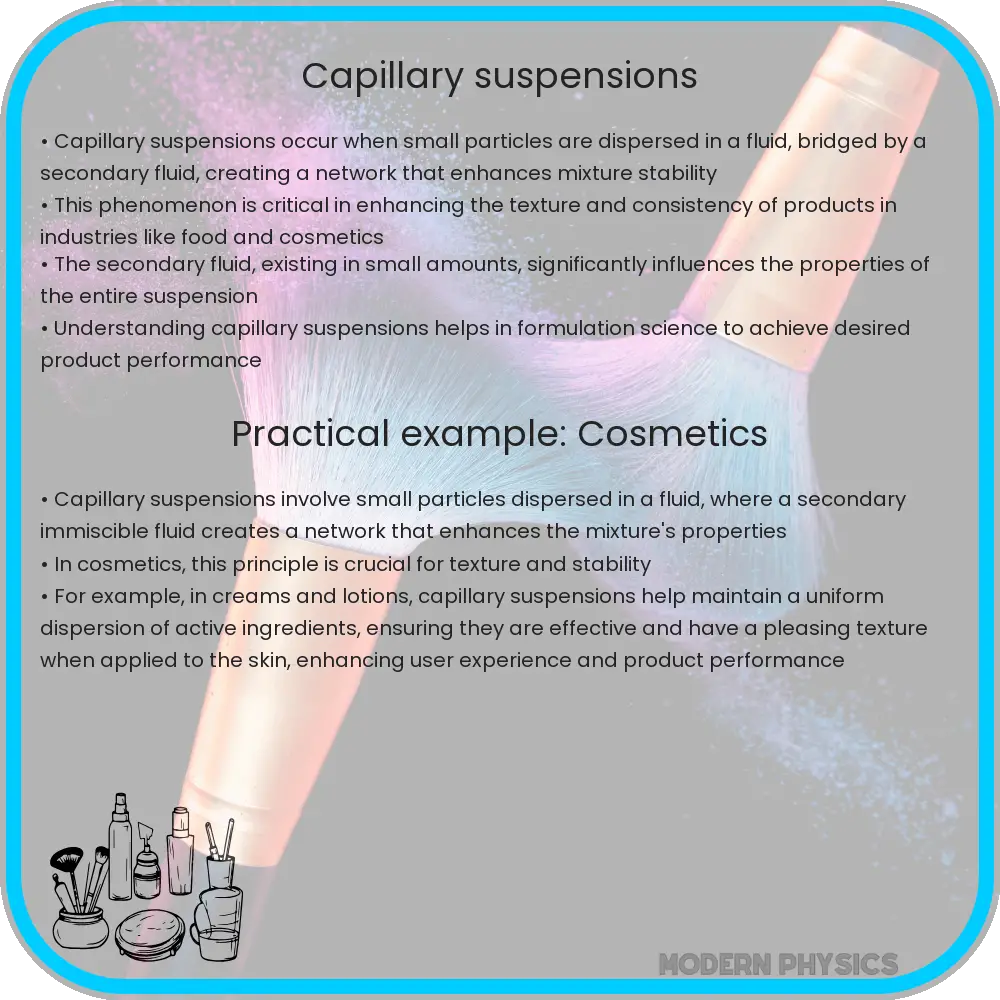
Capillary suspensions represent a fascinating class of materials characterized by their unique rheological properties and broad range of applications. This term refers to a three-phase system consisting of solid particles, a primary liquid in which the particles are poorly wetted, and a secondary liquid that bridges the particles through capillary forces. The intricate balance between these components results in a complex fluid with properties that can be finely tuned for various uses.
Rheological Properties
The rheology of capillary suspensions is marked by its non-Newtonian behavior, primarily showing shear thickening or shear thinning characteristics. The presence of a secondary liquid creates capillary bridges between particles, significantly impacting the suspension’s flow behavior. Under low shear rates, these capillary bridges provide a network structure that increases the material’s viscosity, leading to solid-like properties. Conversely, at high shear rates, these structures break down, and the fluid exhibits decreased viscosity. This unique property allows for applications requiring materials that can transition between solid and liquid states under different conditions.
Applications of Capillary Suspensions
Capillary suspensions have vast applications across multiple industries due to their adaptable rheological properties. In the food industry, they can improve the texture and stability of products like sauces and dressings. In pharmaceuticals, they are used to form stable suspensions, enhancing the delivery and efficacy of drugs. Additionally, in the ceramics industry, capillary suspensions serve as precursors for high-strength, porous ceramics through a process known as gel casting.
Stability Considerations
The stability of capillary suspensions is crucial for their practical application and is influenced by several factors including particle size, the volume fraction of the phases, and the wetting properties of the liquids involved. The precise control over these parameters ensures the longevity and efficacy of the capillary suspension in its respective application. Understanding the interplay between these factors is essential for optimizing the performance and reliability of products derived from capillary suspensions.
Capillary Suspensions: A Comprehensive Overview
Capillary suspensions represent a novel class of materials where a small amount of secondary fluid, immiscible with the continuous phase, is added to a particulate suspension. This addition leads to a dramatic transformation in the system’s properties due to the formation of capillary bridges between particles. These bridges significantly enhance the system’s rheological properties, providing new opportunities for various applications.
Rheological Implications
The rheology of capillary suspensions is profoundly influenced by the capillary forces that arise from the added secondary fluid. These forces induce a network structure within the suspension, leading to an increase in its yield stress and viscosity. The presence of capillary bridges transforms a fluid-like suspension into a semi-solid paste, exhibiting characteristics such as shear thinning and thixotropy. This behavior is critical in applications requiring shape retention post-application, like in 3D printing or food manufacturing.
Applications in Various Industries
- Pharmaceuticals: In tablet manufacturing, capillary suspensions enhance the uniformity and mechanical strength of tablets by improving the binding properties of powders.
- Food Processing: They improve texture and stability in food products, acting as thickeners or stabilizers.
- Cosmetics: Utilized for their rheological control, allowing for better application properties and stability in products like creams and lotions.
- Ceramics: In ceramic processing, capillary suspensions aid in improving the green strength and moldability of ceramic parts.
Stability Considerations
While capillary suspensions offer numerous benefits, their stability is crucial for practical applications. Factors such as the volume fraction of the secondary fluid, particle size distribution, and the wettability of particles significantly influence stability. Ensuring the right balance between these factors is essential for maintaining the desired suspension properties over time. Furthermore, environmental conditions like temperature and humidity can affect the evaporation rates of the secondary fluid, altering the capillary forces and, consequently, the suspension’s stability.
Conclusion
Capillary suspensions present a transformative approach in material science, offering enhanced rheological properties and application potentials across various industries. Understanding the underlying mechanics of capillary forces and stability considerations is crucial for leveraging their benefits. As research continues to evolve, the potential for innovative applications and improvements in product formulation and processing seems boundless. By addressing challenges related to stability and optimizing formulations, capillary suspensions can provide sustainable and efficient solutions tailored to specific industry needs.