
Explore the mechanics and applications of cam follower systems, focusing on their conversion of rotary motion into linear motion, high precision, efficiency, and dynamic operational capabilities.
Understanding the Cam Follower System
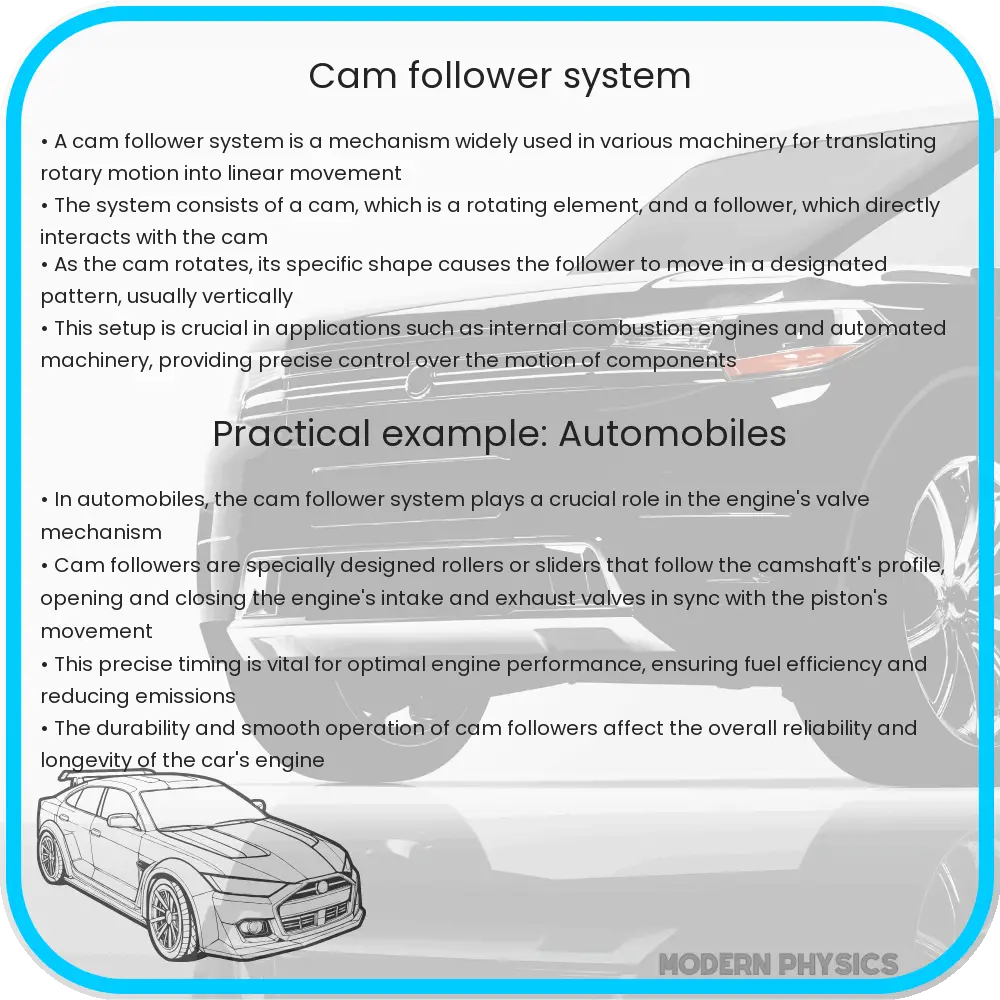
The cam follower system is an essential mechanism found in various applications ranging from automotive engines to automated machinery. This system converts rotary motion into linear motion and is renowned for its precision, efficiency, and dynamic capabilities. It comprises primarily of a cam—a rotating or sliding piece often oddly shaped—and a follower which directly or indirectly interacts with the cam.
Precision in Cam Follower Systems
At the heart of the cam follower system’s design is its ability to achieve high levels of precision. This precision is crucial in applications where exact movements are critical. The shape of the cam dictates the follower’s path, and thus, can be designed to an accurate profile to meet specific motion requirements. This intricate control over follower movement allows for the exact timing and control needed in complex machinery, such as in the control of valves in an internal combustion engine.
Efficiency of Cam Follower Systems
Efficiency in cam follower systems refers to the effective transfer of motion and energy between the cam and the follower. Design considerations such as the materials used, the shape of the cam, and the type of follower (roller, flat, or needle) play significant roles. For instance, roller followers significantly reduce friction compared to flat followers, enhancing the system’s efficiency by minimizing energy losses.
Dynamics of Cam Follower Systems
The dynamics of cam follower systems are influenced by the speeds at which they operate and the forces involved. These systems can achieve very high speeds and can operate under varying load conditions. Dynamic stress analysis allows engineers to predict how the system will perform under different operational conditions. This analysis typically involves the study of kinematics and kinetics of the follower, considering factors such as velocity, acceleration, and forces applied to the follower.
To understand these dynamics, let’s consider the simple harmonic motion of the follower. The displacement y of the follower can be described by the equation:
y = A * cos(ωt + φ)
where:
- A is the amplitude of motion,
- ω (omega) represents the angular velocity, and
- φ (phi) is the phase angle.
This equation helps in designing a cam profile that ensures the follower moves in the desired manner, achieving planned velocities and accelerations, thereby influencing the system’s overall dynamics.
Applications of Cam Follower Systems
Cam follower systems are widely used across multiple industries due to their versatile nature. In automotive engineering, they are crucial for operating valve trains in engines. Their precise movement controls the timing and amount of air-fuel mixture allowed into the combustion chamber, and the exhaust gases expelled out. This precision directly impacts engine performance, fuel efficiency, and emissions.
In manufacturing, automated equipment often relies on cam follower mechanisms to facilitate complex assembly lines. These systems enable the synchronized operation of various machine parts, ensuring smooth and efficient production processes. Additionally, cam followers are used in textile machinery to ensure fabric is manipulated with high precision, which is essential for consistent quality.
Maintenance and Durability of Cam Follower Systems
Maintenance is a critical aspect of ensuring the longevity and performance of cam follower systems. Regular inspection and lubrication help prevent premature wear and failure, particularly in high-load and high-speed applications. Choosing the right materials and coatings can also significantly enhance the durability and performance of these systems. For instance, using hardened steel for cams and incorporating surface treatments can increase resistance to wear and fatigue.
To determine the service life of a cam follower system, load conditions, operational speeds, and environmental factors must be considered. Engineers use lifespan prediction models and testing to estimate maintenance schedules and replacement intervals, which helps in reducing downtime and maintenance costs.
Conclusion
Cam follower systems play a pivotal role in modern mechanical engineering, driving the performance and efficiency of various machinery. From the precise control required in automotive valve trains to the synchronized operations in manufacturing lines, these systems are fundamental in numerous applications. Their design emphasizes precision, efficiency, and dynamic capability, which are enhanced by considering factors such as the cam shape, follower type, and material properties. Additionally, understanding the kinematics and kinetics involved allows engineers to optimize these systems for better performance and durability.
By maintaining these systems properly and choosing suitable materials, the longevity and reliability of cam follower systems can be maximized, contributing to the overall effectiveness of the equipment they are a part of. With continued advancements in material science and mechanical engineering, the future of cam follower systems looks promising, potentially offering even greater efficiency and versatility in their applications.