
Explore the properties and applications of bucky paper, a strong, lightweight material made from densely packed carbon nanotubes.
Understanding Bucky Paper: A Marvel of Material Science
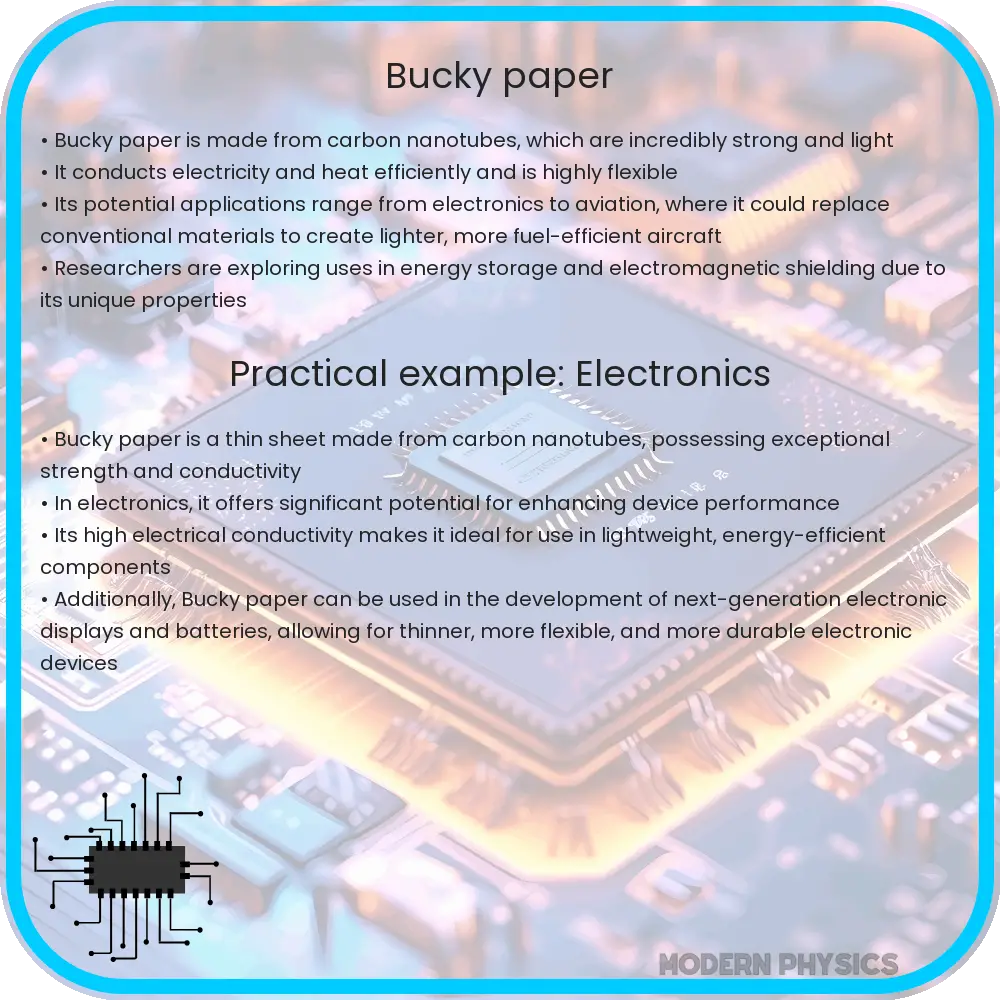
Bucky paper is a thin sheet made from an aggregate of carbon nanotubes (CNTs), which themselves are cylindrical molecules composed of carbon atoms arranged in a lattice structure. The name ‘bucky’ derives from Buckminsterfullerene, the fullerene molecule that resembles the geodesic domes designed by architect Buckminster Fuller. Despite its incredibly lightweight nature, bucky paper is celebrated for its exceptional strength and conductivity.
Composition and Production
At the heart of bucky paper’s remarkable properties, is the carbon nanotube. Carbon nanotubes are renowned for their mechanical, electrical, and chemical properties. They are made from sheets of graphene rolled into tubes, with diameters as small as 1 nanometer. These tubes are not only stronger than steel, but also lighter in weight, owing primarily to the strong covalent bonds between the carbon atoms.
The production of bucky paper involves two crucial steps. Firstly, the carbon nanotubes must be synthesized. This can be achieved through various methods like chemical vapor deposition, laser ablation, or high-pressure carbon monoxide reaction. The second step involves filtering a solution of carbon nanotubes through a membrane. This filters out impurities and allows the formation of a uniform film or “paper” composed of densely packed nanotubes.
Strength and Durability
Bucky paper is distinguished by its remarkable tensile strength and durability. Tensile strength, which measures a material’s ability to withstand pulling forces, is exceptionally high in bucky paper due to the strength of the sp2 bonds found in the carbon atom lattice of the nanotubes. These tubes can withstand great strain without breaking, making bucky paper an ideal candidate for applications requiring lightweight yet strong materials.
Electrical and Thermal Conductivity
Apart from its mechanical strengths, bucky paper is also an excellent conductor of electricity and heat. The seamless structure of the carbon nanotubes allows electrons and thermal energy to flow unhindered across the lattice. This property has significant implications for developing lightweight components in electronics and energy applications, such as in heat sinks, electromagnetic shielding, and wiring in aerospace technologies.
- Lightweight nature makes it suitable for aerospace and portable devices.
- Stronger than steel which provides an advantage in construction and structural applications.
- High conductivity makes it ideal for use in electronic and thermal management systems.
Potential Applications
The unique properties of bucky paper open doors to numerous practical applications across various industries. In aerospace, bucky paper can be used to manufacture parts that are both lighter and stronger than those made from traditional materials, potentially improving fuel efficiency and payload capacity. In electronics, its superior conductivity and thermal stability make it a superior choice for flexible electronics, advanced cooling systems, and even as a potential substrate for building electronic circuits that are both lightweight and flexible.
Given its barrier properties, bucky paper is also being explored for its use in advanced filtration systems, capable of removing microscopic contaminants from air and water. Environmental cleanup, water purification, and breathable protective garments are just a few examples where bucky paper could make significant contributions.
Moreover, the field of energy storage and generation, specifically in batteries and supercapacitors, sees bucky paper as a promising material to enhance the performance and decrease the weight of these devices. This could be particularly impactful in making electric vehicles lighter and extending their driving range.
Challenges and Future Research
While bucky paper presents numerous advantages, there are challenges that need to be addressed to fully exploit its potential. One of the significant challenges is the scalability of production processes. Current methods of synthesizing carbon nanotubes and forming them into bucky paper are often complex, costly, and not suitable for large-scale production. Additionally, ensuring consistency and purity in the nanotubes can be difficult, impacting the final product’s properties.
Another issue is the integration of bucky paper with other materials. For applications in electronics or aerospace, it is crucial that bucky paper interfaces well with other components. Research is ongoing to enhance the compatibility of bucky paper with various substrates and materials to ensure robust, multifunctional composites.
Future research is directed towards overcoming these obstacles. Innovations in manufacturing technologies that can scale up production while reducing costs are particularly critical. Moreover, enhancing the electrical and mechanical properties through functionalization of the carbon nanotubes or by hybridizing them with other nanomaterials is an area of active research. These advancements could further broaden the applications of bucky paper.
Conclusion
Bucky paper is a fascinating material that combines an array of extraordinary properties, from high strength and light weight to excellent conductivity. Its potential uses span across many critical sectors like aerospace, electronics, environmental technology, and more. However, to realize these applications, the challenges of production scalability and material integration need to be overcome. With continued research and technological advancements, there is confidence that bucky paper will play a significant role in the future of material science and engineering, driving innovation in numerous fields. It stands as a testament to the incredible capabilities that nanotechnology holds for the future of high-performance materials.