
Explore the mysteries of brown dwarfs: their observations, atmospheric dynamics, evolution, and the challenges faced in studying these cosmic misfits between stars and planets.
Brown Dwarf Observations: Unveiling Cosmic Misfits
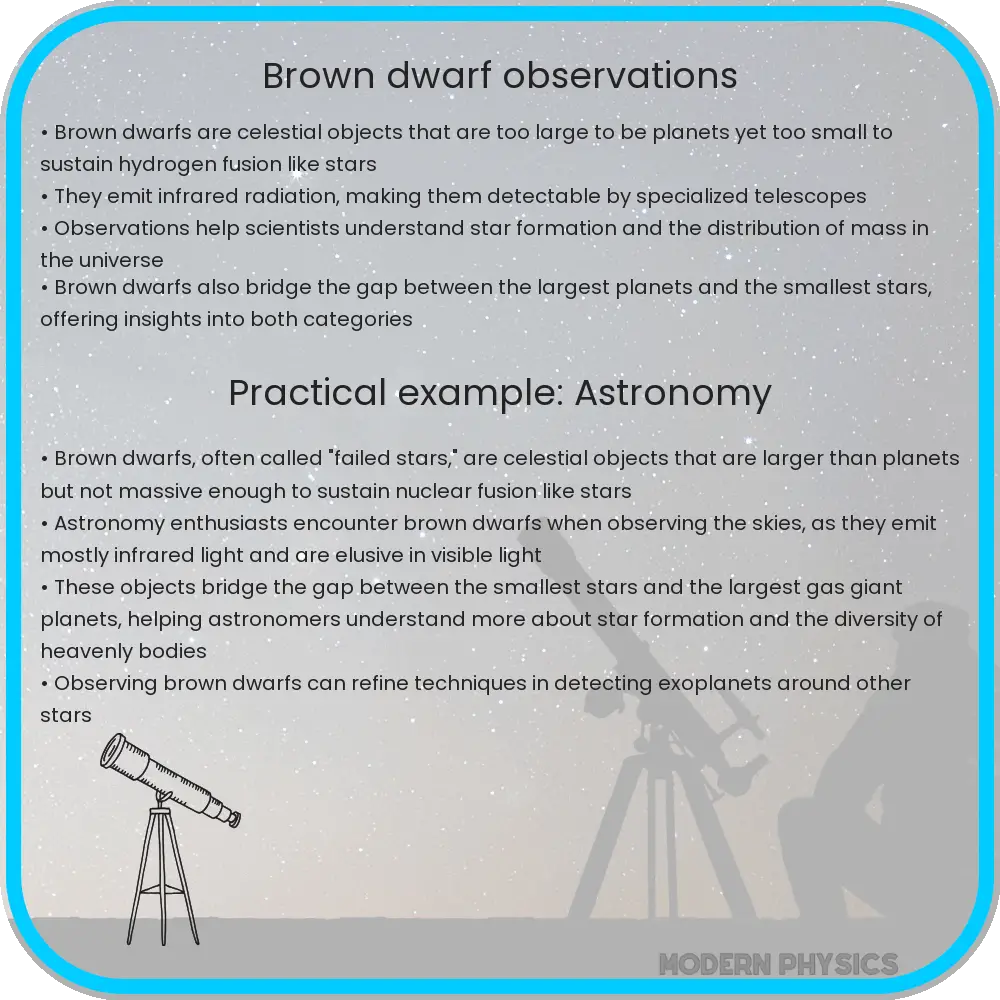
Brown dwarfs, often termed as ‘failed stars,’ occupy the enigmatic realm between the largest planets and the smallest stars. These celestial objects are critical to our understanding of stellar evolution, atmospheric physics, and the diversity of astronomical bodies. Recent advancements in observational technology have paved the way for groundbreaking insights into the mysterious nature of brown dwarfs.
Data Analysis in Brown Dwarf Research
Observational data on brown dwarfs are primarily obtained through infrared and radio telescopes, as these objects emit most of their energy at longer wavelengths. Sophisticated data analysis techniques, such as spectroscopy, allow astronomers to decode the light from brown dwarfs into spectra. By examining these spectra, scientists can infer various characteristics, including temperature, composition, and atmospheric conditions. Machine learning algorithms have increasingly been applied to sift through vast datasets, enhancing the accuracy and efficiency of brown dwarf classification and characterization.
Atmospheric Insights
The atmospheres of brown dwarfs are complex and varied, displaying a rich tapestry of chemicals and weather patterns. Observations have revealed atmospheres composed of molecules such as water (H2O), methane (CH4), and ammonia (NH3). Moreover, the presence of clouds and atmospheric bands akin to those seen in Jupiter’s atmosphere has been detected. The study of these features provides invaluable information on atmospheric dynamics and chemistry not only in brown dwarfs but also in exoplanets.
The Evolution of Brown Dwarfs
Understanding the life cycle of brown dwarfs is crucial for astrophysical theories. These objects cool and dim over time, transitioning through various spectral types. The initial mass of a brown dwarf dictates its evolutionary path, affecting its temperature, luminosity, and lifespan. Observations and modeling of brown dwarf populations contribute to our understanding of the lower end of the stellar mass function and the distinction between the most massive planets and the least massive stars.
Challenges and Future Prospects in Brown Dwarf Studies
Despite significant advancements, the study of brown dwarfs faces numerous challenges. Their inherent faintness and the ambiguity in distinguishing them from high-mass planets and low-mass stars complicate observations and analysis. Additionally, the variability in their atmospheres, influenced by factors like cloud coverage and weather phenomena, requires continuous and long-term monitoring to understand fully. Future missions and telescopes, such as the James Webb Space Telescope (JWST) and the Extremely Large Telescopes (ELTs), are expected to provide deeper insights into the elusive nature of brown dwarfs by offering unprecedented resolution and sensitivity.
Interdisciplinary Implications
The research on brown dwarfs has far-reaching implications beyond the confines of astronomy. It intersects with planetary science, atmospheric physics, and even chemistry, providing a unique laboratory for studying processes and phenomena that cannot be observed directly on Earth. For instance, the atmospheric dynamics of brown dwarfs can shed light on similar processes in the gas giants of our own solar system and exoplanetary atmospheres.
Conclusion
Brown dwarfs serve as a bridge in our understanding of the cosmos, lying at the intersection of planets and stars. Their study not only challenges our definitions but also enriches our knowledge of the universe’s diversity and complexity. As technology advances, so too will our understanding of these fascinating objects. The ongoing and future observations promise to unravel more secrets of brown dwarfs, contributing to the broader fields of astrophysics and planetary science. In embracing the enigmatic nature of brown dwarfs, we continue to expand the boundaries of our cosmic knowledge and challenge the limits of our curiosity.