
Explore Boundary Layer Control’s role in enhancing aerodynamics for transportation, its innovative techniques, and impact on sustainability.
Understanding Boundary Layer Control: Enhancing Aerodynamic Efficiency
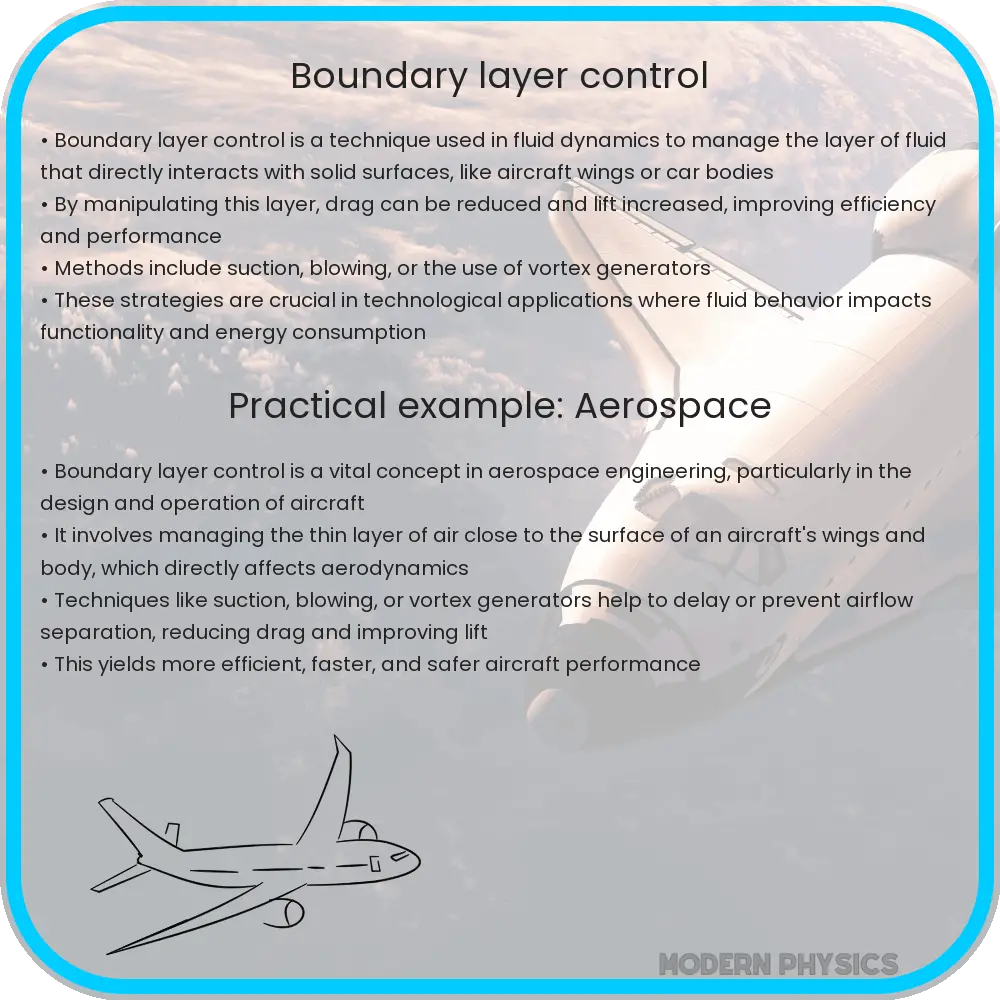
The concept of Boundary Layer Control (BLC) is pivotal in the field of aerodynamics, focusing on manipulating the boundary layer – a thin layer of fluid in immediate contact with a solid surface. This layer plays a critical role in determining the aerodynamic efficiency of vehicles, particularly aircraft and high-speed trains. Effective control of the boundary layer can significantly reduce drag, thereby enhancing efficiency and performance.
Techniques in Boundary Layer Control
Several innovative techniques have been developed to manage the boundary layer effectively. These include:
- Laminar Flow Control (LFC): This technique aims to maintain the boundary layer in a laminar or smooth state for as long as possible, delaying transition to turbulent flow. Laminar flow exhibits less frictional drag compared to turbulent flow, leading to improved efficiency.
- Turbulent Flow Control: In situations where laminar flow cannot be maintained, controlling the characteristics of turbulent flow can still yield benefits. Techniques such as riblets or dimples, similar to those on a golf ball, are used to reduce skin-friction drag in turbulent flow.
- Active Flow Control: This involves the use of devices like blowers or suction systems to directly influence the behavior of the boundary layer. For instance, suction can be used to remove low-energy fluid near the surface, delaying flow separation and drag increase.
Innovations in Boundary Layer Control
Recent advancements in BLC are driven by technological innovations:
- Smart Materials: The use of materials like piezoelectric actuators can dynamically alter surface characteristics, adapting in real-time to different flow conditions to optimize boundary layer behavior.
- Computational Fluid Dynamics (CFD): Advanced CFD models enable precise simulation and understanding of boundary layer dynamics, allowing for more effective design and control strategies.
- Nanostructured Coatings: These coatings can significantly modify the interaction between the fluid and the surface, thereby affecting boundary layer properties and reducing drag.
One of the significant challenges in BLC is the complex interplay between the boundary layer and the larger flow field. Innovations in sensor technology and real-time data processing are crucial for monitoring and adapting to these dynamic conditions. The integration of AI and machine learning algorithms also holds promise for predictive and adaptive boundary layer control systems.
Overall, the advancements in BLC techniques and innovations not only promise enhanced efficiency and performance for aerodynamic vehicles but also open new horizons in sustainable and high-speed transportation technologies.
Impact of Boundary Layer Control on Sustainability and Performance
Boundary Layer Control (BLC) has far-reaching implications in the realm of sustainable transportation and environmental conservation. By reducing drag and thereby lowering fuel consumption, BLC plays a crucial role in diminishing the carbon footprint of aviation and high-speed rail systems. This reduction in energy demand aligns with global efforts to combat climate change, making BLC a cornerstone technology in green transportation initiatives.
In the context of performance, BLC technologies significantly enhance the speed and efficiency of vehicles. For aircraft, this means shorter flight times and reduced operational costs. For trains, it results in higher speeds and improved passenger comfort. The maritime industry also benefits from these technologies, with ships experiencing lower resistance, leading to fuel savings and increased cargo capacity.
Challenges and Future Directions
Despite its benefits, BLC faces several challenges. The complexity of accurately controlling the boundary layer in varying atmospheric conditions and the cost of implementing these systems are notable hurdles. Additionally, maintaining the integrity and functionality of BLC systems over time, especially in harsh environmental conditions, is a significant concern.
Looking ahead, the future of BLC lies in the integration of emerging technologies. Advancements in materials science, nanotechnology, and artificial intelligence are expected to yield more efficient and robust BLC systems. The potential of adaptive surfaces that can change their properties in real-time to optimize boundary layer behavior is a particularly exciting development. Furthermore, the ongoing research in biomimicry, inspired by natural examples such as shark skin, holds promise for innovative BLC solutions.
Conclusion
Boundary Layer Control stands at the forefront of aerodynamic innovation, offering substantial benefits in terms of efficiency, performance, and sustainability. As we move towards a more eco-conscious future, the importance of BLC in reducing the environmental impact of transportation cannot be overstated. The continuous evolution of this field, driven by technological advancements and interdisciplinary research, is set to revolutionize the way we think about and interact with the flow dynamics in transportation systems. The journey of BLC, from a concept to a key component in modern aerodynamics, underscores its transformative potential in shaping the future of transportation.