
Explore the fascinating world of Bose-Einstein Condensates, their role in quantum mechanics, applications in technology, and future potential.
Understanding Bose-Einstein Condensates
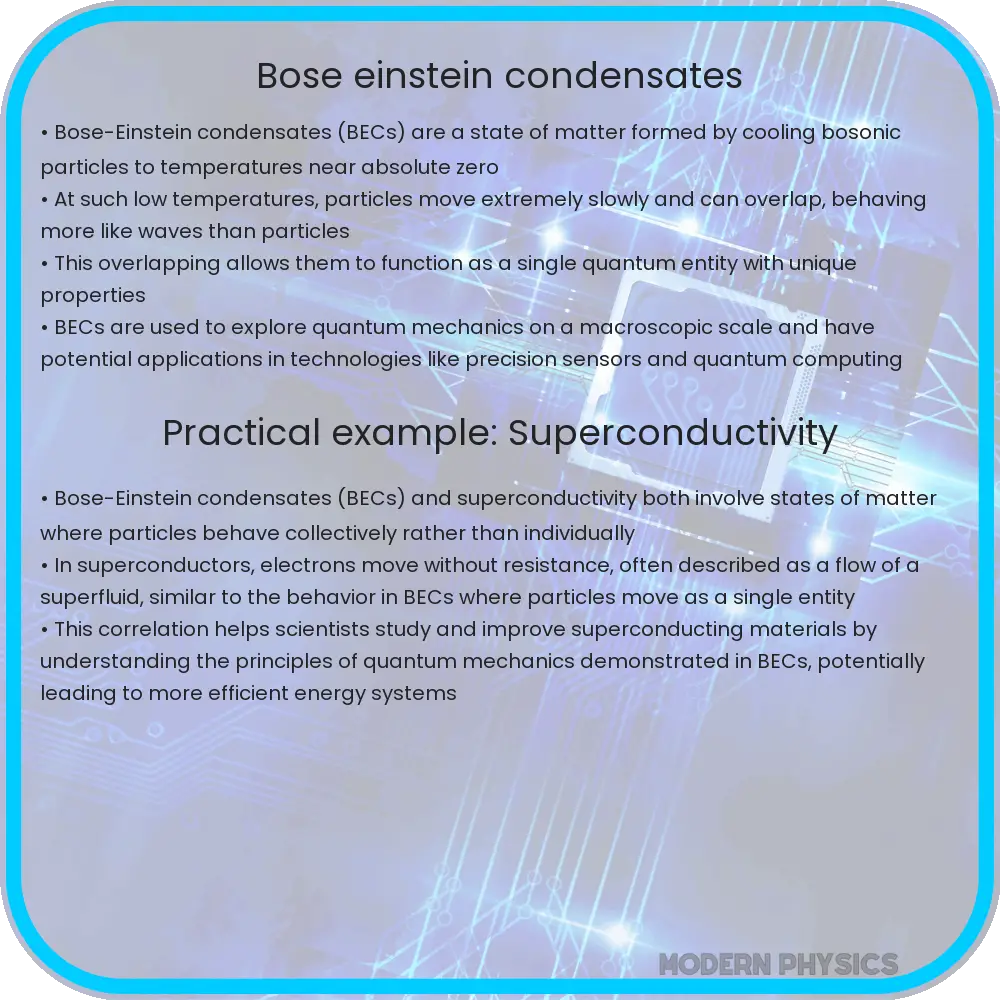
Bose-Einstein Condensates (BECs) represent one of the most intriguing states of matter, lying at the crossroads of quantum mechanics and particle physics. First predicted by Satyendra Nath Bose and Albert Einstein in the early 20th century, BECs were not created in laboratory settings until 1995. These condensates are formed when atoms are cooled to temperatures near absolute zero, leading to unique quantum phenomena that challenge our traditional understanding of physics.
Formation and Characteristics
At temperatures close to absolute zero (0 Kelvin or -273.15°C), particles slow down significantly, allowing quantum effects to dominate over thermal energy. In this ultra-cold environment, a group of atoms can enter the same quantum state, becoming indistinguishable and moving in unison as a single quantum entity. This phenomenon is a direct manifestation of Bose-Einstein statistics, applicable to particles known as bosons, which include photons, W and Z bosons, and atoms with integer spin values.
Quantum Coherence and Superfluidity
One of the most astonishing features of BECs is quantum coherence. In this state, particles behave as though they are part of a larger, interconnected wave function, leading to properties like superfluidity. Superfluidity is the ability of a fluid to flow without viscosity, allowing it to move through narrow channels and over barriers without losing energy. This remarkable property is a key to understanding various quantum phenomena and has significant implications in the study of quantum mechanics and thermodynamics.
Applications and Implications
BECs have opened new avenues in various fields such as condensed matter physics, quantum computing, and even astrophysics. Their unique properties are used to study quantum phenomena on a macroscopic scale, such as superconductivity and superfluidity. Additionally, BECs are instrumental in precision measurements and improving the accuracy of atomic clocks. In particle physics, they provide insights into the behavior of quantum particles under extreme conditions, potentially offering clues about the early universe.
Moreover, the study of BECs is crucial for understanding coherence and entanglement in quantum systems. These properties are fundamental to the development of quantum computing, where qubits must maintain coherence to perform computations. BECs also play a role in exploring the limits of quantum mechanics and the transition between quantum and classical worlds.
Exploring Quantum Mechanics with BECs
Bose-Einstein Condensates are not just theoretical curiosities; they provide a practical platform for exploring and testing the fundamental principles of quantum mechanics. They help scientists understand phenomena like entanglement, where particles remain interconnected regardless of the distance separating them. This principle is a cornerstone of quantum theory, and BECs offer a way to observe it in a controlled environment. Additionally, BECs aid in the exploration of quantum tunneling, where particles pass through barriers that would be insurmountable according to classical physics.
BECs in Advanced Technologies
The potential applications of BECs extend to advanced technologies. For instance, in quantum computing, BECs can be used to create qubits that are more stable and less prone to decoherence. This stability is crucial for the development of reliable quantum computers capable of solving complex problems far beyond the reach of classical computers. Furthermore, in the field of telecommunications, BECs have the potential to improve the efficiency and security of data transmission through quantum communication channels.
Challenges and Future Directions
Despite their promise, working with BECs presents significant challenges. Maintaining the ultra-cold temperatures required for their formation is a complex and energy-intensive process. Additionally, controlling and manipulating these condensates for practical applications requires advanced technology and a deeper understanding of quantum mechanics. However, ongoing research in this field continues to break new ground, bringing us closer to harnessing the full potential of BECs in various scientific and technological applications.
Conclusion
Bose-Einstein Condensates are a fascinating state of matter that bridge the gap between quantum mechanics and classical physics. They provide a unique window into the quantum world, allowing scientists to observe and experiment with phenomena that were once purely theoretical. The study of BECs has not only deepened our understanding of quantum mechanics but also holds the potential to revolutionize technology, from quantum computing to precision measurement. As research continues, the mysteries and opportunities presented by BECs promise to keep this field at the forefront of scientific inquiry for years to come.