
Explore the principles of stability, load balance, and design through the simple analogy of stacking books, and their applications in various fields.
Understanding Book Stack Stability, Load Balance, and Design Principles
The concept of stacking books is a simple yet intriguing analogy for understanding stability, load balance, and design principles in various fields, including engineering, architecture, and even software development. When we stack books, we intuitively apply fundamental principles of balance and design to ensure the stack remains stable. This article explores these principles and their broader applications.
1. Stability in Book Stacking
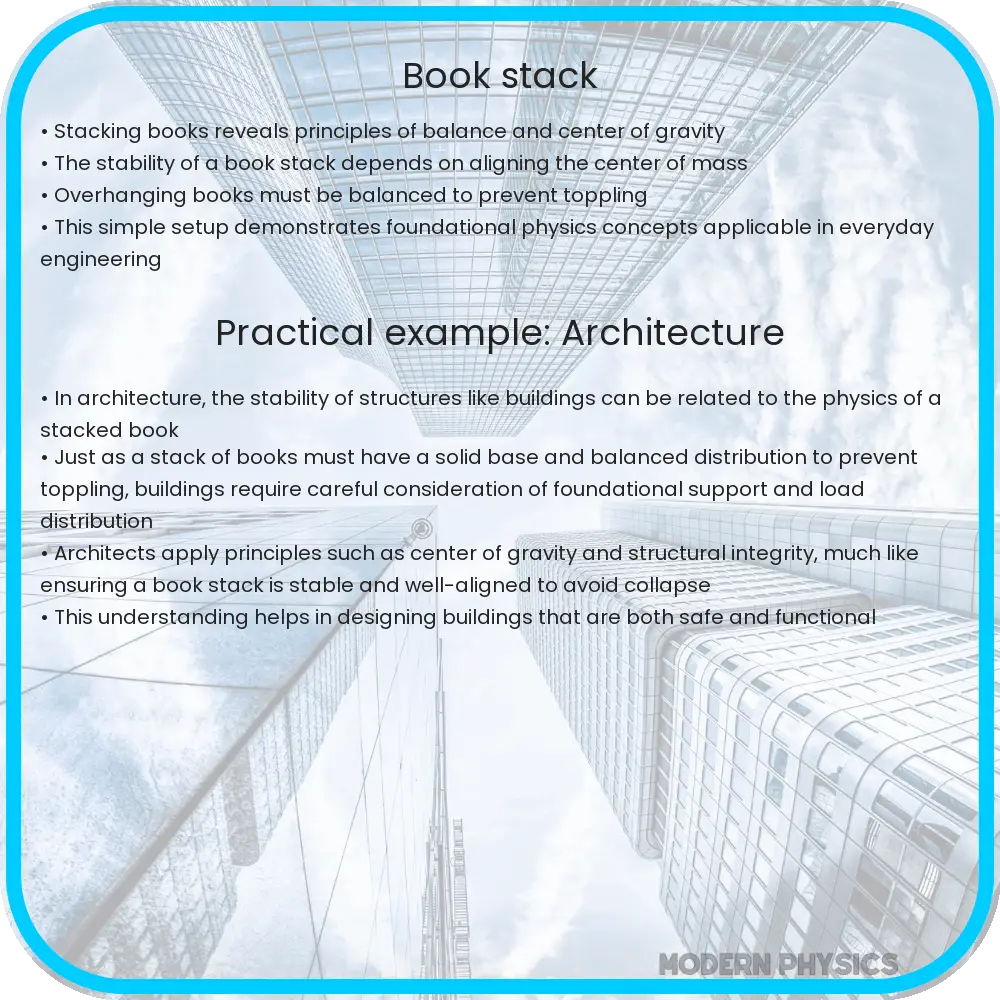
Stability in a book stack is achieved when the center of gravity of the stack remains within the base area of the lowest book. This is akin to the principle of static equilibrium in physics, where the sum of forces and moments acting on an object is zero, ensuring it remains at rest. In practical terms, this means carefully aligning each book so that the stack does not topple over.
2. Load Balance in Book Stacking
Load balancing involves distributing weight or load evenly. In a stack of books, this means placing heavier books at the bottom and lighter ones on top. This principle is crucial in engineering and architecture, where load distribution affects the structural integrity of buildings and bridges. Similarly, in software development, load balancing refers to distributing workloads across multiple computing resources to optimize efficiency and prevent any single resource from being overwhelmed.
3. Design Principles in Book Stacking
Key design principles can be observed in how we stack books. These include:
- Gravity and Balance: Leveraging gravity’s pull to maintain balance, much like how architects consider gravitational forces in building designs.
- Weight Distribution: Evenly distributing weight to maintain stability, a principle vital in structural engineering and user interface design.
- Aesthetics: The visual appeal of a book stack, reflecting principles of symmetry and order, is analogous to the importance of aesthetics in product and graphic design.
Applying these principles to book stacking is a microcosm of their broader applications in various disciplines. Whether it’s ensuring the stability of a skyscraper or the efficient operation of a computer network, the fundamentals of stability, load balance, and design are universally applicable.
In the next section, we will delve deeper into how these principles are applied in specific fields, illustrating the versatility and importance of understanding stability, load balance, and design principles in both physical and abstract contexts.
Applications of Stability, Load Balance, and Design Principles in Various Fields
Building upon the foundational principles of stability, load balance, and design, as exemplified in book stacking, we can see their significant applications across various fields. These principles are not just theoretical concepts but are essential in practical implementations in engineering, architecture, software development, and even in daily life.
1. Engineering and Architecture
In engineering and architecture, the principles of stability and load balance are paramount. For instance, in constructing a building, engineers must calculate the load-bearing capacity of the structure to ensure stability under various conditions, including the weight of the building, occupancy, and environmental factors like wind and earthquakes. Similarly, architects design buildings with an eye for aesthetic balance, ensuring that structures are not only functional but also visually pleasing.
2. Software Development
In software development, these principles manifest differently but are equally crucial. Load balancing is essential in managing network traffic and server loads, ensuring that no single server is overwhelmed, which can lead to system failures. Design principles in software focus on user experience and interface design, ensuring that applications are intuitive, responsive, and aesthetically appealing.
3. Everyday Life
Even in everyday life, we apply these principles often subconsciously. Organizing a room, packing a suitcase, or arranging items on a shelf involves considerations of balance, weight distribution, and aesthetic design. These activities demonstrate the practical application of these principles in our daily routines.
Conclusion
The analogy of stacking books serves as a simple yet profound example of the principles of stability, load balance, and design. These principles, though seemingly basic, have far-reaching implications in various disciplines. They ensure structures stand tall and resilient, software systems operate efficiently, and our daily lives are organized and harmonious. The understanding and application of these principles are fundamental to creating functional, efficient, and aesthetically pleasing systems, whether they are tangible structures like buildings or intangible ones like software programs. In essence, the principles of stability, load balance, and design are integral to the progress and functionality of our modern world, influencing how we build, create, and live.