
Explore the Boltzmann Transport Equation’s role in non-equilibrium systems, its applications in semiconductor physics, and future research directions.
Boltzmann Transport Equation: Bridging the Gap in Non-Equilibrium Systems
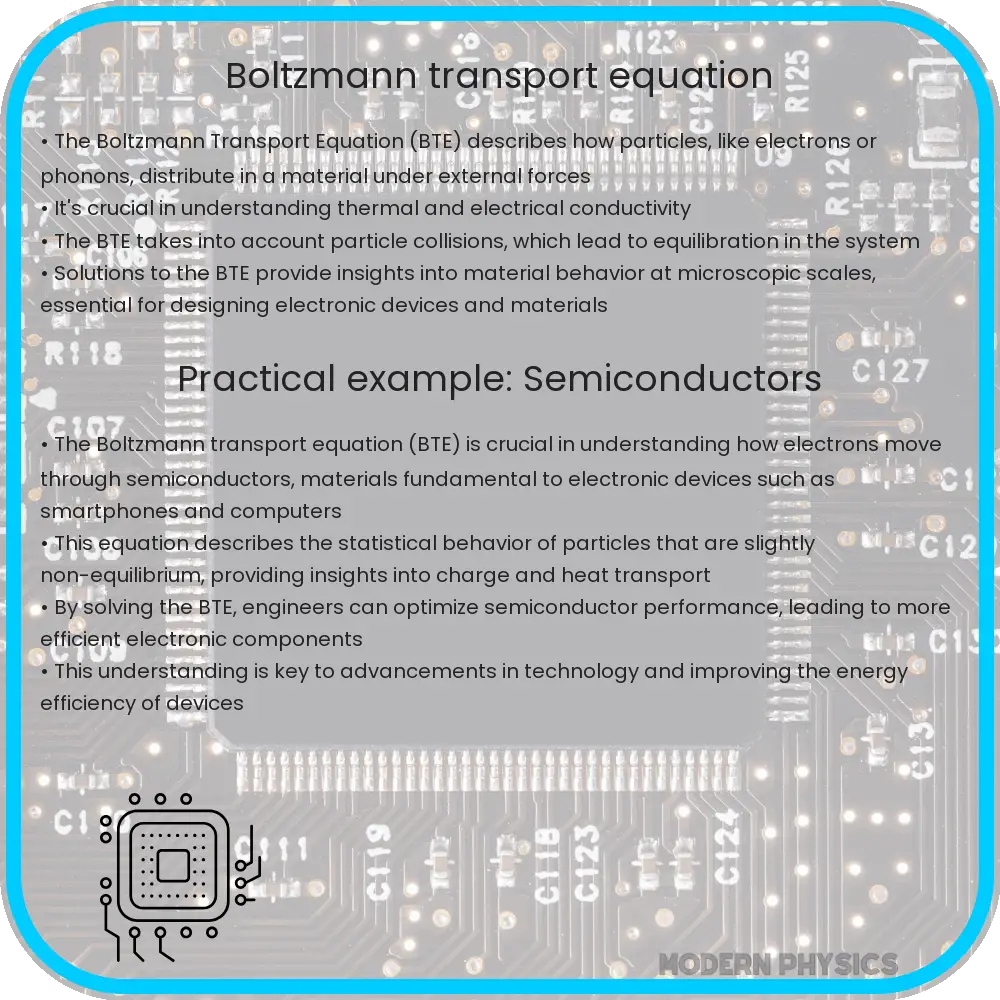
The Boltzmann Transport Equation (BTE) is a cornerstone of statistical mechanics, offering profound insights into the behavior of particles in non-equilibrium systems. This equation, integral to understanding phenomena in fields like thermodynamics and semiconductor physics, provides a framework for analyzing the dynamics of particle distribution in response to external forces and collisions.
Understanding Non-Equilibrium Systems
In contrast to equilibrium systems, non-equilibrium systems are characterized by continual change and flux, influenced by external forces or gradients like temperature and concentration. The BTE is pivotal in analyzing these systems, particularly in understanding how particles, such as electrons in a semiconductor, evolve over time under such non-equilibrium conditions.
The Boltzmann Transport Equation: A Closer Look
The essence of the BTE can be encapsulated in the following form:
f(r, p, t) + F ∙ ∇p f - v ∙ ∇r f = (∂f/∂t)coll
Here, f(r, p, t) represents the particle distribution function, dependent on position r, momentum p, and time t. The term F denotes the external force acting on the particles, while v is the particle velocity. The right-hand side of the equation, (∂f/∂t)coll, signifies the rate of change of f due to collisions.
Applications in Semiconductor Physics
The BTE is particularly significant in the realm of semiconductor physics. It aids in understanding how electrons and holes in a semiconductor respond to external stimuli like electric fields or temperature gradients. This understanding is crucial for the design and analysis of semiconductor devices, including transistors and diodes.
Analytical and Numerical Solutions
Solving the BTE can be challenging, as it often requires sophisticated mathematical techniques. Analytical solutions are possible for some simplified models, but more complex scenarios typically necessitate numerical methods like the Monte Carlo simulation. These numerical methods allow for a more detailed and nuanced understanding of particle dynamics in non-equilibrium systems.
The BTE’s significance extends beyond theoretical physics, impacting practical applications in engineering and technology. Its role in semiconductor device design is just one example of its far-reaching implications. As research continues, the BTE remains a vital tool in the ongoing exploration of non-equilibrium systems.
Advancements in Computational Approaches
The complexity of the Boltzmann Transport Equation necessitates advanced computational techniques for its analysis. Modern computational physics has made significant strides in this area, utilizing methods like finite element analysis and machine learning algorithms. These advancements have not only enhanced the accuracy of solutions but also reduced the computational time, making it feasible to model more complex non-equilibrium systems.
Environmental and Energy Applications
Beyond semiconductor physics, the BTE finds applications in environmental science and energy research. For instance, it aids in the study of atmospheric particles and their transport, which is vital for understanding air pollution dynamics. In energy research, it’s used to model thermal transport in novel materials, contributing to the development of more efficient thermal insulators and conductors.
Challenges and Future Directions
Despite its widespread use, the BTE presents challenges, particularly in accurately modeling collision processes in highly non-equilibrium conditions. Future research is directed towards refining collision models and exploring quantum corrections to the classical BTE, especially relevant at nanoscales. Additionally, as materials science advances, the equation’s adaptability to new materials and phenomena remains a crucial area of study.
Conclusion
The Boltzmann Transport Equation is a fundamental tool in the analysis of non-equilibrium systems, offering invaluable insights into particle dynamics under various external influences. Its applications span from semiconductor physics to environmental science, making it a pivotal concept in both theoretical and applied physics. The ongoing advancements in computational methods and the exploration of new application areas continue to reveal the depth and versatility of the BTE. As we delve deeper into the microscopic world and venture into new technological frontiers, the BTE remains an essential equation, guiding our understanding of the complex behaviors of particles in non-equilibrium states.