
Explore the Boltzmann Distribution in thermodynamics, covering dynamics, equilibrium, energy, and its applications in physics and chemistry.
Boltzmann Distribution: Unveiling the Dynamics, Equilibrium, and Energy
The Boltzmann distribution is a cornerstone concept in statistical mechanics, illuminating the behavior of particles in a gas at thermodynamic equilibrium. At the heart of understanding phenomena in thermal physics, it bridges microscopic particle behavior with macroscopic observable quantities. This article delves into the dynamics, equilibrium, and energy aspects of the Boltzmann distribution, offering insights into its fundamental principles and applications.
Understanding the Boltzmann Distribution
The Boltzmann distribution, named after the Austrian physicist Ludwig Boltzmann, describes the probability distribution of states for a system in thermal equilibrium. It is mathematically represented as:
\[ P(E) = \frac{g(E) e^{-\frac{E}{kT}}}{Z} \]
where \( P(E) \) is the probability of the system being in a state with energy \( E \), \( g(E) \) is the degeneracy of the state (the number of ways the state can be realized), \( k \) is the Boltzmann constant, \( T \) is the absolute temperature, and \( Z \) is the partition function, a normalization factor ensuring the total probability sums to one.
Dynamics and Particle Behavior
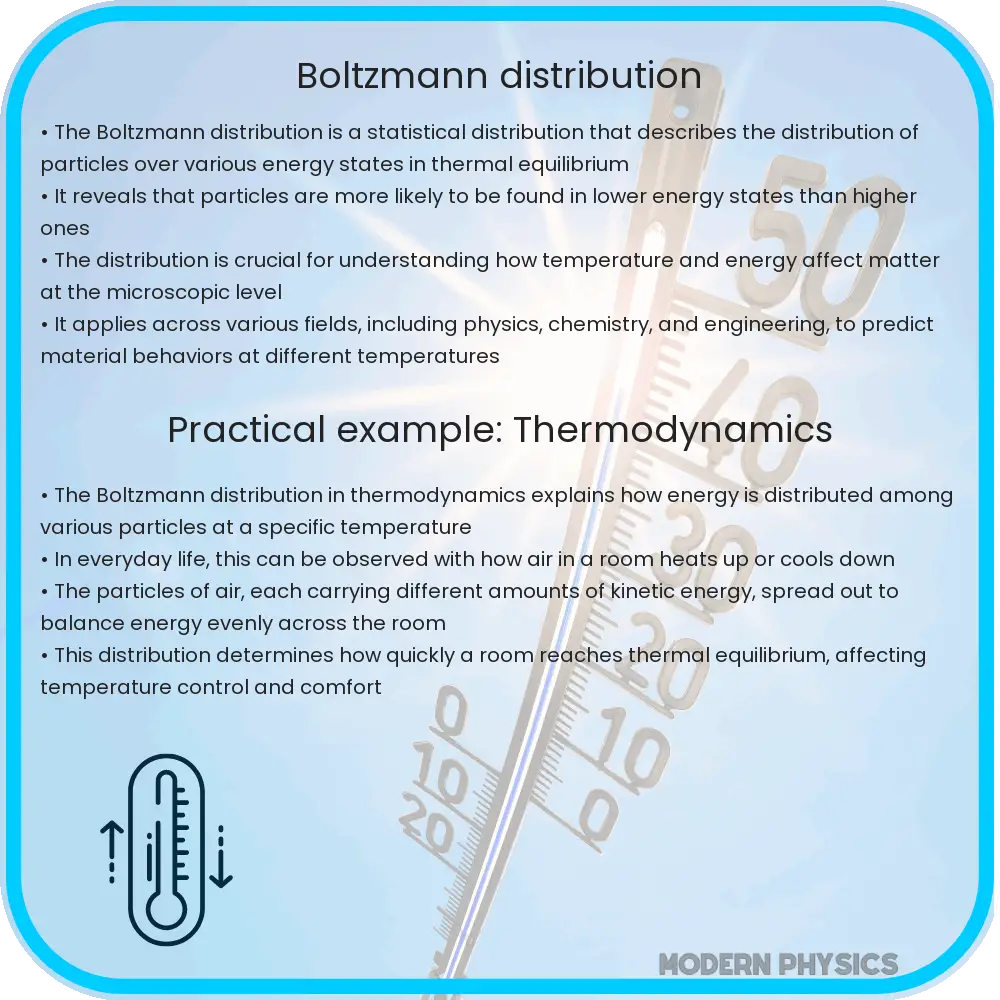
In the context of gas molecules, the Boltzmann distribution elucidates how energy is distributed among the particles. It reveals that at any given temperature, there is a variety of energy states available to the molecules, with lower energy states being more probable than higher ones. This dynamic distribution is crucial for understanding molecular speeds, kinetic energies, and the overall behavior of gases under various temperature conditions.
Equilibrium and Energy Distribution
Equilibrium in a thermodynamic system is a state where macroscopic properties like pressure, volume, and temperature remain constant over time. The Boltzmann distribution plays a vital role in defining this equilibrium by dictating how energy is dispersed among particles. It shows that at equilibrium, the distribution of energy states does not change with time, leading to a stable, predictable macroscopic state. This equilibrium distribution is fundamental in calculating thermodynamic properties like entropy, free energy, and heat capacity.
The concept of energy equipartition, derived from the Boltzmann distribution, states that, on average, each degree of freedom in a system at thermal equilibrium carries an equal amount of energy, specifically \(\frac{1}{2}kT\) per degree of freedom. This principle allows the prediction of energy distribution in more complex systems and is key to understanding specific heat capacities of gases.
Applications of the Boltzmann Distribution
The Boltzmann distribution finds extensive applications in various fields of physics and chemistry. In chemical kinetics, it helps in understanding reaction rates and activation energies, explaining why certain reactions occur more readily at higher temperatures. In semiconductor physics, it predicts the distribution of electrons and holes, playing a critical role in the functioning of devices like diodes and transistors. Additionally, in the realm of astrophysics, it aids in analyzing stellar atmospheres and the distribution of particle speeds in space plasmas.
Challenges and Limitations
While the Boltzmann distribution offers profound insights, it has its limitations. It assumes a non-interacting system in thermal equilibrium, which might not hold true in all scenarios. In systems with strong inter-particle interactions or far from equilibrium, the distribution may not accurately predict the behavior. Also, in quantum systems at very low temperatures, quantum effects become significant, necessitating the use of quantum statistics like Fermi-Dirac and Bose-Einstein distributions.
Conclusion
The Boltzmann distribution is a fundamental concept in statistical mechanics that provides a deep understanding of the distribution of energy among particles in a thermodynamic system. It forms the bedrock for understanding dynamics, equilibrium, and energy distribution in gases and extends its relevance to various scientific and technological fields. While it has its limitations, particularly in non-ideal or quantum systems, its applicability in explaining a wide array of physical phenomena makes it an indispensable tool in the study of statistical mechanics and thermodynamics. The insights gained from the Boltzmann distribution continue to fuel advancements in science and technology, demonstrating the enduring legacy of Ludwig Boltzmann’s contribution to the physical sciences.