
Explore the crucial role of bolometers in astrophysics, delving into their sensitivity, speed, and accuracy in detecting distant celestial phenomena and advancements.
The Role of Bolometers in Astrophysics
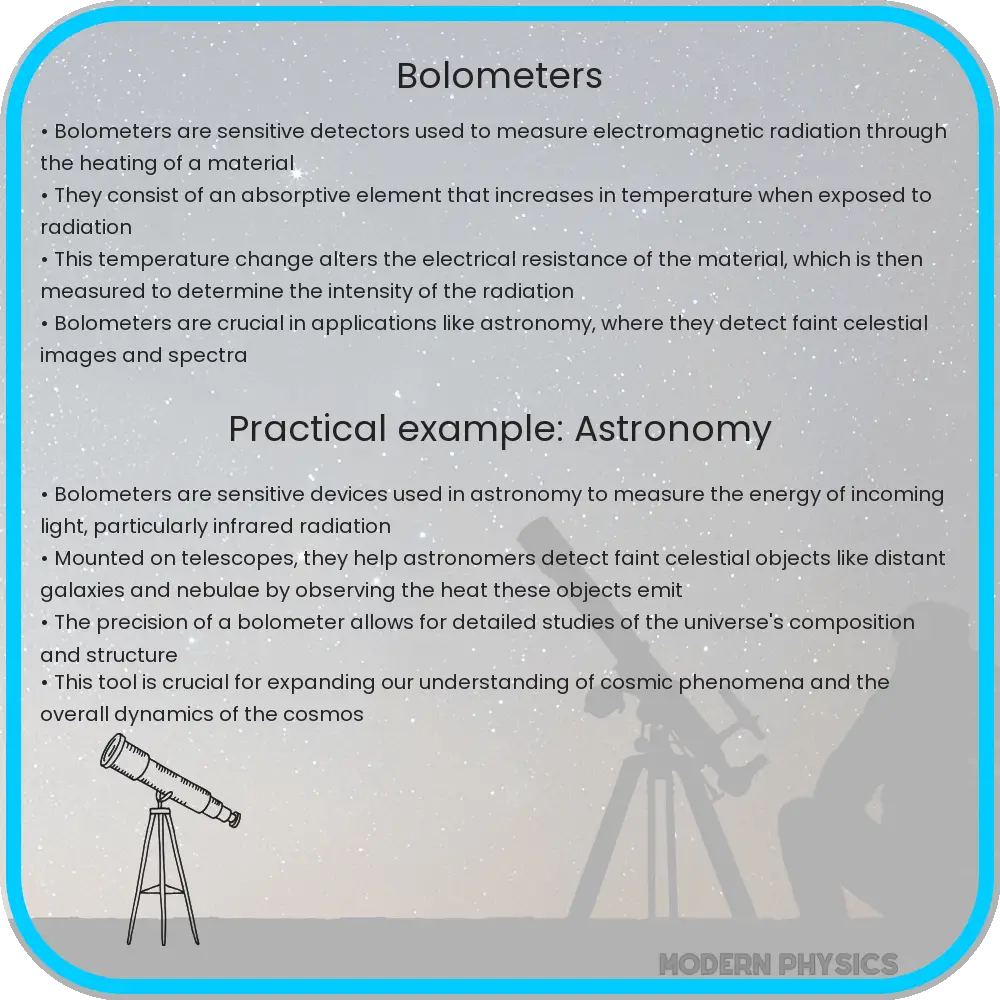
Bolometers, highly sensitive instruments for measuring electromagnetic radiation, play a pivotal role in astrophysics. They are particularly crucial in the study of faint astronomical objects and phenomena, such as distant galaxies, nebulae, and the cosmic microwave background radiation. This article delves into the sensitivity, speed, and accuracy of bolometers in astrophysical observations.
Sensitivity of Bolometers
The sensitivity of bolometers is essential for detecting weak signals from far-reaching corners of the universe. These instruments measure the energy of incoming radiation, typically in the form of heat, thereby allowing astronomers to infer the properties of distant celestial bodies. The sensitivity is primarily determined by the absorptive and thermal properties of the detector materials. Advances in materials science have led to the development of superconducting bolometers, which operate at temperatures close to absolute zero, enhancing their sensitivity to unprecedented levels.
Speed and Responsiveness
The speed, or the response time, of a bolometer determines how quickly it can detect changes in radiation. This is crucial for observing transient phenomena such as supernovae or gamma-ray bursts. Modern bolometers have response times ranging from milliseconds to seconds, which is a significant improvement over older models. The speed is influenced by the thermal capacity and the thermal conductivity of the detector material, with lower values leading to faster response times.
Accuracy and Calibration
Accuracy in bolometers is vital for the precise measurement of radiation. It depends on the quality of the calibration against known standards and the stability of the instrument over time. Calibration involves comparing the bolometer’s readings with those from a reference source of known radiation intensity. This process ensures that the measurements accurately reflect the true energy of the astronomical sources being studied. Moreover, ongoing advancements in calibration techniques continue to enhance the precision of bolometric measurements, thereby providing astronomers with highly reliable data.
Challenges and Solutions in Bolometric Measurements
Despite their advanced capabilities, bolometers face several challenges in astrophysical applications. One significant issue is the background noise, which can stem from various sources such as thermal fluctuations, electromagnetic interference, and cosmic rays. This noise can obscure the weak signals from distant celestial bodies, making them difficult to detect and analyze. To combat this, astrophysicists employ various techniques such as cryogenic cooling, which significantly reduces thermal noise by lowering the temperature of the bolometer. Additionally, shielding and filtering methods are used to minimize electromagnetic and cosmic ray interference, respectively.
Another challenge is the need for wide spectral range detection. Astronomical phenomena emit radiation across a broad spectrum, from radio waves to gamma rays. Developing bolometers that can effectively detect this wide range of frequencies requires innovative materials and design strategies. Multi-band bolometers and composite materials have been developed to address this need, allowing for more comprehensive observations of the universe.
Future Prospects
The future of bolometers in astrophysics looks promising, with ongoing research and development aimed at enhancing their sensitivity, speed, and accuracy. Innovations such as nanotechnology and quantum sensors are expected to revolutionize bolometric detection, enabling even more precise measurements of faint and distant astronomical objects. Furthermore, the integration of bolometers into large-scale telescope arrays and space missions will expand our observational capabilities, opening new windows into the cosmos.
Conclusion
Bolometers are indispensable tools in the field of astrophysics, enabling scientists to probe the depths of the universe with remarkable sensitivity, speed, and accuracy. Despite facing challenges such as background noise and the need for wide spectral range detection, continuous advancements in technology and methodology are overcoming these obstacles. As we look to the future, the evolving landscape of bolometric technology promises to further our understanding of the universe, shedding light on its most elusive and mysterious phenomena.