
Explore the versatility and applications of block copolymers in nanotechnology, biomedicine, and energy storage, and understand their design principles.
Introduction to Block Copolymers
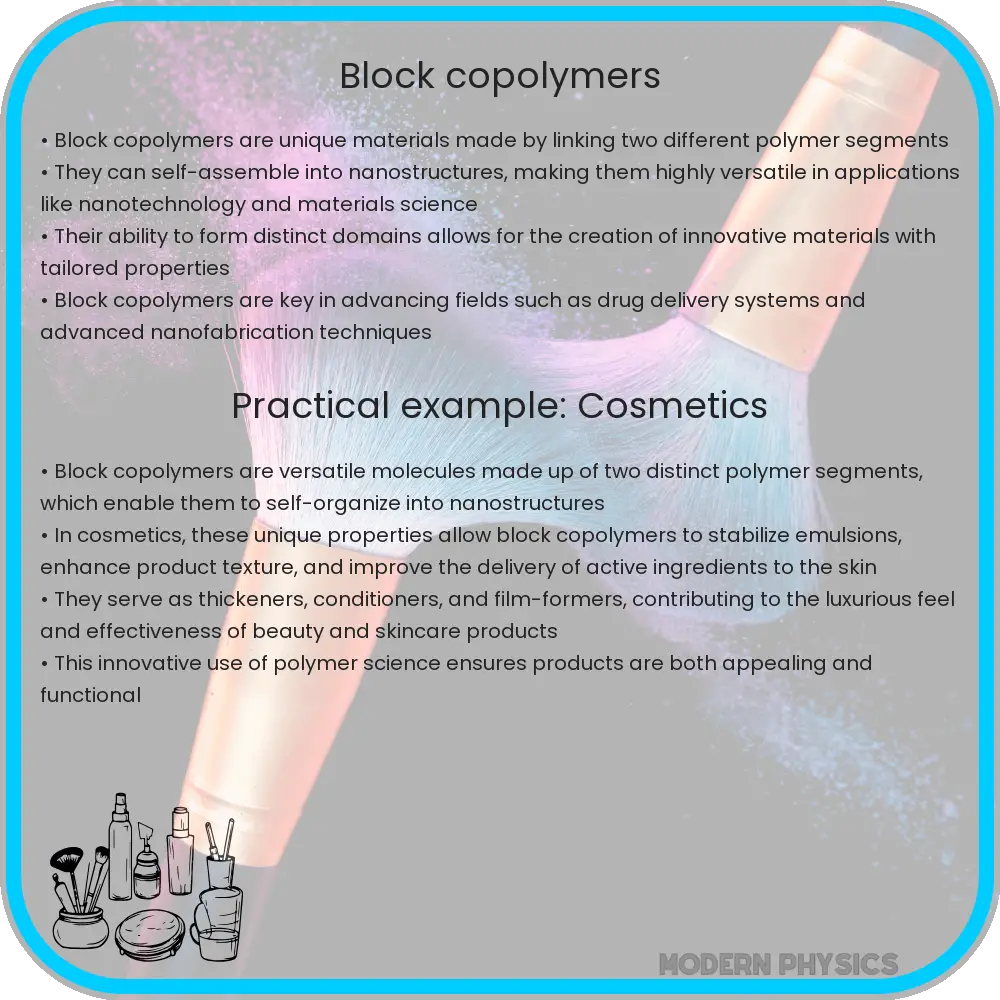
Block copolymers are innovative materials that have revolutionized the field of soft condensed matter due to their unique ability to spontaneously self-assemble into complex microstructures. Composed of two or more chemically distinct polymer blocks covalently bonded together, these materials exhibit properties that are not only a blend of their components but can also exhibit new properties arising from the specific morphology of the self-assembled structures.
Versatility of Block Copolymers
The versatility of block copolymers lies in their molecular design, where varying the block length, composition, and sequence can lead to a myriad of self-assembled structures such as spheres, cylinders, lamellae, and more complex morphologies. This ability to tailor microstructures at the nanoscale allows for the design of materials with specific physical, chemical, and mechanical properties. Consequently, block copolymers serve as a fundamental basis in the development of nanotechnology, impacting various applications from medical to industrial fields.
Applications of Block Copolymers
- Nanotechnology and Electronics: Block copolymers are used in the fabrication of nanoscale devices and patterns, essential for semiconductor manufacturing and data storage. Their ability to form well-ordered nanostructures makes them ideal for lithography and nanolithography processes.
- Biomedical Engineering: In the medical field, block copolymers contribute to the development of drug delivery systems, tissue engineering scaffolds, and biocompatible implants. Their self-assembling nature allows for the creation of nanocarriers that can encapsulate and release drugs in a controlled manner.
- Energy Storage: The unique properties of block copolymers are exploited in energy applications, particularly in the design of battery electrolytes and fuel cell membranes. Their phase-separated domains can facilitate ionic transport while maintaining mechanical stability.
Design Considerations in Block Copolymers
Designing block copolymers for specific applications involves understanding the relationship between their physical properties and their chemical structure. Key factors include the molecular weight of each block, the volume fraction of the blocks, and the interaction parameter between the dissimilar blocks. These parameters dictate the self-assembly behavior and, consequently, the final material properties. Advanced techniques like controlled radical polymerization allow for the precise synthesis of block copolymers with tailored architectures, enabling the exploration of new material functionalities.
Advanced Techniques in Block Copolymer Synthesis
Recent advancements in polymer science have led to innovative techniques for the synthesis of block copolymers, enhancing their functionality and applicability. Techniques such as Atom Transfer Radical Polymerization (ATRP) and Reversible Addition-Fragmentation Chain Transfer (RAFT) polymerization enable the precise control over the molecular weight and composition of the polymer blocks. This precision facilitates the creation of copolymers with specific block sequences and architectures, opening new avenues in materials design and engineering.
Environmental and Sustainability Considerations
With the growing emphasis on sustainability, the development of block copolymers is also being steered towards eco-friendly practices. Researchers are increasingly focusing on synthesizing block copolymers from renewable resources and incorporating biodegradable segments into the polymer chains. This shift not only reduces the environmental impact but also enhances the biocompatibility of these materials, making them more suitable for medical and pharmaceutical applications.
Challenges and Future Directions
Despite their vast potential, the application of block copolymers faces challenges, primarily related to the scalability of synthesis methods and the control of self-assembly in dynamic environments. Future research is directed towards overcoming these hurdles, developing more robust synthesis techniques, and understanding the self-assembly processes under various conditions. Additionally, the integration of block copolymers with other materials and technologies presents a promising area for creating hybrid systems with superior properties.
Conclusion
Block copolymers stand at the forefront of materials science, offering unmatched versatility and a broad spectrum of applications across various fields. Their unique ability to self-assemble into well-defined structures allows for the precise tailoring of material properties to meet specific needs. As synthesis techniques continue to evolve and become more environmentally sustainable, the potential applications for block copolymers will expand even further. The ongoing research and development in this area are set to pave the way for new innovations in nanotechnology, biomedicine, energy storage, and beyond, making block copolymers a key element in the advancement of modern materials science.