
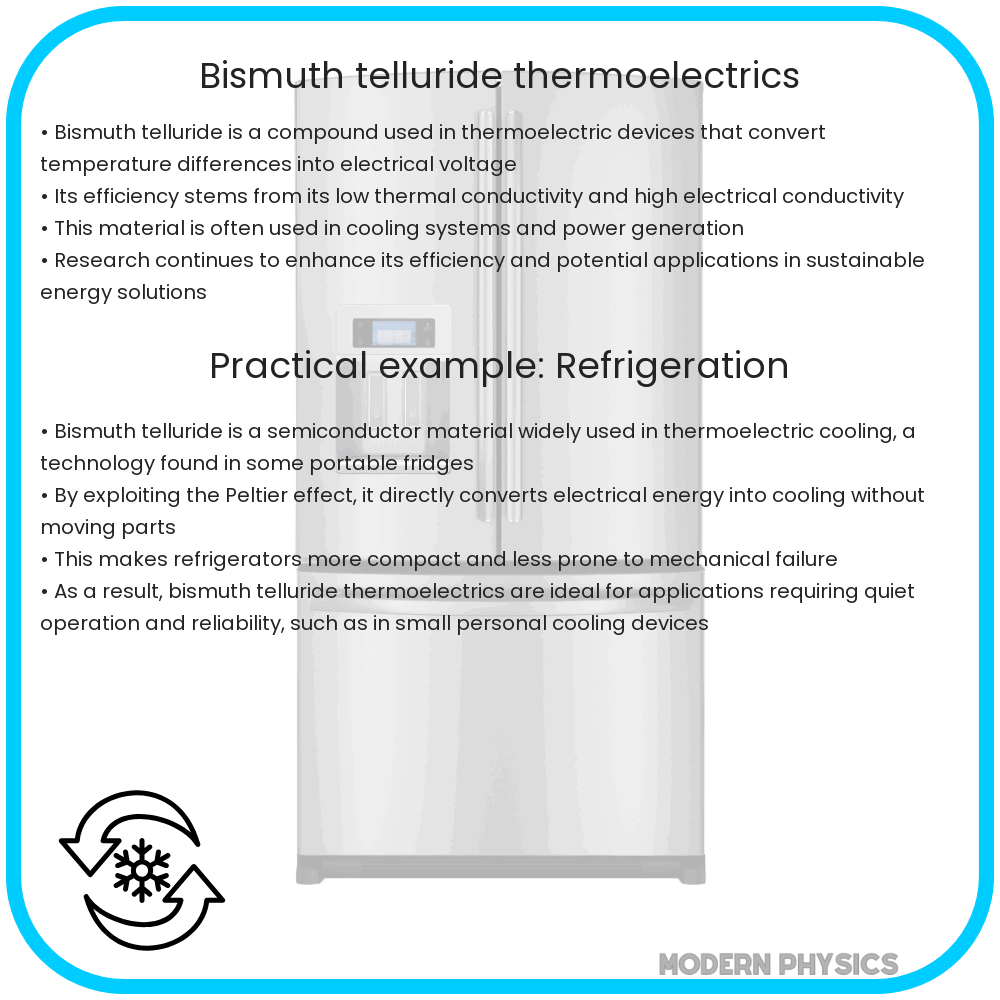
Bismuth telluride (Bi2Te3) is a thermoelectric material known for its high efficiency in converting temperature differences into electrical voltage, ideal for cooling systems and power generation.
Understanding Bismuth Telluride and Its Role in Thermoelectrics
Bismuth telluride (Bi2Te3) is a compound that has attracted considerable attention in the field of thermoelectrics due to its exceptional properties. This material excels at converting temperature differences directly into electrical voltage and vice versa, making it crucial in the development of energy-efficient cooling systems and power generation technologies.
Efficiency of Bismuth Telluride
The efficiency of a thermoelectric material can be evaluated by its figure of merit, denoted as ZT. The ZT value is a dimensionless number which combines the material’s Seebeck coefficient, electrical conductivity, and thermal conductivity. The equation for ZT is given as:
ZT = (S2 σ T) / κ
where S is the Seebeck coefficient, σ (sigma) is the electrical conductivity, T is the absolute temperature, and κ (kappa) is the thermal conductivity. High ZT values indicate superior thermoelectric performance. Bismuth telluride boasts one of the highest ZT values close to room temperature, generally in the range of 0.8 to 1.1, making it highly efficient for near-room temperature applications.
Uses of Bismuth Telluride
Bismuth telluride’s unique properties make it suitable for various practical applications. Some of the primary uses include:
- Cooling Systems: It is commonly used in thermoelectric coolers or Peltier devices, which are employed in consumer products for temperature regulation, such as portable coolers, wine coolers, and electronic component cooling.
- Power Generation: Bismuth telluride can also be found in thermoelectric generators that convert waste heat into useful electrical energy. This application is particularly beneficial in automotive industry, where waste heat from the engine can be converted to power vehicle electronics.
- Sensors: Due to its sensitivity to temperature differences, bismuth telluride is also used in precise temperature measurement and control systems as well as in infrared detectors.
Innovations in Bismuth Telluride Thermoelectrics
Research and development efforts have continuously focused on enhancing the thermoelectric performance of bismuth telluride. Innovations often involve manipulating the nanostructure of the material or alloying it with other elements to reduce its thermal conductivity without substantially decreasing its electrical properties. Enhanced performance in bismuth telluride thermoelectrics can lead to broader and more effective applications, pushing the boundaries of energy efficiency and sustainability.
Recent advancements have also explored the potential of using bismith telluride in tandem with other thermoelectric materials to form multi-layered or composite structures. These efforts aim to harness the properties of different materials at various temperature ranges to optimize overall efficiency and function.
Challenges in Utilizing Bismuth Telluride
Despite the many benefits, there are challenges associated with the use of bismuth telluride. One significant obstacle is the cost and availability of tellurium, a rare element that is less abundant in the Earth’s crust. This scarcity leads to high material costs, limiting the widespread adoption of bismuth telluride-based technologies. Additionally, the production of bismuth telluride often involves complex and energy-intensive processes, which may offset some of the environmental benefits gained from its use in energy-efficient applications.
Another challenge lies in the durability and long-term stability of bismuth telluride devices. In environments with fluctuating temperatures, the repeated heating and cooling can cause mechanical stresses that gradually degrade the material’s performance. Researchers are thus motivated to find ways to increase the robustness of this thermoelectric material to enhance its commercial viability.
Future Prospects
Looking forward, the future of bismuth telluride in thermoelectrics appears promising, with ongoing research aimed at overcoming its current limitations. Efforts are being made to discover or synthesize alternative compounds that offer similar or better thermoelectric performance but are made from more abundant and cheaper materials. Researchers are also exploring innovative manufacturing techniques that could lower the costs and improve the scalability of bismuth telluride production.
Advancements in technology may also lead to novel applications of bismuth telluride beyond cooling and power generation. For instance, its use in nanotechnology and flexible electronics presents exciting opportunities to create new types of wearable devices that harness the power of thermoelectrics in everyday life.
Conclusion
As one of the leading materials in the field of thermoelectrics, bismuth telluride (Bi2Te3) has proven to be indispensable in applications requiring efficient energy conversion and management. Its remarkable properties enable the execution of innovative cooling systems and power generation modules that contribute to energy sustainability. While challenges such as cost, availability, and durability remain, the ongoing research and development aimed at improving and diversifying its applications paint an optimistic future. With further advancements, bismuth telluride could play an even more crucial role in the development of green technologies and sustainable energy solutions.