
Explore the crucial role of biomolecular folding in cellular functions, its impact on diseases, and the cutting-edge biophysics techniques unraveling its mysteries.
Biomolecular Folding: Unveiling the Mysteries through Biophysics
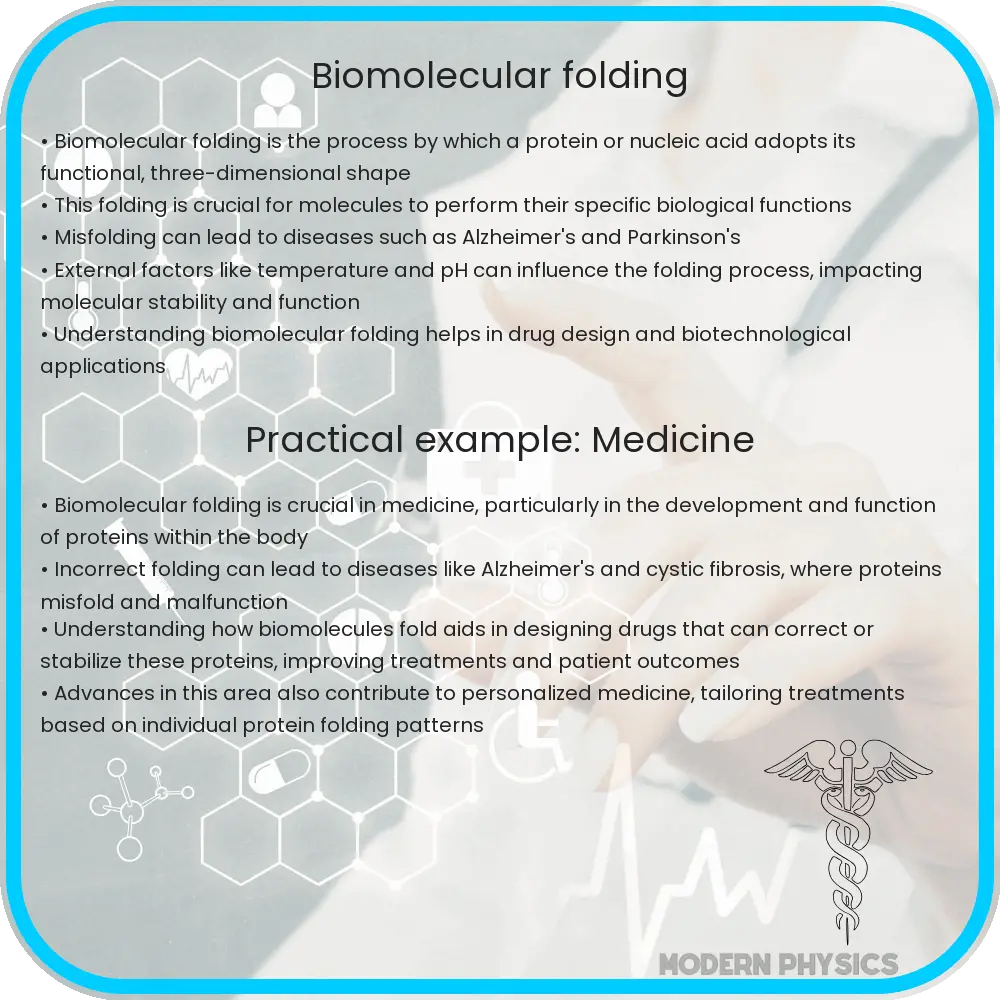
Biomolecular folding, a crucial process within cellular machinery, underpins the structural formation that dictates the function of proteins, nucleic acids, and other biological macromolecules. This dynamic process transforms linear chains of amino acids or nucleotides into three-dimensional structures, each tailored to perform specific tasks within the organism. The study of biomolecular folding not only illuminates the blueprint of life at the molecular level but also aids in the understanding of diseases and the development of pharmaceuticals.
Insights into Biomolecular Folding
At the heart of biomolecular folding lies the principle that the function of a biomolecule is inherently linked to its structure. The intricate process is driven by a combination of hydrophobic interactions, hydrogen bonds, van der Waals forces, and electrostatic interactions, steering molecules towards their energetically favorable configurations. Misfolding, however, can lead to aggregation or dysfunctional molecules, associated with conditions such as Alzheimer’s and Parkinson’s disease, highlighting the critical importance of correct folding.
Techniques in Studying Biomolecular Folding
- X-ray Crystallography: This technique provides high-resolution images of molecular structures, revealing how atoms are spatially arranged and thus offering insights into the folded structures of biomolecules.
- Nuclear Magnetic Resonance (NMR) Spectroscopy: NMR allows for the observation of molecular folding in solution, presenting a view of biomolecules in environments that closely mimic their natural state within cells.
- Cryo-Electron Microscopy (Cryo-EM): Cryo-EM has become increasingly popular for its ability to image large biomolecules and complexes without the need for crystallization, showcasing the flexibility and dynamics of biomolecular structures.
- Computational Modeling: Advances in computational biology enable the simulation of folding processes, providing valuable predictions of molecular structures and understanding of folding mechanisms at an atomic level.
Each technique offers unique insights, yet it’s their collective application that has propelled the field forward, enhancing our comprehension of biomolecular folding and its implications for health and disease.
Exploring the Frontiers of Biomolecular Folding
As the field of biophysics continues to advance, new methodologies and technologies emerge, offering deeper insights into the complexities of biomolecular folding. Single-molecule techniques, for example, have revolutionized our understanding by allowing the observation of folding events in real-time, revealing the pathways and intermediate states that molecules traverse en route to their final structures. Additionally, the integration of artificial intelligence and machine learning models promises to decipher the vast and complex landscape of protein folding, predicting structures with unprecedented accuracy and speed.
Challenges and Future Directions
Despite significant progress, challenges remain. The prediction and manipulation of folding pathways, understanding the role of intrinsically disordered proteins, and the exact characterization of misfolding and aggregation in disease contexts are areas requiring further exploration. Future research is poised to harness the synergistic potential of experimental and computational approaches, focusing on the dynamic aspects of folding, interactions within cellular environments, and the development of novel therapeutic strategies targeting folding-related pathologies.
Conclusion
The journey into the realm of biomolecular folding, guided by biophysics, offers a fascinating glimpse into the molecular underpinnings of life. This exploration, grounded in sophisticated analytical techniques and theoretical models, sheds light on the delicate balance of forces that dictate the formation and function of biomolecular structures. As we delve deeper into understanding these processes, the insights gleaned pave the way for groundbreaking advancements in biomedical research, drug design, and the treatment of diseases linked to folding anomalies. The quest to unravel the mysteries of biomolecular folding continues, promising to unlock new horizons in science and medicine, enhancing our capability to intervene in life’s most fundamental processes.