
Explore the Biermann Battery Effect in astrophysics, understanding how it generates magnetic fields in non-magnetic plasmas and its implications in the universe.
Introduction to the Biermann Battery Effect
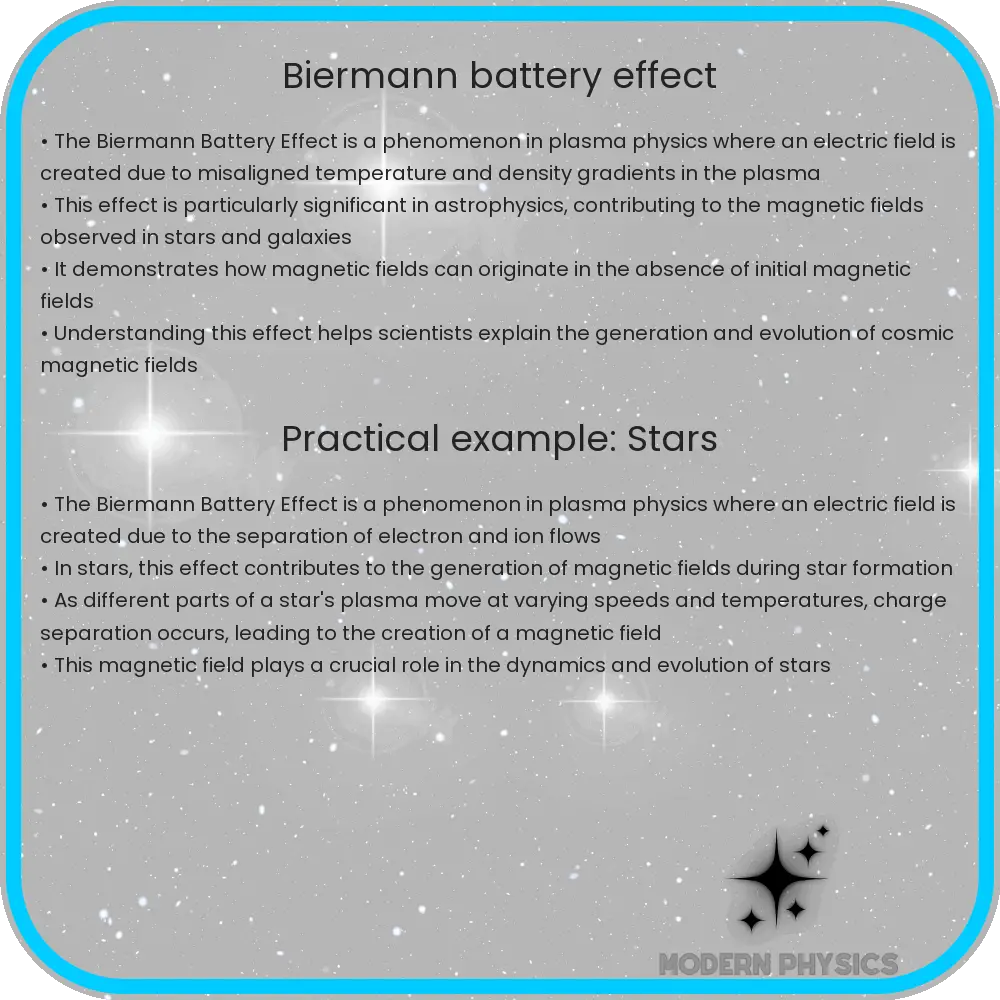
The Biermann Battery Effect is a fundamental phenomenon in astrophysics and plasma physics that explains the generation of magnetic fields in initially non-magnetic plasmas. This mechanism is named after Ludwig Biermann, who first proposed the concept in the 1950s. Understanding this effect is crucial for explaining the magnetic properties of various astronomical objects, including stars, galaxies, and interstellar clouds.
Principles of the Biermann Battery Effect
The Biermann Battery Effect arises from the differential motion between electrons and ions in a plasma. In astrophysical settings, this can occur in scenarios where there is a temperature gradient within the plasma. As electrons are much lighter and more mobile than ions, they tend to move more rapidly from hot regions to cooler ones, creating a charge separation. This separation induces an electric field, which, in the presence of a density gradient perpendicular to the temperature gradient, generates a magnetic field.
The mathematical expression for the generated magnetic field, B, due to the Biermann Battery Effect is given by:
\[B = \nabla n_e \times \nabla T_e\]
where \(n_e\) is the electron density and \(T_e\) is the electron temperature.
Applications and Implications
The Biermann Battery Effect has significant implications in various astrophysical contexts. It provides a mechanism for the initial generation of magnetic fields in the universe before other processes, like dynamo action, amplify and sustain these fields. For instance, in star formation regions, the effect can lead to the initial magnetization of protostellar clouds. Similarly, in galaxy formation, it can contribute to the seed magnetic fields that evolve into the large-scale galactic magnetic fields observed today.
Moreover, the Biermann Battery Effect is not just a theoretical construct; it has been observed in laboratory plasma experiments, providing valuable insights into both astrophysical phenomena and plasma physics.
Challenges and Research in the Biermann Battery Effect
Despite its significant implications, the Biermann Battery Effect presents several challenges in both observation and modeling. One of the main issues is distinguishing the magnetic fields generated by this effect from those produced by other mechanisms, such as turbulent dynamo actions or flux freezing processes. Additionally, accurately measuring and simulating the initial conditions in astrophysical plasmas—where this effect is presumed to operate—is exceedingly complex due to the vast scales and extreme conditions involved.
Current research is focused on improving simulation techniques and conducting high-resolution observations to better understand the role of the Biermann Battery Effect in cosmic magnetism. Advances in computational astrophysics and plasma physics experiments are gradually shedding light on the intricacies of this phenomenon.
Conclusion
The Biermann Battery Effect remains a cornerstone concept in the study of astrophysical magnetism. By providing a natural explanation for the origin of magnetic fields in non-magnetic environments, it has significantly advanced our understanding of the magnetic structures observed throughout the universe. Despite the challenges in direct observation and modeling, ongoing research continues to unveil the complexities and implications of this fundamental effect.
As computational power increases and observational techniques become more sophisticated, we can expect deeper insights into the Biermann Battery Effect and its role in shaping the magnetic landscape of the cosmos. The continued study of this phenomenon not only enriches our understanding of astrophysics but also enhances our knowledge of plasma physics, thereby bridging the gap between cosmic events and laboratory experiments.