
Explore the Berry Phase in quantum fields: uncovering its principles, applications in quantum computing and physics, and groundbreaking insights.
Berry Phase in Quantum Fields: Unveiling the Mysteries
Quantum mechanics, a cornerstone of modern physics, often presents concepts that challenge the boundaries of our understanding. One such concept is the Berry phase, a phenomenon that occurs in quantum systems when they undergo a cyclic evolution. This article delves into the principles, applications, and profound insights offered by the Berry phase in the realm of quantum fields.
Understanding the Berry Phase
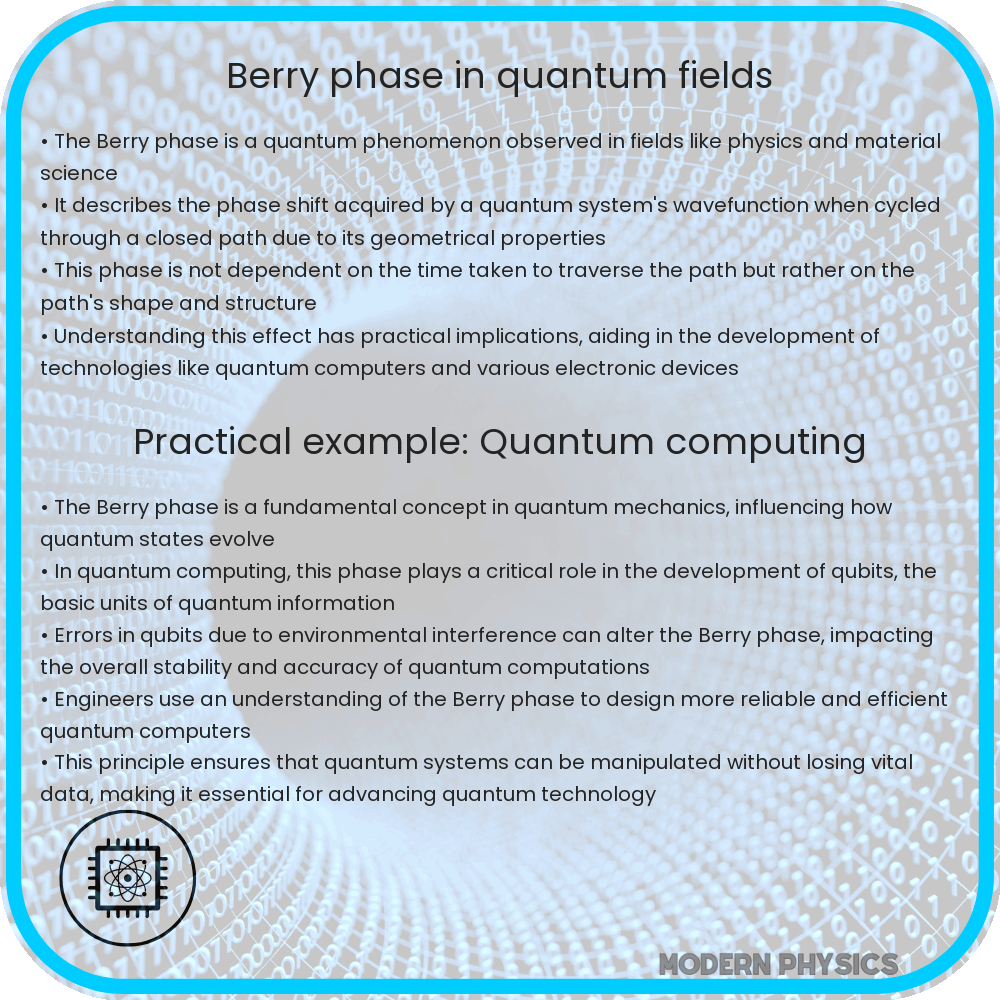
The Berry phase, first introduced by physicist Michael Berry in 1984, is a geometric phase acquired over the course of a cycle, when a system is subjected to cyclic adiabatic changes. It’s crucial to differentiate this phase from the dynamic phase, which is related to the energy of the system and the time taken in the cycle. The Berry phase, in contrast, depends solely on the geometric path taken in the parameter space.
Mathematical Formulation
Mathematically, the Berry phase is expressed as an integral over a closed loop C in parameter space. It can be represented as:
γ = ∮C A⋅dλ
Here, A is the Berry connection, a gauge-like potential, and dλ is an infinitesimal change in the parameters. The integral is taken over the loop C in the parameter space.
Applications in Quantum Fields
Berry phases find extensive applications in various quantum fields. In condensed matter physics, they play a critical role in understanding topological insulators and superconductors. These materials exhibit unique properties like conducting surfaces and insulating interiors, primarily due to the Berry phase associated with the band structure of electrons.
In quantum computing, Berry phases are fundamental in designing qubits for quantum computers. The ability to manipulate these phases allows for the creation of more stable and error-resistant qubits, a crucial aspect of quantum information processing.
Additionally, Berry phases have profound implications in the study of molecular systems and quantum optics. In these fields, they assist in explaining phenomena like the Aharonov-Bohm effect, where particles are affected by electromagnetic potentials, despite being in regions with zero electric and magnetic fields.
Furthermore, the concept of Berry phase has paved the way for a deeper understanding of geometric phases in general. These phases provide insights into the intrinsic geometric properties of quantum systems, revealing connections between different areas of physics.
Insights from Berry Phase in Quantum Mechanics
The exploration of Berry phase in quantum fields extends beyond practical applications to offer profound insights into the fundamental nature of quantum mechanics. It has shed light on the subtle interplay between quantum states and their evolution, illustrating how geometric and topological concepts are intricately woven into the fabric of quantum theory. For instance, the study of Berry phases has contributed to the understanding of quantum entanglement and decoherence, phenomena that are pivotal in quantum mechanics and quantum computing.
Berry Phase and Quantum Field Theory
In the context of quantum field theory, the Berry phase acquires an even more significant role. It aids in exploring the properties of particles in high-energy physics, including the phases they acquire in field interactions. This aspect of the Berry phase has implications for understanding the fundamental forces and particles in the universe, potentially contributing to theories that unify quantum mechanics with general relativity.
Challenges and Future Directions
Despite its profound implications, the application and understanding of Berry phase in quantum fields are not without challenges. One major hurdle is the mathematical complexity involved in calculating Berry phases in more intricate systems. Furthermore, experimentally observing and measuring Berry phases, especially in complex quantum systems, remains a daunting task for physicists.
Future research in this area is poised to delve deeper into the unexplored territories of quantum mechanics. As technology advances, especially in the field of quantum computing and materials science, the Berry phase will likely play a pivotal role in new discoveries and innovations.
Conclusion
The Berry phase stands as a testament to the beauty and complexity of quantum mechanics. From its initial discovery to its current applications in various fields of physics, it continues to be a source of fascination and inspiration. Its influence extends from the microscopic world of atoms and molecules to the broader realms of materials science and quantum computing. As we continue to unravel the mysteries of the quantum world, the Berry phase remains a crucial tool, providing unique insights and paving the way for future breakthroughs in science and technology.