
Explore the essentials of beam profiling: accuracy, resolution, and optical design to optimize laser systems for research, industry, and medicine.
Understanding Beam Profiler Basics
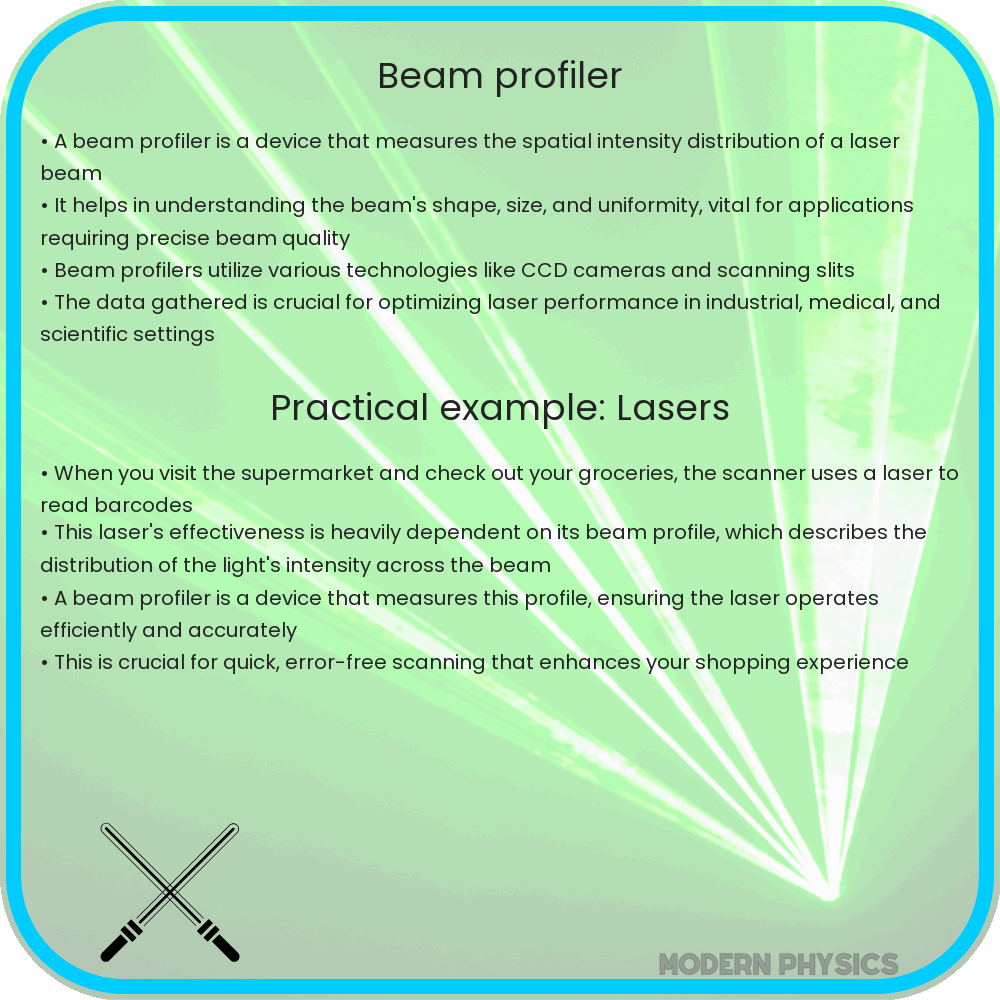
Beam profilers are crucial tools in the field of optics, designed to analyze the spatial intensity distribution of laser beams. These devices play a vital role in optimizing the performance of laser systems by providing accurate measurements of beam width, shape, and intensity profile. Understanding the accuracy, resolution, and optical design aspects of beam profilers is essential for selecting the right equipment and ensuring the quality of laser applications in scientific research, industrial processes, and medical procedures.
Accuracy in Beam Profiling
Accuracy in beam profiling refers to the precision with which the profiler can measure the characteristics of a laser beam. It is influenced by several factors including detector sensitivity, calibration procedures, and the software algorithms used for data analysis. High accuracy is essential for applications requiring precise control over the beam’s properties, such as in laser cutting, welding, and optical surgery. Ensuring the accuracy of a beam profiler involves regular calibration against known standards and careful attention to environmental conditions that may affect measurements.
Resolution Considerations
The resolution of a beam profiler indicates its ability to discern fine details within the beam’s spatial distribution. Resolution is determined by the pixel size of the detector array and the optical magnification system used to image the beam onto the detector. A higher resolution allows for more detailed analysis of beam characteristics, including the identification of subtle beam imperfections and the measurement of very tight beam waists. However, increased resolution may also require slower measurement speeds and more complex optical systems.
Optical Design Elements
The optical design of beam profilers is tailored to match the specific requirements of the laser beam being measured. Key design considerations include the spectral response of the detector, the optical magnification needed to image the beam properly, and the use of filters or attenuators to protect the detector from damage. The choice of optical components must balance the need for high resolution and accuracy with the practical limitations of cost and complexity.
Optimizing the optical design of a beam profiler involves selecting the right combination of lenses, mirrors, and detectors to achieve the desired measurement capabilities. This often requires a trade-off between various performance parameters, with the ultimate goal of providing reliable and precise beam analysis for the intended application.
Enhancing Beam Profile Measurement with Advanced Techniques
Advanced beam profiling techniques, such as phase-front analysis and M2 measurements, further extend the capabilities of beam profilers. These techniques allow for the comprehensive characterization of beam quality and propagation characteristics, providing insights into the spatial coherence and modal content of the beam. Incorporating such advanced measurements can be crucial for applications in optical fiber communication, laser resonator design, and high-precision focusing systems.
Software and Data Analysis in Beam Profiling
The role of software in beam profiling cannot be overstated. Modern beam profilers are equipped with sophisticated software tools that enable detailed data analysis, including beam width calculations, peak intensity tracking, and 3D beam visualization. These software solutions enhance the usability of beam profilers, allowing users to easily interpret measurement data and make informed decisions about laser system adjustments. Furthermore, the ability to export data for further analysis or reporting makes beam profilers integral to quality control processes in manufacturing and research environments.
Choosing the Right Beam Profiler
Selecting the appropriate beam profiler requires careful consideration of the laser system’s specifications, the desired measurement accuracy, and the specific application needs. Factors such as the laser’s wavelength, power level, and beam size must be matched with the profiler’s capabilities. Additionally, the operational environment, including space constraints and ambient light conditions, can influence the choice of profiler. Consulting with manufacturers and utilizing trial measurements can be invaluable steps in finding the most suitable beam profiling solution.
Conclusion
Beam profilers are indispensable tools in the optimization and quality control of laser systems across various applications. The accuracy, resolution, and optical design of a beam profiler determine its suitability for specific measurement tasks, impacting the precision and reliability of laser beam characterization. By understanding these key aspects and considering advanced measurement techniques and software capabilities, users can select and utilize beam profilers that enhance the performance and efficiency of laser applications. As technology advances, the ongoing development of beam profiling instruments promises even greater insights into laser beam dynamics, supporting the cutting-edge research and industrial processes that rely on laser technology.