
Explore the intriguing world of baryon spectroscopy, delving into the roles of quarks, the complex structure of baryons, and their interactions.
Understanding Baryon Spectroscopy: Quarks, Masses, and Interactions
Baryon spectroscopy is a fundamental aspect of particle physics, delving into the study of baryons – subatomic particles made up of three quarks. This field plays a crucial role in enhancing our understanding of the quantum world, particularly in exploring the composition and interactions of matter’s most basic units.
What are Baryons?
Baryons, including well-known particles like protons and neutrons, are composite particles formed by three quarks bound together by the strong force. Quarks, the building blocks of baryons, come in six flavors: up, down, charm, strange, top, and bottom. Each quark carries a fractional electric charge, and the combination of different quarks leads to the formation of various baryons with unique properties.
The Role of Quarks in Baryons
Quarks are held together in baryons by gluons, the carriers of the strong nuclear force. This force, one of the four fundamental forces of nature, is incredibly strong at short distances, effectively confining quarks within baryons. The interactions among quarks and gluons are described by Quantum Chromodynamics (QCD), a theory that explains how the strong force operates at the subatomic level.
Baryon Mass and Structure
The mass of a baryon is not merely the sum of its constituent quarks’ masses. In fact, the majority of a baryon’s mass arises from the dynamic energy of the quarks and gluons as described by Einstein’s famous equation, E=mc2. The internal structure and dynamics of baryons are complex, and understanding these aspects is key to deciphering the behavior of nuclear matter under various conditions.
Exploring Baryon Interactions
Baryons interact with each other primarily through the residual strong force, also known as the nuclear force. This interaction is responsible for binding protons and neutrons together in atomic nuclei. Baryon spectroscopy studies these interactions by analyzing the energy levels of baryons, providing insights into the forces at play within the nucleus.
In summary, baryon spectroscopy is a vital tool in the study of fundamental particles, offering insights into the composition, mass, and interactions of baryons. This field not only enhances our understanding of the atomic nucleus but also provides a deeper comprehension of the forces governing the universe.
Advanced Techniques in Baryon Spectroscopy
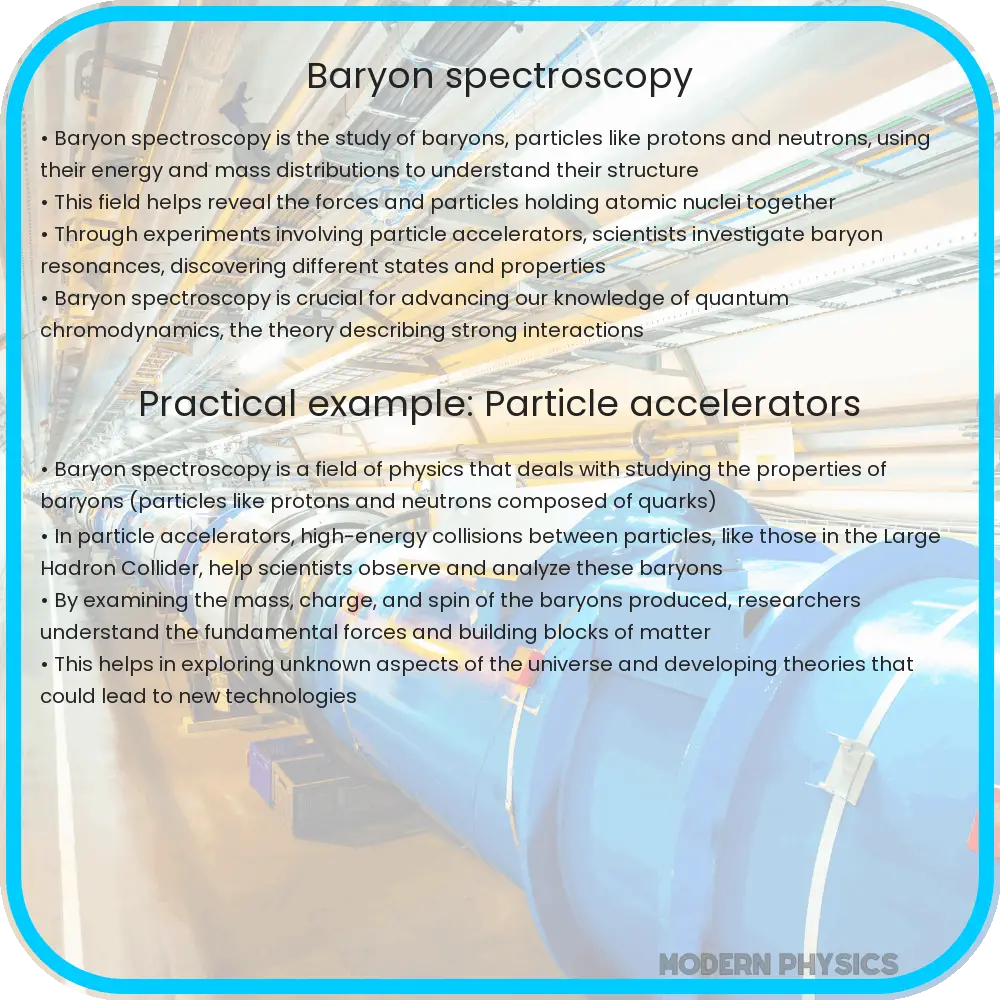
Advancements in experimental physics have significantly enhanced baryon spectroscopy. High-energy particle accelerators, such as the Large Hadron Collider (LHC), enable physicists to create and study baryons that do not naturally occur on Earth. These experiments involve colliding particles at near-light speeds, creating an environment conducive to the formation of exotic baryons. The data obtained from these collisions are pivotal in testing and refining our understanding of Quantum Chromodynamics (QCD).
Discoveries and Implications
Recent discoveries in baryon spectroscopy have unveiled baryons with charm and bottom quarks, expanding our knowledge beyond the conventional up and down quark-based baryons. These findings are not just crucial for particle physics but also for astrophysics, providing insights into the behavior of dense cosmic objects like neutron stars. Additionally, understanding the strong force through baryon spectroscopy has implications in nuclear fusion research, potentially guiding us towards new energy sources.
Challenges and Future Directions
Despite significant progress, challenges remain in baryon spectroscopy. One of the primary difficulties is the computational complexity involved in simulating QCD interactions. Quantum computing presents a promising avenue for overcoming these challenges, offering the potential to simulate complex quantum systems more effectively. Furthermore, ongoing research aims to explore higher energy levels and more exotic combinations of quarks, pushing the boundaries of our understanding of the subatomic world.
Conclusion
In conclusion, baryon spectroscopy represents a fascinating and dynamic field of modern physics, central to our understanding of the fundamental constituents of matter. Through the study of quarks, masses, and interactions within baryons, scientists continue to unravel the mysteries of the quantum world. The advancements in this field not only deepen our understanding of the universe at its most fundamental level but also pave the way for technological and scientific breakthroughs in various domains. As we continue to explore the complex nature of baryons, the insights gained will undoubtedly contribute significantly to the evolution of physics as a discipline, offering a more profound comprehension of the universe and its workings.