
Explore Baryon Acoustic Oscillations (BAOs) in this article, understanding their role in measuring the universe’s scale and insights into dark matter and expansion.
Understanding Baryon Acoustic Oscillations (BAOs)
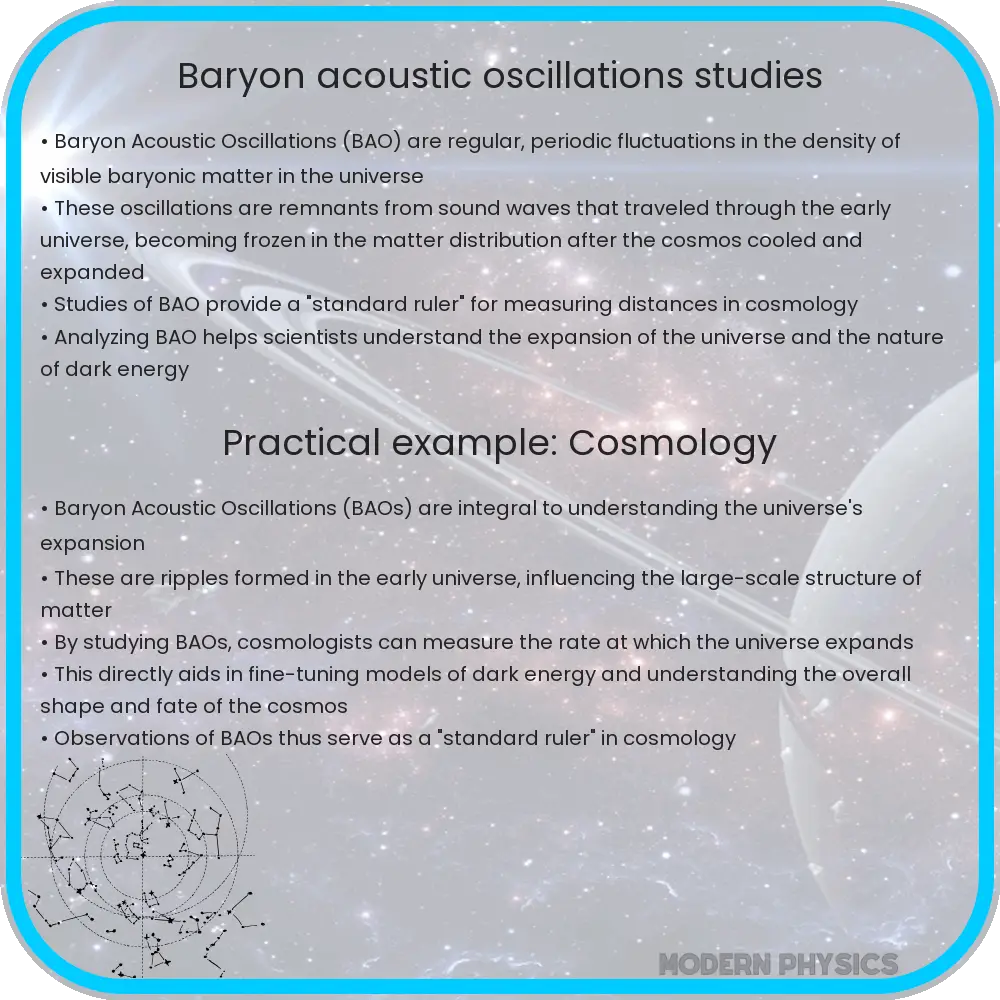
Baryon Acoustic Oscillations (BAOs) are ripples in the distribution of galaxies in the universe, remnants of sound waves that traveled through the early universe. These sound waves originated from the pressure differences in the primordial plasma, a hot, dense mix of electrons, protons, and light before the formation of atoms. As the universe expanded, these sound waves left imprints on the cosmic microwave background radiation and the large-scale structure of the universe, providing a “standard ruler” for cosmological distances.
The Cosmic Scale and the Role of Dark Matter
The cosmic scale set by BAOs is crucial for understanding the universe’s expansion and the nature of dark matter. Dark matter, an unseen and unidentified form of matter, makes up approximately 27% of the universe’s total mass and energy. It does not emit, absorb, or reflect light, making it invisible and detectable only through its gravitational effects. BAOs help astronomers map the distribution of dark matter by measuring the distances between galaxies and clusters of galaxies, thereby shedding light on the universe’s overall structure and evolution.
BAOs and the Expansion of the Universe
The study of BAOs provides insight into the rate of expansion of the universe, known as the Hubble Constant. By measuring the size of the acoustic peaks in the cosmic microwave background and comparing them to the scale of BAOs in the current universe, scientists can trace the history of the universe’s expansion. This research contributes to our understanding of dark energy, the mysterious force driving the acceleration of the universe’s expansion. As such, BAOs serve as a critical tool in cosmology, offering a direct measurement of the universe’s scale and expansion history.
Through the lens of BAOs, scientists can piece together the cosmic puzzle, from the distribution of dark matter to the rate at which the universe is expanding. This cosmic yardstick not only highlights the interconnectedness of all cosmic phenomena but also continues to challenge and refine our understanding of the cosmos.
Understanding Baryon Acoustic Oscillations
Baryon Acoustic Oscillations (BAOs) are ripples in the distribution of galaxies within the cosmos, serving as a “standard ruler” for measuring the scale of the Universe. These oscillations originated from the early universe, specifically from the interplay between radiation and matter. Understanding BAOs is crucial for cosmology because they provide insights into the expansion rate of the Universe and the nature of dark matter and dark energy.
The Early Universe and the Origin of BAOs
In the infant universe, matter was not evenly distributed but instead exhibited slight fluctuations. These fluctuations were amplified by gravitational forces, leading to regions of higher density. In this hot, dense environment, normal matter (baryons) and photons were tightly coupled, creating pressure waves or acoustic oscillations. These oscillations traveled through the primordial plasma until the epoch of recombination, approximately 380,000 years after the Big Bang, when the universe cooled enough for atoms to form and light to travel freely. This moment imprinted a scale (approximately 150 Mpc in today’s universe) in the distribution of matter, the signature of which we observe as BAOs.
The Role of BAOs in Cosmic Measurements
BAOs serve as a standard ruler for cosmologists. By measuring the length scale imprinted by these oscillations in the large-scale structure of the universe, scientists can infer the expansion history of the universe. This has profound implications for our understanding of dark energy, the mysterious force driving the accelerated expansion of the universe. Additionally, BAO measurements help refine the Hubble Constant, the rate at which the universe is expanding, and provide constraints on the properties of dark matter.
Conclusion
Baryon Acoustic Oscillations are a cornerstone of modern cosmology, offering a window into the universe’s earliest moments and its ongoing expansion. By studying BAOs, scientists can shed light on the nature of dark matter and dark energy, contributing to our understanding of the universe’s composition and fate. The insights gained from BAOs not only refine our cosmic measurements but also help answer fundamental questions about the structure and evolution of the cosmos.