
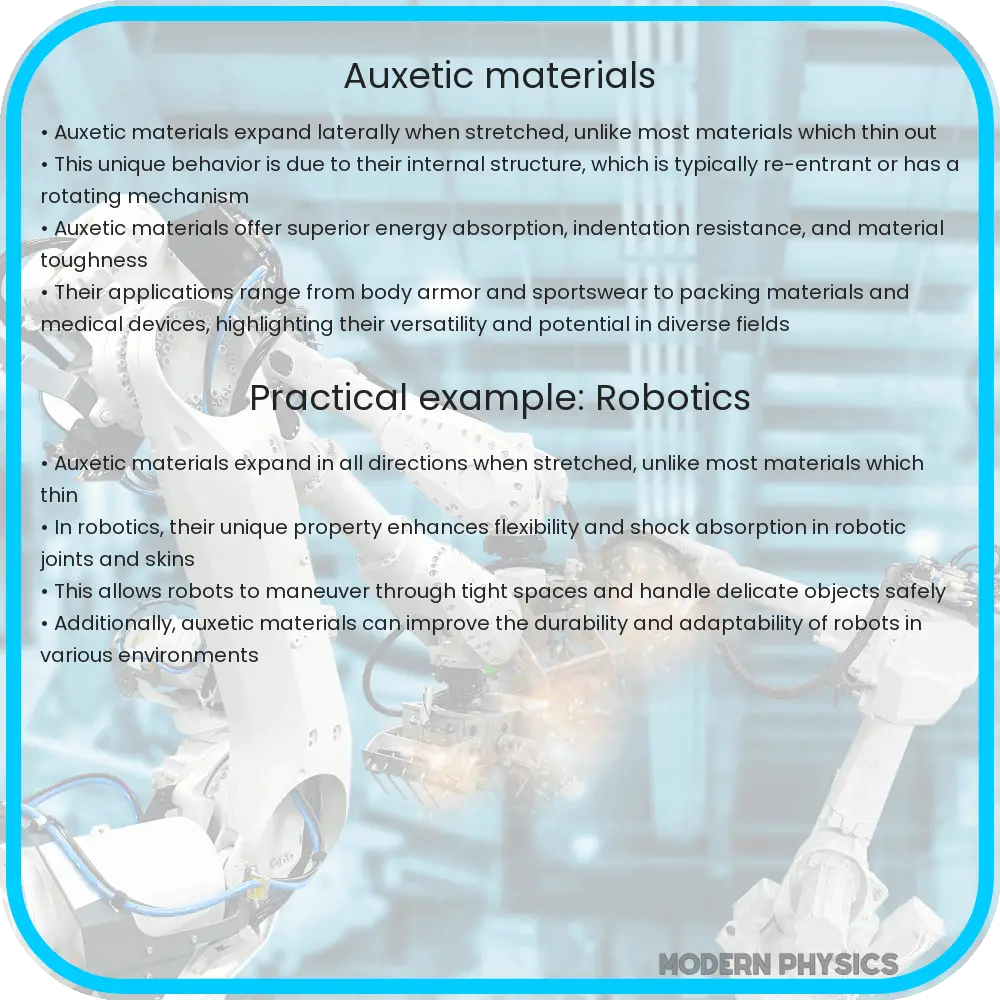
Auxetic materials expand when stretched, unlike typical materials that thin out, offering enhanced strength, toughness, and energy absorption.
Introduction to Auxetic Materials
Auxetic materials are a fascinating class of materials that display an unusual property; they become thicker perpendicular to the applied force when stretched. Unlike conventional materials, which typically thin out under tension, auxetics expand in all directions. This extraordinary behavior has significant implications for their mechanical properties, including enhanced strength, toughness, and energy absorption capabilities.
Understanding the Auxetic Behavior
The counterintuitive behavior of auxetic materials can be attributed to their unique internal structure. Most auxetic materials feature a re-entrant geometry, which refers to a structure that has angles pointing inwards. When these materials are stretched, the forces acting on the structure cause a rotation of the units, leading to an overall expansion in the lateral directions.
Types of Auxetic Materials
- Synthetic Polymers: Many synthetic polymers can be engineered to have auxetic properties by manipulating their microstructure during the manufacturing process.
- Metals: Certain metallic foams have been designed to exhibit auxetic behavior, used in applications where high energy absorption is required.
- Ceramics: Some advanced ceramic materials can also display auxetic characteristics, useful in high-impact environments.
- Composites: Composite materials combining auxetic properties with non-auxetic materials create hybrids that leverage the strengths of both components.
Principles of Auxetic Design
The design of auxetic materials relies on the engineering of the material’s microscale and macroscale structure to achieve the desired properties. This involves precise control over the geometry, size, and arrangement of the patterns that make up the material. Utilizing computer simulations and advanced manufacturing techniques like 3D printing, researchers and engineers can develop materials with tailored auxetic responses for specific applications.
Applications of Auxetic Materials
Auxetic materials are not just a subject of academic curiosity but have practical applications across various industries:
- Protective Gear: The enhanced energy absorption and densification under load make auxetic materials ideal for use in body armor, helmets, and other protective equipment.
- Medical Devices: In stents and other implantable devices, auxetic structures may provide better compatibility with biological tissues due to their ability to expand uniformly.
- Sporting Equipment: The unique properties of auxetic materials can improve the performance and durability of sports gear, such as padding and footwear.
- Automotive Components: Auxetic materials are used in manufacturing gaskets and seals that require a high degree of deformation and energy absorption without failure.
Enhancing Material Properties
One of the critical aspects of auxetic materials is their ability to enhance mechanical properties such as toughness, strength, and the ability to absorb shock and vibrations. When auxetic materials are stretched, their structure tends to become more aligned and tightly packed, which increases their intrinsic strength. Additionally, the energy absorbed during deformation is typically higher compared to non-auxetic materials, making them excellent choices for impact-resistant applications.
Future Outlook and Challenges
The potential of auxetic materials is vast, yet several challenges need to be addressed to fully tap into their capabilities. One of the primary challenges lies in the scalability of production processes. While prototypes and small-scale applications have been successful, large-scale manufacturing remains costly and complex. Furthermore, the long-term durability and reliability of auxetic materials under different environmental conditions still require extensive research.
Another area of focus is the customization of auxetic materials for specific applications. As the demands of different industries vary widely, tailoring the physical and chemical properties of auxetics to meet specific needs is crucial. This requires ongoing collaboration between scientists, engineers, and industry professionals to refine the properties and processing methods of these materials.
Environmental Impact and Sustainability
Auxetic materials also present an opportunity to address environmental concerns. Their high strength-to-weight ratios can lead to lighter designs that require less material, consequently reducing the environmental footprint. Additionally, researchers are investigating the use of biodegradable polymers to create eco-friendly auxetic materials that can decompose naturally, further enhancing their sustainability.
It is essential, however, for ongoing research to consider the lifecycle and recyclability of these materials to ensure they contribute positively to environmental sustainability.
Conclusion
Auxetic materials represent a remarkable advancement in material science, offering properties that conventional materials cannot match. Their unique ability to expand under tension holds a promising future in enhancing the performance and safety of various products across multiple domains including medical, protective gear, automotive, and aerospace industries. Despite facing challenges like scalability and customization, ongoing research and development efforts are paving the way for broader applications and more sustainable solutions. Ultimately, as the science behind auxetic materials evolves, it is likely that they will become integral components of many cutting-edge technologies.